Key Takeaways:
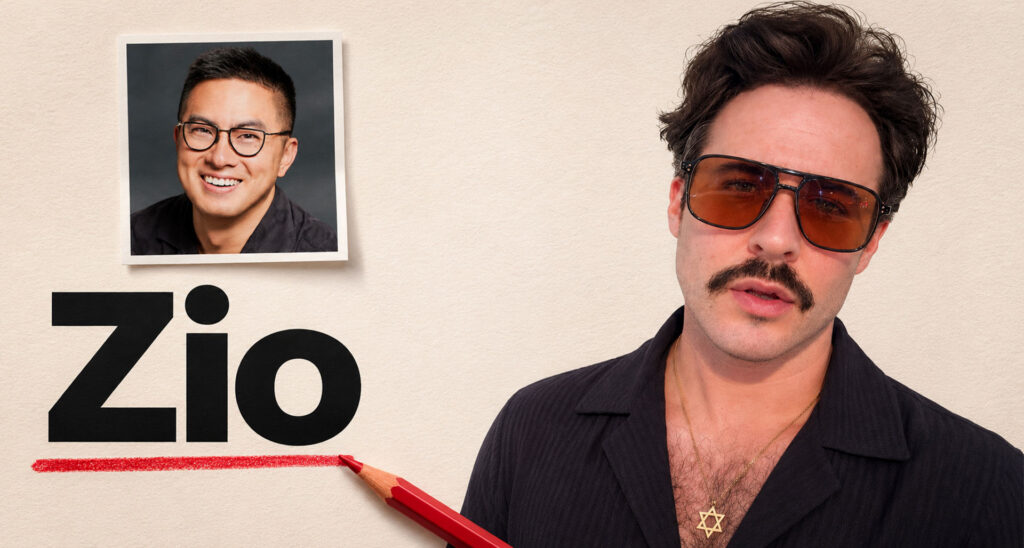
- The contempt came before the slur. Bowen Yang said ‘Zio’ and both hosts laughed at a Jewish refugee’s love for Israel.
- Yang apologized for the word and left the sneer intact. He said nothing about why Regina Spektor’s love for Israel was a punchline.
- Pride betrays its own principles when it makes Jews hide a Star of David or disavow Israel to belong.
Bowen Yang, a gay Chinese-American actor, used a far-right anti-Jewish slur. His friends laughed.
On the October 14 episode of Las Culturistas, the actress Edy Modica was chatting with hosts Bowen Yang and Matt Rogers when the singer Regina Spektor came up. Modica said Spektor had become “a little Israel hardcore.” Yang, the former Saturday Night Live star, did not miss a beat: “Yeah, she’s Zio.” And the hosts laughed along.
Bowen Yang and Matt Rogers are gay men. I am a gay man.
I am also a Jew. I have spent years writing about what it means to embody both of those identities, and about the particular grief of watching one community I belong to turn on the other. When the clip resurfaced last week, I felt shocked. I was not surprised. That is its own kind of sadness: to be shocked by something you have been taught to expect.
The Whole Conversation
Most of the coverage has focused on Yang’s use of a far-right slur. It should. But the slur was only the punchline. The joke had been building for a while. And after Yang used the word, Modica said, “It’s crazy. Someone like that. So crazy,” as Yang and Rogers laughed.
Someone like that.
“Someone like that” was born in Moscow in 1980 to a Jewish family who were, as one profile put it, practicing Jews in a state that punished them for it. In 1989 they fled, spending several months in refugee camps in Austria and Italy before reaching the Bronx with only a few hundred dollars. Her parents warned her she would probably never play piano again. She has described how her family faced discrimination as Jews in the Soviet Union. She is a refugee from Jew-hatred.
A nine-year-old girl who left her home because she was a Jew grew up to love the one country on earth built so that Jews would never again have nowhere to go. That is not madness. It is Jewish memory.
A Soviet Jewish refugee who loves the Jewish state is not “hardcore.” She is not “out to lunch.” She is a Jew who knows her own history and draws the most natural conclusion from it.
Her crime is that she does not hide her love for Israel. She sang Avinu Malkeinu at a commemoration for the victims of October 7th. She has been singled out by an Instagram account dedicated to listing Zionists in Music. And in July 2025, when a heckler at her Portland concert interrupted the show shouting about Palestine, she answered him with a sentence I have thought about many times since: “You’re just yelling at a Jew.”
To call her devotion madness is not commentary. It is antizionist contempt. It takes one of the most ordinary Jewish feelings there is, a connection to our indigenous homeland, and recasts it as a fringe pathology. It turns the Jew into “someone like that.” Yang’s slur simply put a name to what the others had already said.
I know this tone well. I have heard it from people who would think twice before speaking this way about any other minority. They talk about Jews as though none of us are listening. As though none of us are in the room. On this occasion, the people laughing were two gay men.
And Yang knows what it’s like to have people treat who you are as something wrong with you. When his parents discovered he was gay at seventeen, they told him, “Where we come from, this doesn’t happen,” and his father booked him eight sessions of conversion therapy. He has described causing his parents that pain as the worst thing you can do as a child of immigrants. He survived it. He built a life and a career on refusing to be what other people insisted he should be.
When a Jewish refugee is dismissed as ‘someone like that’ for loving her people, I would have expected him to understand what was happening. He knows what it’s like to be spoken about that way, and he still joined in.
The Origins of the Slur Zio
“Zio” is not just a shorthand to describe Zionists that emerged innocently. It is a slur, and it has a dark history.
It was made famous by David Duke, the former Grand Wizard of the Ku Klux Klan. One review of his radio archive found the word in 359 episode descriptions in just over five years. An expert at the ADL’s Center on Extremism explained that hardened antisemites adopted it as a way to attack Jews while keeping plausible deniability. That is its function. It lets a person say “Jew” while pretending to say something else.
When Yang said it, he was not describing Regina Spektor’s politics. He was marking her.
In Britain, we have been here before. In 2016 the Chakrabarti inquiry into racism in the Labour Party concluded that “Zio” had no place in party discourse, and placed it alongside “Paki.” Even Jeremy Corbyn called it a vile epithet. I do not usually cite Jeremy Corbyn as an authority on Jew-hate. But when even he concedes a word is beyond the pale, the question is settled.
The “Apology”
Once the clip spread, Yang posted an apology on his Instagram. He said he wanted to apologize for using the word without knowing its antisemitic history. He noted, with some discomfort, that he had repudiated antisemitism on the show only weeks earlier. He said he was upset to have borrowed language from the far right.
Then in his next slide he added a postscript: “At the same time, Free Palestine.”
Jonathan Greenblatt of the ADL called the whole performance a textbook example of normalizing antisemitism. Amy Spitalnick, who leads the progressive Jewish Council for Public Affairs and is nobody’s idea of a right-wing hawk, said it was incredibly disappointing to see the word used about a Jewish artist.
They are right.
Imagine the reverse. Imagine a comedian called Bowen Yang an anti-Chinese slur on a podcast, then apologized for not realizing where the word came from, and closed with a political slogan about China. Nobody would accept that. Yang knows how much a slur spoken into a microphone can matter. In 2019, Saturday Night Live hired Shane Gillis and then dropped him after audio emerged of him using an anti-Chinese slur on his podcast.
He apologized for using the word. He said nothing about why Regina Spektor’s attachment to Israel had become a joke in the first place.
The Gay World’s Jewish Problem
It could be comforting to believe that what happened on Las Culturistas was one man’s mistake. It was not. That conversation is how Jew-hatred very often sounds in the gay world today: casual and utterly sure of its own virtue.
Much of what I understand about pride, I learned as a gay man. The gay rights movement taught me that shame is imposed from outside. It taught me that a minority has the right to define itself, and that when others redefine us in order to demean us, we refuse their definition. That lesson shaped everything I have written about Jewish pride.
Which is why it is so painful to watch that same world deny Jews the right it fought so hard to win for itself.
In 2017 the Chicago Dyke March expelled Jewish women for carrying rainbow flags bearing the Star of David. When Jews objected, the March’s account mocked them: “Zio tears,” it said, replenished its electrolytes. Jewish lesbians were thrown out of a Pride event for being visibly Jewish, and the word used to laugh at their pain was David Duke’s.
In 2025 London Trans+ Pride announced that Zionists were not welcome on its march. That same summer Montreal Pride excluded Ga’ava, which describes itself as Canada’s oldest and largest Jewish LGBTQ+ group, from its parade, and only reinstated it after a public outcry.
The pattern is consistent. Jews are welcome in gay spaces on a condition. The condition is that we renounce Zionism, which for most Jews means renouncing our connection to our homeland, and with it a part of ourselves. The Star of David may come in on a necklace. It may not come in on a flag. We may be Jewish, provided we are Jewish in the way our hosts approve of.
It was not always meant to be like this. Harvey Milk, perhaps the most famous gay politician in American history, was a Jew, and he never forgot it. His nephew recalls him carrying a sign on marches that read: “I’m from Woodmere. I’m Jewish. I’m gay.” His biographer Lillian Faderman has argued that his Jewish identity was as central to him as his gay one. And according to his partner Scott Smith, Milk once accused San Francisco’s major gay leaders of being a bunch of antisemites. Almost half a century later, the gay world he helped build still has not reckoned with that charge.
Bowen Yang has built a career on the principle of self-definition. His comedy is joyful and unapologetically gay. He would never accept a straight person telling him what “gay” really means, or which gay people are the acceptable ones. Yet that is precisely what “Zio” does to Jews. Zionism is the Jewish people’s connection to, and self-determination in, our ancestral homeland. Jews defined it. Others have redefined it into an insult, and then into a slur, so that a Jewish refugee who loves Israel can be dismissed with a single syllable and a laugh.
That is the choice too many queer Jews are offered today. You may come in. You may march. But leave the Star of David at the door, and if you will not, we have a word for you.
I will not leave it at the door.
Liked this article? Follow HonestReporting on Twitter, Facebook, Instagram and TikTok to see even more posts and videos debunking news bias and smears, as well as other content explaining what’s really going on in Israel and the region. Get updates direct to your phone. Join our WhatsApp and Telegram channels!
© Divuach Ne’eman R”A, 2025