Key Takeaways:
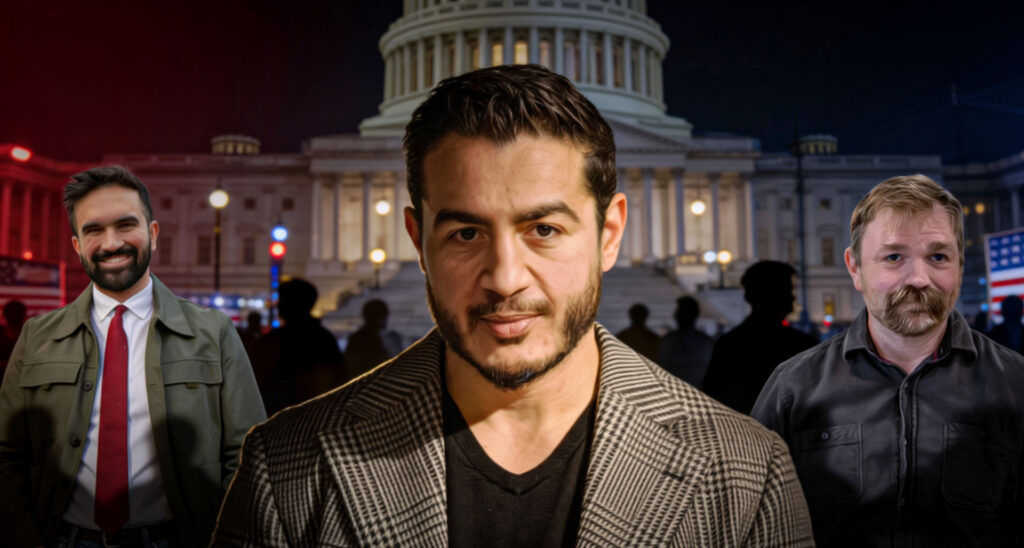
- Morris Katz is the shared strategist behind Platner, Mamdani, and El‑Sayed, driving a broader “progressive”, anti‑Israel project that shields its candidates from serious accountability.
- El‑Sayed and Mamdani still rely on Katz and Fight Agency even after Platner’s campaign collapsed amid abuse and sexual assault allegations and left-wing calls to drop Katz.
- Major media and platforms treated Platner and Katz with kid gloves, exposing a wider failure of journalistic and institutional oversight when the scandal involves favored progressive figures.
Graham Platner has finally withdrawn from the Maine Senate race, with the latest allegations of sexual assault proving the final nail in the coffin of a campaign that had long been under scrutiny.
Unsurprisingly, he chose to exit without a shred of humility. In a statement posted to his campaign’s X account, Platner suggested that “billionaires… buying elections” were partly responsible for his downfall, signing off with a string of petulant, largely meaningless slogans: “F*ck ICE. Free Palestine. Up the Hearts.”
Just 48 hours earlier, he had released an 11-minute video denying the allegations against him, describing the “immense amount of weight” they had placed on his decision-making. In the same video, Platner lashed out at what he called a “corporate media system and the political establishment,” accusing them of acting as “judge, jury and executioner.”
The claim is difficult to square with reality. For months, Platner benefited from sympathetic coverage across major outlets, even as serious allegations mounted, including an exclusive New York Times article detailing claims from a former girlfriend who accused him of physical intimidation and abuse. In that piece, the Times repeatedly framed her as a longtime Republican operative and emphasized his denials, in ways that subtly cast doubt on her account even as it laid out her allegations in detail.
The Platner affair is a troubling indictment on several fronts: a Democratic Party that only withdrew support after sustained pressure, and a media ecosystem that, in several cases, appeared more interested in downplaying allegations than rigorously interrogating them.
There are also questions about the role of major tech platforms. Reports indicate that Apple News and Google News – two of the most widely used news aggregators – carried little to no coverage of the controversies surrounding Platner between last November and May, including no stories related to Platner’s Nazi tattoo and offensive Reddit activity.
But Platner’s withdrawal does not necessarily mark the end of the story. If anything, it raises further questions about the network of political strategists and operatives behind his rise.
At the center of that network is Morris Katz.
Katz, 27, is a media and political strategist best known for his role in New York City Mayor Zohran Mamdani’s campaign, and and he remains an adviser to the mayor to this day. In January, The New York Times profiled him as a “part casting director, part media guru,” describing him as a key force behind several of the most prominent Democratic campaigns this cycle.
Like Mamdani, Katz is portrayed by The New York Times as a product of New York’s cultural elite who is nevertheless “fluent in the anti-elite language of progressive populism” and has “helped to select, mold and make ads for a crop of rough-hewed, gruff-voiced Democratic candidates throughout the country,” including Graham Platner.
Notably absent from that profile, however, is Katz’s connection to another Senate contender: Abdul El-Sayed.
El-Sayed, who describes himself as a “physician” despite not holding a current license to practice medicine and never completing a medical residency or board certification, is running in Michigan on a platform of Medicare for All, abolishing corporate PACs, and ending U.S. military aid to Israel, which he has accused of committing “genocide” in Gaza. His positions on Israel and Islamist terrorism are extensive and extreme, yet they appear to have done little damage to his standing on the left, even as some Democrats worry that his rhetoric and policies could alienate moderates and cost the party a critical Senate seat.
There are numerous issues that should concern moderate voters, aside from his grotesque pronouncements on Israel and terrorists who kill Jews, but one stands out as a near sure-fire liability: his evasiveness about his finances, particularly his refusal so far to release his tax returns.
Pressed repeatedly on the issue – and after fellow Democratic primary contender Haley Stevens suggested he may be concealing a millionaire’s wealth – El-Sayed has defended his failure to file by claiming that his wife and her family own property overseas, and that gathering the necessary documentation is “complicated.”
This explanation sits uneasily alongside evidence HonestReporting has found, including a previously filed tax return in which El-Sayed lists a property in India as jointly owned by him and his wife, suggesting that obtaining the relevant paperwork was not so onerous in the past.
To the media’s credit, there has been at least some scrutiny of El-Sayed’s most controversial positions, with outlets such as the Washington Free Beacon and a handful of others probing his record and rhetoric. Even Mehdi Hasan – the former MSNBC host and Zeteo founder who is generally sympathetic to far-left extremists and Islamist-aligned causes – has felt compelled to press El-Sayed on questions that refuse to go away.
Katz helped found the Democratic political consulting firm Fight Agency, which has produced several of the core ads for El-Sayed’s Senate campaign, including glossy biographical spots, his “Abolish ICE” ads, and issue spots framing him as a fearless outsider taking on “the powerful.”
And yet, El-Sayed’s campaign has had nothing to say publicly about Katz’s role in the Platner fiasco or the growing backlash against him on the left. Indeed, even as members of the Democratic Socialists of America – a group with which El-Sayed is closely aligned ideologically, though not a formal member – circulated a letter urging candidates and elected officials to sever ties with Platner’s consultants, El-Sayed has remained conspicuously silent.
“We, the undersigned, call on DSA candidates and elected officials to no longer contract or work with Morris Katz or Fight Agency, his political consulting firm,” the letter reads, according to reporting in far-left outlet The Intercept. “Morris Katz is one of the chief parties responsible for the catastrophic campaign of scandal-ridden Maine Senate candidate Graham Platner. Billed as a top adviser to the campaign, Katz helped recruit Platner and supercharged his candidacy with slick video production, friendly media placements, and political connections.”
Katz, for his part, has tried to rewrite his own role in Platner’s collapse. In a post on X, he claimed that “as soon as the team became aware of the rape allegations against Graham Platner we advised he suspend his candidacy, and in the following days worked to wind down the campaign.” A Community Note quickly pointed out that Platner’s campaign initially denied the allegation and continued to attack the accuser before finally folding, laying bare just how misleading Katz’s self-exonerating spin is.
Yet despite all this, Zohran Mamdani has publicly vowed to continue working with Katz, insisting that he remains a “top adviser” even after the Platner debacle and the rape allegation that finally ended the campaign. El-Sayed, meanwhile, is still airing Fight Agency-produced ads and presenting himself as a champion of accountability, transparency, and justice, while refusing to explain why he is so comfortable with the very political strategist many on the left now blame for enabling Platner’s rise.
For both Mamdani and El-Sayed, the problem is not simply the optics of sharing a consultant with a disgraced Senate candidate. It is what Katz represents: a political project that fuses hard-edged, anti-Israel populism – often shading into explicitly antisemitic and hostile rhetoric toward Israel’s very legitimacy – with a ruthlessly instrumental approach to power, one that downplays or excuses abuse when it is politically convenient and then frantically rewrites the record once the cost becomes too high.
Platner’s implosion has exposed that project in stark relief. The question now is whether Democrats – and the media that helped elevate Platner, Mamdani, and El-Sayed – will treat Katz’s continued influence as a warning sign, or simply as another scandal to be memory-holed in deference to his underlying politics.
Liked this article? Follow HonestReporting on Twitter, Facebook, Instagram and TikTok to see even more posts and videos debunking news bias and smears, as well as other content explaining what’s really going on in Israel and the region. Get updates direct to your phone. Join our WhatsApp and Telegram channels!
© Divuach Ne’eman R”A, 2025