Key Takeaways
- The argument about Israel is not a political one; it’s a technological one, and that is why it never resolves. Postwar Europe decided national difference was the poison, globalization was the cure, and then the internet, a technology built to flatten every difference between users, put the whole project “on crack.”
- Antisemitism is a symptom rather than a cause, and what’s on display right now isn’t hate but envy. Jews arguing that Zionism is simply the right of a people to a sovereign nation are making that argument to an audience that no longer believes it has that right for themselves either.
- Retiring the word “Zionism” is not the solution. Newhouse rejects the argument that since Israel exists, the ideology can be shelved, since it’s not really about the Jews. “The target here is the West. We are just in the way.”
Most arguments about Israel are conducted as though everyone in them agrees on what is being argued about. Alana Newhouse’s contribution to the past five years of Jewish intellectual life is the claim that they do not; that the fight over Zionism is a fight about something else entirely, and that almost nobody in it, on any side, has noticed.
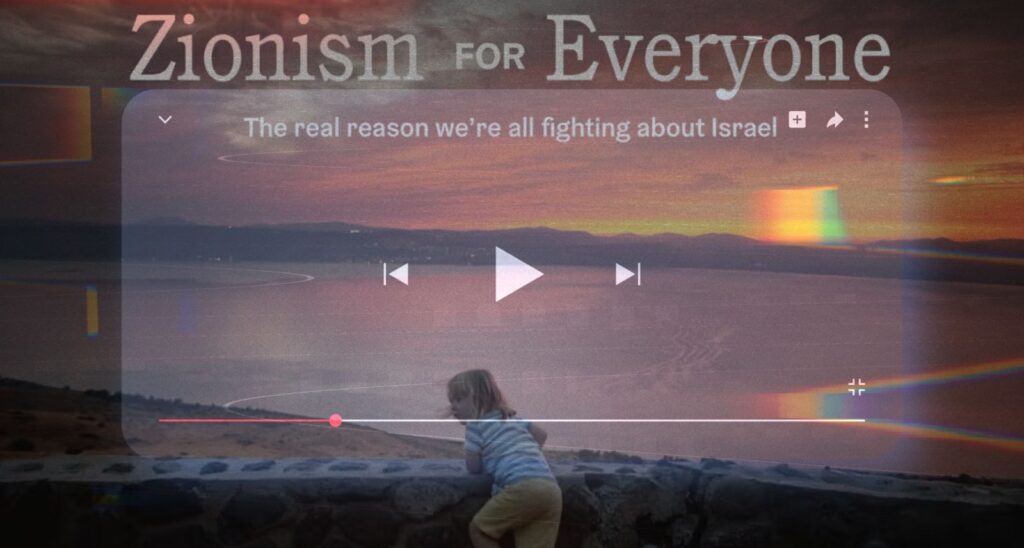
She is the founder and editor-in-chief of Tablet, which she started in 2009 and which became, after October 7, the English-language room where a great many Jews went to think. In 2021, she wrote “Everything Is Broken,” the essay that diagnosed “flatness” and launched a small movement. In March, she published “Zionism for Everyone,” a 6,000-word cover essay arguing that Zionism is now a portable technology for national renewal available to anyone, and that anti-Zionism runs substantially on envy. It has been answered by Daniel Gordis, Irwin Kula, Noah Millman, and most of Jewish Twitter, and she has not moved an inch.
She also has an origin story nobody ever asks her about and, as it turns out, happens to explain the rest.
She Learned Politics From a Man Who Did Not Trust Polls
Newhouse grew up in the Five Towns, in a modern Orthodox home, in a family that was not remotely uniform. Her mother was Sephardic, her father Ashkenazi. Both her parents had been married before, and neither was religious; they became observant when she was born. Her half-siblings grew up traditional but not observant, and went in every possible direction afterward: one became quite religious, the rest scattered.
“I like to joke around that I kind of had all of American Judaism inside of my nuclear family,” she said. “Modern Orthodox shading into Yeshivish and Chasidic, and then Reform, Conservative, totally unaffiliated, Sephardic and Ashkenazi.”
She went to Barnard intending to be an English major, was placed in a political theory class by mistake, and by the end of the first session had abandoned English for good; she never took a single English class in the four years that followed. What caught her was the role of the media in shaping views that people don’t experience as political at all, but as social, or simply as their ideals.
In a textbook, she found a photograph of David Garth, the man who invented the modern political commercial, elected a good share of New York’s mayors, and worked for Menachem Begin. Garth’s office was in New York, so she called it every Friday for about six months.
“I just put it on my calendar and I made a call every single week,” she said. “And one Friday I got back to my dorm and I had a voicemail from David. He was like, ‘Alana, this is David Garth. If I give you a job, will you stop calling me?’”
She worked for him for years and became his in-house archivist, going through every commercial, every clip from every campaign, and interviewing him about his own life. What she took from it was a method, and that method is prevalent in every argument she makes.
“He had incredible gut reactions to things that did not show up in polls or from wonky observers of politics,” she said. “His commercials often came from that feeling. It was very emotional. And not based on an Excel spreadsheet in any way.”
Then she noticed that this kind of politics had stopped functioning in America, that nobody was operating at street level anymore designing around what people actually felt. So she went looking for a job where paying attention to people was the whole assignment, and decided that job was journalism.
The Format Is All That Is Left
Tablet’s original mission was narrower than what it would become: a magazine about Jewish identity and culture for what she assumed was a very small audience of people who wanted 5,000-word pieces on Jewish history with fantastic cover art. The internet’s promise, in 2009, was that she would not have to find them all in one place.
What she did not anticipate was that the journalism around her was quietly falling apart, and that Tablet would start filling the vacuum, first without meaning to, then deliberately. Pieces began appearing without the words Jew, Jewish or Israel anywhere in them. About nine or ten years in, pieces started running that could have appeared in any mainstream magazine but simply weren’t appearing there.
“I think of Tablet now as a general interest magazine where we bring a certain perspective to our reporting and our analysis and the way that we observe the world,” she said. Layering Google Analytics over reader surveys, she estimates about a quarter of Tablet’s readers have no connection to Jewish life at all.
After October 7, the readership got significantly younger, and those readers brought a problem with them. In what she calls good David Garth fashion, Newhouse runs informal focus groups, five to ten people at a time, mostly out of WhatsApp groups that form spontaneously after her speeches. She kept hearing the same thing from the youngest participants: they did not trust what they were reading online.
One of them explained why in a way she has been quoting ever since. He had never known a world without the internet — “the internet’s the wallpaper of my life” — and that was precisely the problem.
He told her: “I know how easy it is for me to go to GoDaddy and buy a URL that’s like the Cleveland Post or something and put up a bunch of completely unsourced garbage. So I don’t know what to trust online.”
What she realized is that his parents and grandparents carried an emotional investment in legacy brands. They see the AP or The New York Times on something, even online, and they trust it instinctively. Younger readers have no such attachment to any of those names.
“And so all that’s left is the format,” she said. “And the format had started to become untrustworthy.”
He asked for a print edition. She probed further, and someone else gave her the second half of the answer: it isn’t that a printed magazine would be automatically believed, it’s that somebody paid to make it and mail it. “I at least feel that investment in it,” he said. “Which I don’t have on the internet, because it’s all free.”
Tablet launched in print about a year ago, and she calls it a crazy success. She is careful to say the appeal is not nostalgia; Tablet was always rooted in aesthetics, always committed to art and illustration, always believed a piece deserves to be shown the respect of being illustrated properly. Print was a return to the form the magazine had been imitating all along.
She will go further than most editors would.
“I’m pretty woo,” she said, “but I really do believe that the energy that gets put into a product is felt by the recipient. What you’re describing is a set of humans putting a certain kind of energy into a story or into a magazine. And that magazine then goes into people’s hands and into their homes and onto their coffee tables. I think that that gets transmitted.”
Flatness Was a Design Decision
“Everything Is Broken” is routinely misread as an anti-technology essay. It is not, and the distinction matters for everything she builds on top of it.
“What I tried to explain in that essay was that many of us were experiencing the effects of a technological revolution. We all kind of thought we were just getting email and texting. But actually what was happening was that every part of our life was being reordered.”
The subject of the essay is not the technology itself. It is about the institutions people had used as mediators between themselves and the world, and what happened to those institutions when technology arrived: some responded well, most did not, and the ones that either resisted it or swallowed it whole without understanding what it would do to their relationship with human beings got broken.
This is the reason for the endless calls with customer service, and for the fact that you do not know whether a human or a machine read your MRI. She is careful here too: it may in fact be better that a machine read it. “But the point is, it being read by a robot and you not having a human to call is a difference in people’s lives.”
Every system you move through in a day — the DMV, the museum, the airport — is straining. And when a system does not respond to you, she said, you can decide the problem is you, or you can decide the problem is some vague enemy. “But it’s actually about the system that you’re trying to flow through not being flowable right now.”
Underneath all of it is a design decision, and she illustrates it with paper towels. Amazon wants you to buy them in one click. Each additional page creates friction, so the friction gets cut. But a system built for one click has to be built on the assumption that there is no difference between the people using it; it has to draw down to the lowest common denominator of human behavior and make that the foundation.
“That can be very functional, and it can be very effective,” she said, “but in society it can also create a forgetting about what is different about us and what is distinctive.”
And this is the part her overarching argument, and indeed, worldview, rests on: “More importantly, it can leach our lives of all friction, which is incredibly important to human development. Challenge and friction are vital. And when we take that out of all aspects of our lives, we weaken human existence.”
She wrote all of that before the arrival of consumer AI, which she thinks does both things at once: it continues the flattening, because ChatGPT does the same level-setting of all people. But she is bullish anyway, because she thinks AI also lets us learn about and reanimate some of the differences.
Her evidence is her own life. Everything Is Broken opens with the story of her son, a medical mystery eventually diagnosed with a rare neurogenetic disorder; after the essay was published, the family finally got a diagnosis, and she found herself inside the world of gene therapy and gene editing research, which turned out to be far more advanced than she had understood. Until about a year ago, she said, Google had almost nothing on any of it.
“If you ask ChatGPT, it’s all there. Nearly as advanced as what reality is. Not quite, but nearly there.” The ability to get sophisticated, high-level information about your own specific life, she thinks, will turn out to have been good for us.
The West Traded Away the Thing Israel Kept
If you squint, she says, there is a straight line from “Everything Is Broken” to “Zionism for Everyone,” because both are driven by the same analysis of how technology shapes a society. The first essay described flatness at the scale of a life. The second describes it at the scale of a nation.
In the postwar decades, first in Europe and eventually everywhere, the reaction to the Holocaust produced a conviction that nationalism and national difference were the poison, and the remedy was to strip away national identity, national boundaries, culture itself. Globalization accelerated it. Then the internet arrived and, in her phrase, put the whole thing on crack.
“Technology then turbocharges that flattening,” she said.
What that produced, mostly below the level of anyone’s conscious awareness, is a West in which people no longer feel that a sovereign, distinct nation is a privilege they are allowed to enjoy. And that is the room into which Jews walk with their standard defensive line: that Zionism isn’t a threat; it’s just the right of the Jewish people to a sovereign nation in the land of Israel.
“When you put that claim into a landscape where everyone else has abrogated their own sovereignty, all of a sudden it looks like Israel gets to have something that nobody else does.”
Neither side can see the other’s position. Jews and Israelis are not conscious that everyone else appears to have lost the privilege somewhere along the way. So they think they are arguing to have what everyone else has.
“Everyone else feels that [the Jews] are arguing for special treatment. And therein lies, I think, a huge part of the controversy around Israel and Zionism.”
That reframing is what turns her diagnosis into a proposal. Once she stopped reading the fight as hatred, she started noticing good-faith actors who did not want Jews to lose anything; rather, they wanted the same thing for themselves. Which raises the only question she thinks is worth asking: how do they get it back?
So she went and looked at how Israel got it. It is a very young country, which makes it worth studying as a template, and what she found there was simple enough to be portable.
It begins with an understanding of your people as distinct, she said. “But once you have a distinct people with a distinct culture, you then add two things to it. One, a vision for the future. What do you want your future to look like? And two, ruthless pragmatism to achieve that vision.”
Matter-of-factly, she adds: “Anyone in the world can do that.”
The pushback from those who understand the existential threat Israel faces has been: doesn’t Israel succeed largely because it has to? Failure is simply not an option. Failure means annihilation.
“Maybe, and maybe that’s part of the culture [of Israel]. But plenty of nations thrive and succeed with a different culture. You do not need to have an existential threat to have a country.”
Pressed on how she would put it instead, she said the interesting question is whether Israel would exist if it had no enemies around it at all, and she believes it would. The internal culture has become strong enough, and the region already sees it as something other than a safe haven for the Jews.
“I think Israel has made its case in that neighborhood to be more than that,” she said. “Many of its neighbors, whether they say it publicly or not, already think of it that way. That’s not to say they’re not currently under threat. It’s just to say that if the threat was partially or even mostly removed, I still think that the country would thrive and grow going forward.”
Asked what it would actually look like for a Western country to pick this up, she declines to write anyone else’s national story. She takes Germany as her example, remarking she is not German, nor does she live there; it is not her culture. What she wants is for other people to do it, for the Germans to answer for themselves, and she says the conversations are still arriving in her inbox.
“I think there is such a thing as France. I think there is such a thing as Japan. I think there is such a thing as America. And I refuse to believe that we’re all just one big trackless mass. It’s not my experience of life.”
Then she makes it concrete: “I know when I’m in a system that’s been designed by an Italian. I know when I am in a space that a Scandinavian has decorated. That’s not fake. It’s real. And it’s culture, and it’s important. And it’s how humans develop their ideas about how to organize their lives.”
Would it work? Would a more Italian Italy and a more French France actually drain the animus toward the Jewish state? She says yes, and immediately adds the caveat that it would take a long time, because the confusion runs deep. National identity, identity markers, and social bonds have been replaced by politics that people now experience as their identity. It will take a while for people to understand that their lives are not based on who they follow on TikTok, and it will be a patchwork — some succeed, some fail, everyone at a different rhythm.
She is also careful to position herself, because she says readers keep missing it. She is arguing against two ideologies at once: on the left, the embrace of flattening and boundarylessness and the individual as the only functional unit, with tribes and communities and nations treated as irrelevant at best and suspect at worst. On the right, the blood-and-soil thinkers, who she says are missing the same opportunity from the opposite direction by being relentlessly backward-looking.
“All of those people tend to be driven by a desire to reanimate some lost glory of the past,” she said. “And I think that takes people into very dark places.”
Antisemitism Is a Symptom, And The Real Sentiment Is Envy.
The line that lit up Jewish Twitter was that expressions of disgust are often evidence of envy. The strongest available objection to this line of reasoning is that the accusations aimed at Israel — killing children, dual loyalty — are a thousand years older than the state. Doesn’t that make envy a new alibi for something much older?
Her first move is to question the premise. “You’re imagining that antisemitism historically was never about envy, which I don’t know is the case.”
She presents her argument as a psychological one rather than a historical one. “There is a difference between how a thing gets expressed and what the underlying feeling is. Anybody in a marriage knows that what you say is often not what you feel. And the internet manufactures ready-made containers, memes, that let you pour your feelings into a shape somebody else built.”
And throughout history, she adds, “antisemitism is a symptom of societies under stress. And I think that that is what we’re looking at now. What I’ve tried to explore in that essay is what is the stress that society is put under.”
“So what are you really feeling when you say you believe that the Jews are killing babies? What’s underneath it? If what’s underneath it is a feeling that the Jews have something that you don’t have, then what’s underneath it is envy. If what’s underneath it is a suspicion that the Jews secretly control the levers of power, thereby disempowering you, then what’s underneath it is envy.”
She is explicit that this is not a description of the surface. “We all know what we’re seeing on the surface. What I’m trying to do is go a few levels deeper and say, what are people actually feeling, even if they don’t know that it’s what they’re feeling.”
And on the reception: “In good psychoanalytic framework, the fact that that line is the line that infuriated everyone strikes me as evidence that I was right.”
The Jews Are Not the Target
There is a serious argument, made recently by Sam Harris among others, that the word Zionism has become an own goal. The state exists, the project succeeded, and continuing to defend a nineteenth-century ideology only hands opponents a target. Newhouse has an answer ready and does not bother to soften it.
“That idea could not be more misguided, in my view. Zionism is not something that we picked up at Walmart twenty years ago and is now irrelevant to our lives. Zionism was an idea that’s thousands of years old. And we don’t simply discard things from our legacy. It doesn’t seem like good hygiene culturally to do that.”
But this objection is secondary to the larger strategic one: “The impulse to abrogate this jewel that helped us get what nobody else has now is weak. It’s defensive. And it’s also the key to us making everybody else vulnerable. The Jews and Zionism are not the target. The target here is the West. We are just in the way.”
The task is not to hold the line on a word; it is to persuade everyone else to pick it up.
“It’s not simply about us not abrogating Zionism,” she said. “It’s about us encouraging everyone else to embrace it too. Because the reason they’re fighting about us is because they’re really fighting about everybody else. The question here is: can the West have distinct civilizations?”
And if the West wants to fight for that privilege, she said, it will not be able to do it “if the price for being in that conversation is the Jews giving it up.”
“We’re the first line of defense.”
Four Survival Tests, and Only One Western Country Passes
The four items usually described as pillars are, in her telling, tests: four questions a society can ask itself, and which she says only Israel currently answers in the affirmative among Western nations.
Can you maintain your demographics? Are you having children? Israelis are reproducing above replacement level, which makes them unique in the West.
Can you defend yourself? “It is a truism, whether we like it or not, that people who can’t defend themselves tend to not survive. So you have to be both able and willing to defend your people, the people that you see yourself as a part of.”
Are you happy? She uses the word because it is used sociologically, and there are real markers. “Israel is reliably among the happiest nations on earth, even though they are frequently in violent wars.” That, she says, is where you see the effect of a forward-looking vision.
And finally: how do you meet the technological challenge of your moment? Here she is not claiming that larger or more varied countries cannot meet it. She is claiming that Israel is meeting it in a very particular way, because the systems now reshaping everything put a premium on deploying small, cohesive teams.
Then she offers a thought experiment: “If I told you that you had two choices, you could be president of one of two countries right now. You could be the president of a large country with very high obesity, problems in education, a lot of diverse people who don’t share anything in common. Or you could be president of a country of 10 million people, half of whom serve in the military together, and a large portion of whom sit around together in small groups and learn an obscure legal document.”
“There’s one that, simply by analysis, is going to be primed to be better at meeting this technological moment.”
Not All Instruments Appear in Each Country’s Orchestra
Asked whether October 7 knocked diaspora Jews out of the flatness trap, she said that is exactly what it did, and then explained the mechanism with a metaphor she uses for culture generally.
A people needs to make music that is distinct, recognizable to itself as its own and to everyone else as theirs. Cultures are built from different instruments at different levels.
“So in Japan, race is a loud instrument,” she said. “If you are not Japanese and you move to Japan, even if you speak Japanese fluently, you will still be seen as distinct from Japanese culture, because race is a strong sound in their music.”
Then the turn: “Race is not in the Israeli music at all. Israel has other tethers that keep them together and that create the foundation of their culture, but race is not one of them.”
Which is the source of a specific, recurring failure in how the West argues about Israel. American racial discourse gets applied to a country whose culture is not scored for it, and the circuits jam.
“The left can’t figure it out. And then the right keeps saying, see, it’s a racially diverse thing. And the whole conversation becomes people talking over each other, because nobody is rooted inside of this fundamental idea, which is that cultures are different.”
Diasporism Is a Jewish Costume for Communism
The revival of the Bund on the Jewish left — doikayt, hereness — could be perceived as the counter to all that Newhouse argues. Jewish life built where Jews already are, with diasporism replacing Israel as the center of Jewish identity; a frictionless version of Judaism.
She clarifies that she takes the diaspora seriously. “I do believe in the diaspora. I live in the diaspora, and I’m firmly committed to my diaspora country. I’m an American. So I meet them in their commitment to their diaspora context.”
Her pushback is in the terms themselves. “The problem is that it’s not really Bundism, it’s communism. And they just want to be communists. And they’re looking for a Jewish costume for their communism, which is fine. If you want to be a communist, just go be a communist.”
She adds that history does not repeat itself, and she sees no use in trying to reanimate something that existed in the past. Therefore, the Yiddish revival gets a related objection, on grounds of lived life rather than ideology. Imagining Yiddish outside of a Yiddish-speaking people and culture, she said, is impossible.
“It’s a performance, and it’s a play that you’re putting on, which can be fun, and that’s great. But you’re not going to the supermarket and talking to the supermarket lady in Yiddish. There’s something intellectually off. It’s like Swiss cheese. It’s not really a real argument.”
Her closing move on this is the one worth sitting with, because it is aimed at the person rather than the position. She understands the appeal: diasporism is a way of being accepted on the left without having to abrogate everything about who you are.
“But I would encourage you then to ask yourself why you feel you have to abrogate who you are in those spaces. What is it about those spaces that’s asking that of you? I just think the answer might not be what people think it is.”
It’s a Lot, and It’s Enough
Asked what Jews are feeling right now that the legacy institutions are not naming, her answer was, unexpectedly, optimism.
“I’m so hopeful about Jews. I’m hopeful about American Jews, I’m hopeful about Jews in other countries, and very hopeful about Israel.” What she sees is a growing acceptance that being a minority is the natural Jewish position rather than a sign of failure.
And she has revised her own numbers upward. She does not need every person who tells a pollster they are Jewish to agree with her about anything.
“I do need a small cohort of Jews to feel kindred with me. And I have that. And increasingly, that cohort is much bigger than I ever would have thought it would be at this moment.” In the immediate wake of October 7, she was afraid the cohort willing to raise the flag for its own Jewishness would be vanishingly small. It’s not.
Put a number on it, and she will happily accept it. If it turned out that only 45 percent of American Jews were committed to being distinctly Jewish and Zionist, her answer was, “Let’s go. It’s a lot, and it’s enough.”
Will Legacy Media Survive The Next Decade?
On where Tablet sits relative to the legacy Jewish institutions, she resists the premise that they are a single object — different institutions, different missions, different leadership, makes it hard to treat them as a behemoth. Notwithstanding, Newhouse is clear-eyed on what purpose Tablet serves. “The journalist’s natural posture is to be outside of power, particularly political power. And so Tablet is outside of those institutions that present themselves as representing American Jews in the halls of power.”
Asked about the ideological water in the journalism schools — she graduated from Columbia more than twenty years ago — she gave the same answer she gives about everything: the conversation that looks political is really about format. Even when she was there, there were limited jobs available in the journalism industry. There are even fewer today.
The disappearance of well-paying jobs means that employers have to provide compensation of another kind. “What these institutions have done is they’ve replaced the promise of a job that actually might be able to sustain you, and maybe even a family, with a sense of righteousness. That’s how you get paid. Your paycheck is your sense that you’re fighting for some righteous cause, because you’re not getting another paycheck that’s actually cash money.”
Her read of the last decade: legacy outlets failed to see the challenge to both their business and their culture, got caught flat-footed, and stopped doing their jobs. An alternative space rose during and after COVID — Substack, social platforms, independent sites — and was primed to take legacy media’s place in the diets of enormous numbers of Americans.
“That independent media space then in many ways hurtled into a space of conspiracy theories and nutcases,” she said. “They had the opportunity to replace the legacy media landscape. But instead they started to commit their own sins.”
What she sees forming now is a blend of the normative elements of both, and she thinks it will take another decade to settle. Her example, which she flags as her own read and possibly wrong, is CBS’s acquisition of The Free Press: not a legacy outlet swallowing an independent one, but a legacy outlet trying to infuse itself with the independent one’s spirit and journalistic principles.
What she wants out of the blend is the thing neither landscape currently offers. “Both of them offer these weird, kind of monolithic views of the world. I think that readers and viewers, at this point, given the internet, want real diversity of opinion. They want true difference of perspective. And the media outlets that can do that are the ones that are going to succeed going forward, whether they’re from the independent space or from the legacy space.”
Her advice to a talented 25-year-old Jewish journalist is, first, to come work for her. Her serious advice is a sorting exercise she applies to any institution, industry or idea, again falling into four baskets: it either works well enough and deserves preserving energy; or it has lost its way but there is gold in it and it deserves reforming energy; or it is finished and the right move is to build something that does not exist yet; or it has become so poisoned that it is worth actively dismantling.
“Those are the burn-it-all-down people,” she said of the fourth. “I do know people who are in those spaces around particular institutions, and they make good cases. It’s not my impulse, but it’s definitely an impulse that’s alive today.”
Know What Is Distinct About You, and Then Jam On It
For the person who wants to bring friction back in their own life, what is the one thing they can actually do?
“So when I say Zionism is for everyone, what I mean is it’s not only for nations and peoples. I actually mean it’s for individuals too. The whole point of thinking about Zionism as a technology is that it allows you to think of it as three different things. There’s the understanding of what’s unique or different about you. And then there’s adding onto it a vision for the future. And adding onto it work.
“That is a methodology that you can use as an individual. Who are you? What is different about you? What do you think is distinct? I’m not asking you how you would sell yourself to someone else. I’m asking you what do you really believe you have to contribute that is special. It doesn’t have to be better than other people — this is not a superiority contest. It’s just, where do you imagine that you have something to offer in this life?
“Then have a vision for where and how you want to do that work. And then just wake up every single day and jam on it. That’s the whole method.”
Alana Newhouse is the founder and editor-in-chief of Tablet, author of “Everything Is Broken” and “Zionism for Everyone,” and president of the Foundation for Angelman Syndrome Therapeutics. Read Tablet at tabletmag.com.
Listen to The Honest Take: podcast.honestreporting.com
Liked this article? Follow HonestReporting on Twitter, Facebook, Instagram and TikTok to see even more posts and videos debunking news bias and smears, as well as other content explaining what’s really going on in Israel and the region. Get updates direct to your phone. Join our WhatsApp and Telegram channels!
© Divuach Ne’eman R”A, 2025