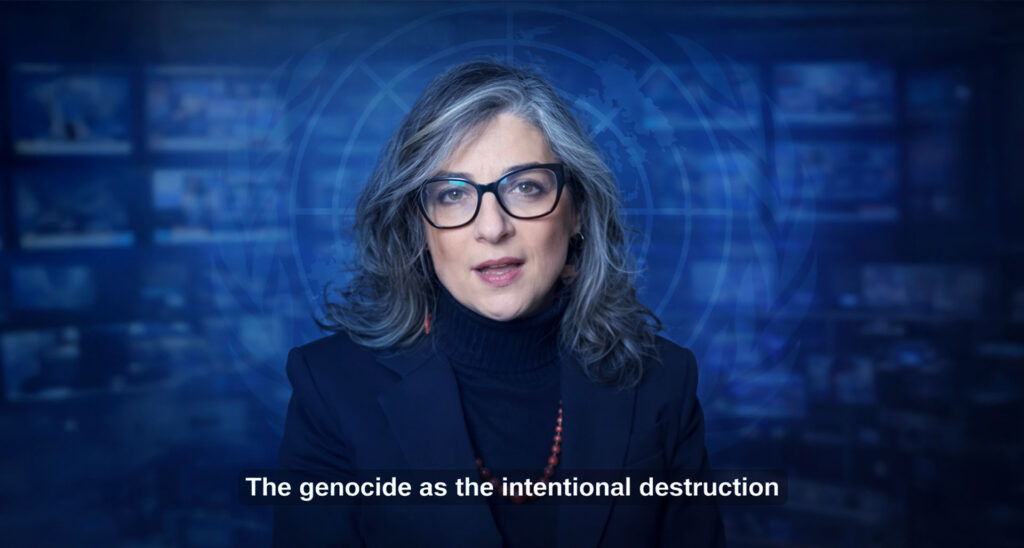
Francesca Albanese has done it again.
The United Nations Special Rapporteur on the Palestinian territories is once more facing calls for her resignation after her remarks at an Al Jazeera forum last week triggered accusations of antisemitism.
Albanese claims her words were taken out of context. But when a senior UN official with a well-documented record of inflammatory rhetoric invokes language that closely mirrors classic antisemitic tropes, the problem is not misquotation. It is judgment.
Given her long track record, it’s hardly surprising that her comments at the Al Jazeera event referring to the global community’s “common enemy” were heard as echoing classic antisemitic tropes about Jewish power and influence. The full speech (in addition to an edited clip) has circulated widely on social media. Rather than clearly distinguishing between criticism of Israeli government policy and rhetoric targeting Jews as a collective, her language blurred that line in ways that were neither accidental nor isolated.
In an embarrassing attempt to exonerate herself, Albanese herself later posted the full clip of her speech, accompanied with a caption that could have been copy-pasted from the Protocols of the Elders of Zion.
View this post on Instagram
View this post on Instagram
Watch my AJ Forum speech last week: the common enemy of humanity is THE SYSTEM that has enabled the genocide in Palestine, including the financial capital that funds it, the algorithms that obscure it and the weapons that enable it.
Related Reading: Correction: U.S. Sanctions Albanese Over Antisemitism, Pro-Terror Rhetoric, and Threats to U.S. Interests
Part of a Pattern
Some media outlets — like France24 — defended Albanese and claimed her remarks were taken out of context, omitting the fact that this was not an isolated slip of the tongue by an otherwise careful official. It is part of a pattern.
Albanese’s record of inflammatory statements and associations is well documented. We detailed how the Al Jazeera forum provided a stage not only for Albanese but for terrorists like Hamas leader Khaled Meshaal. That context matters.
It also matters that this is not the first time Albanese has faced consequences for her rhetoric. As we’ve previously noted, she has already been sanctioned by the United States over what officials described as antisemitic and pro-terror language.
Those sanctions were not imposed lightly. They followed a documented record of statements and actions viewed as crossing the line from criticism of Israel into hostility toward Jews and open alignment with actors hostile to the United States.
When someone with that background speaks about “power” or “control” in a way that echoes historical antisemitic narratives, it is not unreasonable for audiences to hear what history has taught them to hear.
BREAKING: Hamas joins Amnesty International, throws full support behind Francesca Albanese. Hamas said France’s demand for her to quit “demonstrates a premeditated intention to punish her for firm positions rooted in conscience, human values, and international humanitarian law.” https://t.co/Vc2dJEVCOi pic.twitter.com/au52bzPRnu
— UN Watch (@UNWatch) February 14, 2026
Albanese’s defenders argue that she was referring only to political lobbying or state policy. But given her record, the burden is on her to speak with precision and clarity. Instead, she spoke in a forum known for amplifying anti-Israel rhetoric, using language that predictably triggered outrage.
Over social media, many rushed to frame the controversy as a misunderstanding. Headlines emphasized her claim that she was quoted selectively. Others suggested that criticism of her remarks was politically motivated. What was often missing was a straightforward acknowledgment of her documented history and the cumulative effect of her rhetoric over time.
The issue is not whether UN officials are allowed to criticize Israel. Of course they are. The issue is whether a UN special rapporteur can repeatedly invoke language that resonates with antisemitic tropes, appear at forums that platform terrorist voices, and then dismiss legitimate criticism as bad faith.
The United Nations claims to uphold universal principles and to oppose antisemitism in all its forms. That standard must apply to its own officials. If several democratic governments — France, Italy, and Austria — are calling for Albanese’s resignation, it is not because her remarks were awkwardly phrased. It is because her pattern of conduct has eroded trust in her ability to carry out her mandate impartially.
The question now is not whether her words were clipped or misquoted. It is whether the UN is prepared to acknowledge that a special rapporteur’s credibility depends on more than technical defenses. It depends on judgment, responsibility, and an unambiguous rejection of rhetoric that has historically targeted Jews.
Until that happens, the controversy will not fade. And nor should it.
Liked this article? Follow HonestReporting on Twitter, Facebook, Instagram and TikTok to see even more posts and videos debunking news bias and smears, as well as other content explaining what’s really going on in Israel and the region. Get updates direct to your phone. Join our WhatsApp and Telegram channels!
© Divuach Ne’eman R”A, 2025