Key Takeaways:
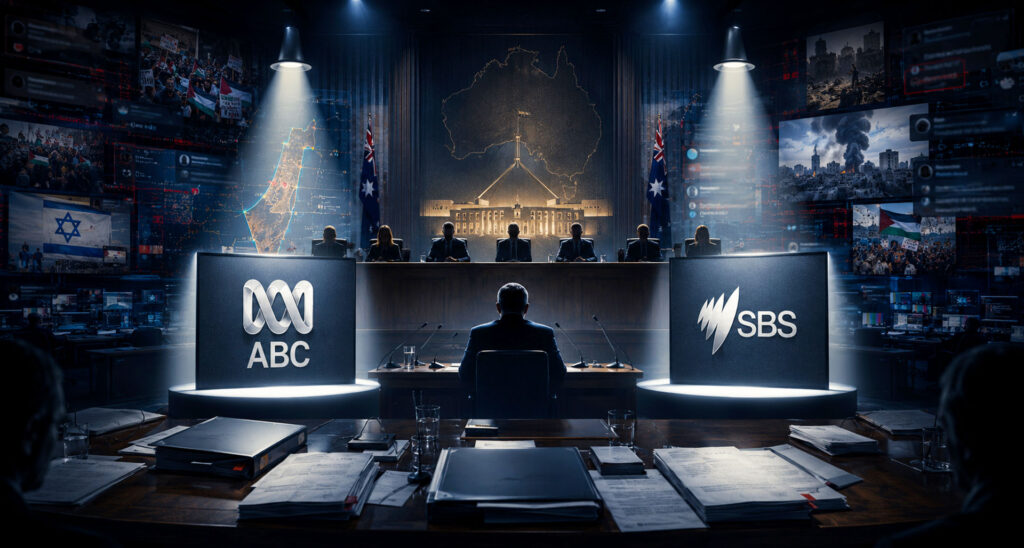
- Australia’s Royal Commission on Antisemitism placed the ABC and SBS under scrutiny over allegations that their coverage of Israel has contributed to rising antisemitism and eroded trust among Jewish Australians.
- The hearings exposed concerns over the broadcasters’ reliance on Hamas-linked and poorly verified sources, their handling of the false “14,000 babies” claim, and their refusal to adopt the IHRA definition of antisemitism.
- As publicly funded media organizations reject greater external oversight, the inquiry raises broader questions about whether editorial independence can substitute for accountability when reporting on Israel.
Australia is in the news these days for all the wrong reasons. Antisemitism has become so rampant in the country that the government took the extraordinary step of establishing a formal Royal Commission on Antisemitism and Social Cohesion.
It is in front of this Royal Commission that Australia’s two taxpayer-funded broadcasters – the Australian Broadcasting Corporation (ABC) and the Special Broadcasting Service (SBS) – have spent this past week defending themselves. At the heart of the inquiry: whether their coverage of Israel and the Gaza conflict has contributed to an increasingly hostile, dangerous environment for Jewish Australians.
For media watchdogs and Israel supporters who have spent years sounding the alarm over a persistent, systemic bias infecting these publicly funded newsrooms, the proceedings have perhaps offered a moment of grim vindication.
A Disproportionate Focus on Israel
Australia’s Special Envoy to Combat Antisemitism, Jillian Segal, argued before the Commission that the public broadcasters had contributed to an environment in which antisemitism could flourish, pointing to what many Jewish Australians see as a longstanding pattern of disproportionately negative coverage of Israel.
“It’s the perception of the Jewish community feeling constantly that they are being faced with reporting about the Middle East, about Gaza and about Israel in a way that paints Israel constantly in a negative light.”
There will always be “examples on both sides” in a war, she noted. But it is “the preponderance of the focus … on the behavior of Israel, as opposed to the behavior of Hamas” that has eroded trust.
When Truth Becomes the Casualty
One of Segal’s most serious criticisms concerned not tone, but sourcing. She argued that SBS has relied on casualty figures from the Hamas-run Gaza Health Ministry without adequate caveats, even though such figures do not distinguish between combatants and non-combatants and come from a source under Hamas control.
She made a similar point about the ABC’s use of UN-sourced claims, arguing that the broadcaster should fact-check such material rather than present it as settled fact. Her broader point was simple: information emerging from Gaza should be treated with skepticism and verified, not merely repeated because it comes wrapped in the authority of a UN title or a health ministry label.
SBS News and Current Affairs Director Mandi Wicks defended the broadcaster’s reporting, saying that while SBS does not always explicitly describe the Gaza Health Ministry as “Hamas-run,” its overall coverage makes clear that Hamas is in charge of Gaza.
Which rather misses the point.
Rejecting the Global Standard on Antisemitism
One of the most telling moments of the hearings was the outright refusal of both networks to formally adopt the International Holocaust Remembrance Alliance (IHRA) working definition of antisemitism.
ABC editorial director Gavin Fang said the broadcaster rejected the IHRA definition because it contained what he described as contested assumptions, and because the ABC’s own Middle East guidance was sufficient.
That position is hard to defend. The IHRA definition is widely used internationally and has been adopted by the Australian government. It is not a ban on criticism of Israel. In fact, it explicitly says that criticism of Israel, similar to that leveled against any other country, cannot be regarded as antisemitic.
But it also makes clear that antisemitism can appear in the way Israel is discussed, such as through double standards, denial of Jewish self-determination, classic antisemitic imagery, or collective blame directed at Jews for Israel’s actions. The ABC’s claim that its internal hate-speech guidance broadly aligns with the IHRA’s core premise – although it rejects the IHRA’s specific examples – does not change the fact that it has refused to adopt the definition itself.
As for SBS, they later told the Royal Commission it was not their policy to adopt third-party definitions on editorial matters.
But the obvious question remains: If public broadcasters (including those outside of Australia) are serious about combating antisemitism, why refuse a widely adopted definition specifically designed to help identify it?
The Fake “14,000 Babies” Claim
Arguably the most damaging moment of the week came when ABC editorial director Gavin Fang was forced to concede a “bad mistake” over one of the broadcaster’s most viral Gaza claims: that as many as 14,000 babies faced imminent death from malnutrition.
The claim originated on the BBC. According to Segal’s testimony, the BBC moved quickly to pull its own version of the story once the UN distanced itself from the figure – while the ABC’s online version stayed up for days before being removed. On air, the false claim was broadcast on News Breakfast at 6 am on May 21, 2025, and was already known to be inaccurate by 3 am that same morning. The correction didn’t air until 4 pm, and only on the lower-rated Afternoon Briefing program, not to the News Breakfast audience that had actually seen the original claim.
“It was a bad mistake,” Fang admitted, in what could be seen as something of an understatement.
Shining a Light… On Their Own Neglect
SBS has said it takes pride in “shining a light on prejudice.” But the broadcaster’s own testimony raised an uncomfortable question: how can it claim to do that while omitting antisemitism from mandatory staff training?
SBS Ombudsman Amy Stockwell confirmed that staff complete a mandatory ten-hour inclusion program, but that the training contains no specific content on antisemitism.
That is an extraordinary omission at a time when antisemitic incidents have surged across Australia.
Oversight They Do Not Want
To restore public trust and address the spread of biased, harmful narratives, Segal proposed a vital remedy: the establishment of an independent, external oversight committee to vet the broadcasters’ Middle East coverage, similar to the model used to monitor the BBC.
Predictably, both the ABC and SBS rejected the proposal, invoking their editorial independence and existing accountability mechanisms.
But as Segal rightly pointed out, letting public broadcasters police themselves is the ultimate exercise in “marking their own homework.”
And we all know they are not going to give themselves an “F.”
The Public Deserves Better
When taxpayer-funded media outlets reject the working definition of antisemitism adopted by their own government, fail to specifically train staff to recognize antisemitism, broadcast inflammatory falsehoods about Israel, cite casualty figures from a Hamas-run authority without consistently making that clear, and resist independent scrutiny of their overall coverage, they should not be surprised when Australian Jews lose trust in them.
Nobody is asking the ABC or SBS to become cheerleaders for Israel. Israel should be scrutinized. Its government should be criticized when criticism is warranted. Its actions should be reported accurately and rigorously. But Israel is entitled to the same journalistic standards as every other country.
But especially at a time when Australian Jews are facing an unprecedented wave of antisemitism, the country’s public broadcasters should be examining whether their reporting has contributed to that environment – not indignantly insisting that the very idea of independent scrutiny threatens their independence.
These are public broadcasters. Australians fund them.
And Australian Jews have every right to demand better.
Liked this article? Follow HonestReporting on Twitter, Facebook, Instagram and TikTok to see even more posts and videos debunking news bias and smears, as well as other content explaining what’s really going on in Israel and the region. Get updates direct to your phone. Join our WhatsApp and Telegram channels!
© Divuach Ne’eman R”A, 2025