Key Takeaways:
- Pulitzer-winning Gaza imagery is built on a closed-access environment where photographers operate under the control of Hamas, shaping what can be seen and what cannot.
- Repeated subjects, tightly composed scenes, and selective framing turn individual images into a consistent narrative architecture centred on suffering and attribution.
- By awarding this work without addressing access, repetition, or omission, major institutions convert editorial selection into historical record.
The images are now official.
Award-winning. Institutionally validated. Elevated above challenge.
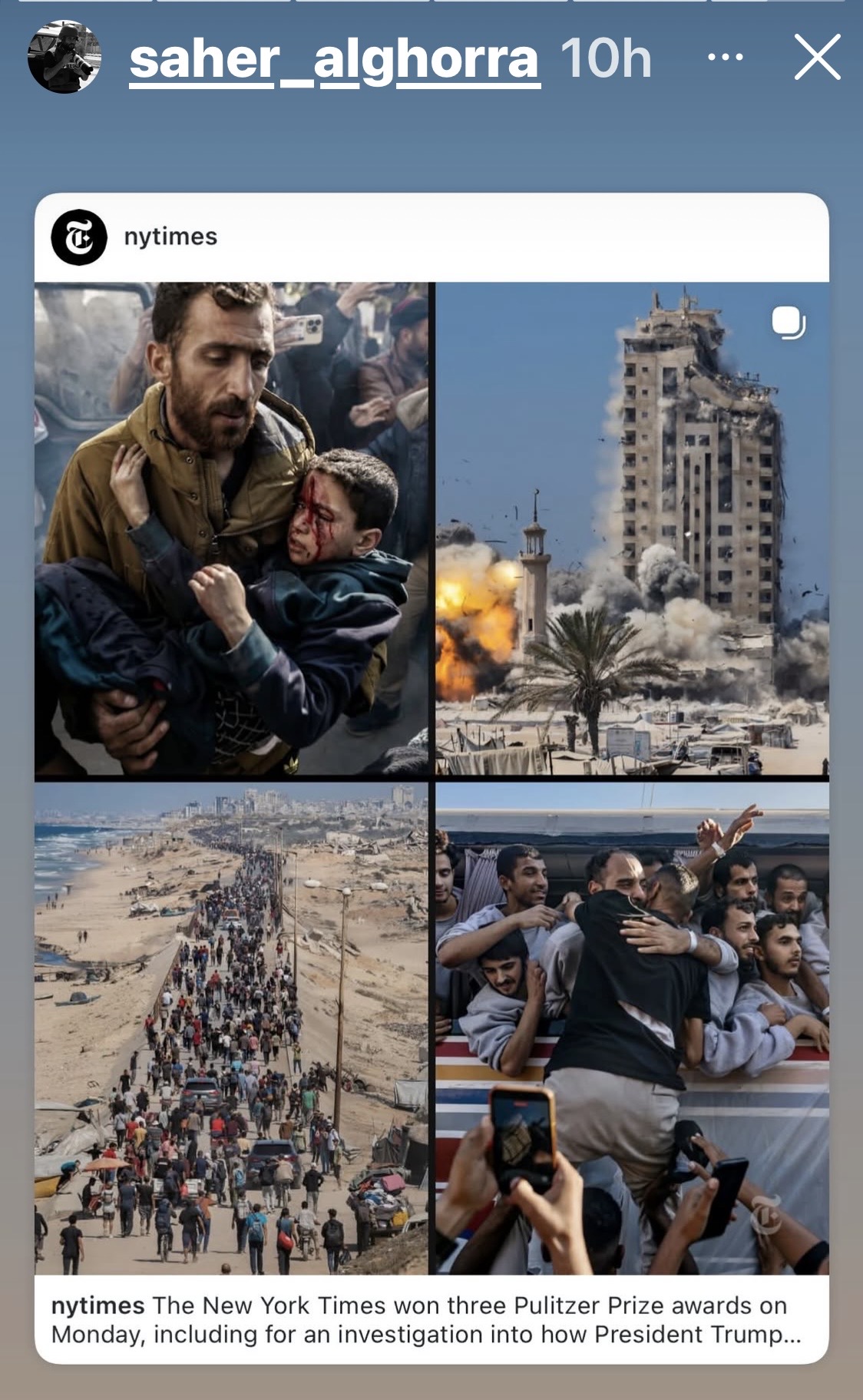
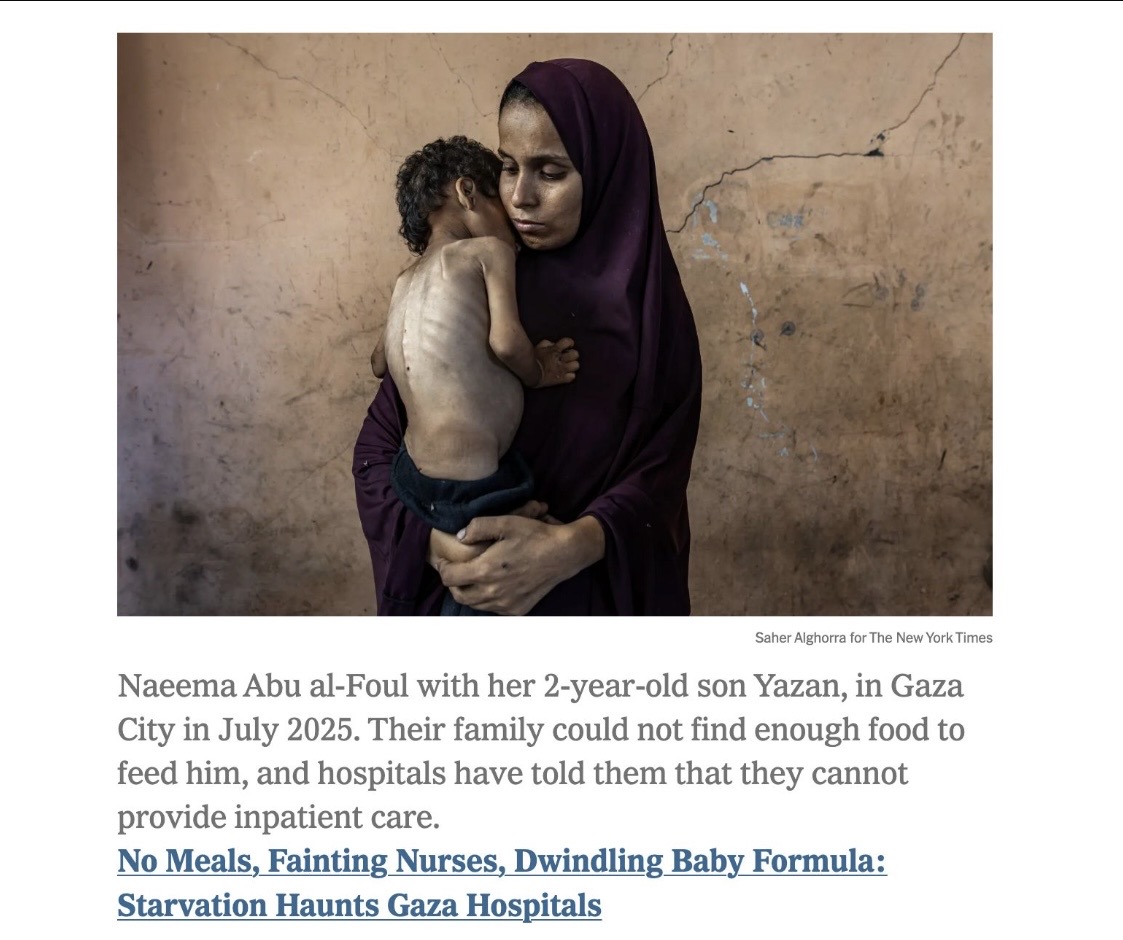
A child, emaciated, held in a frame that reads instantly as famine.
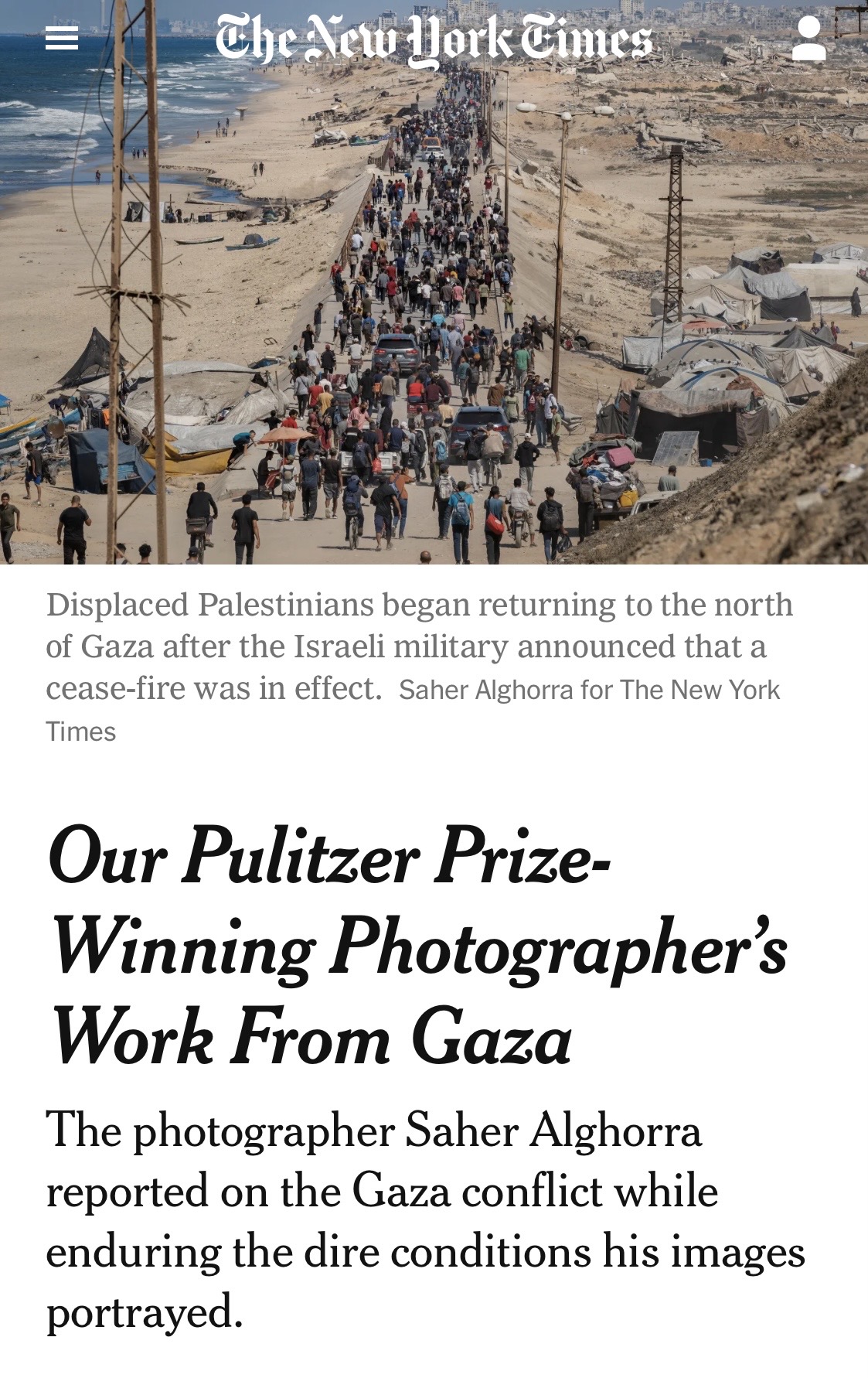
A crowd moving along a coastal road, presented as displacement.
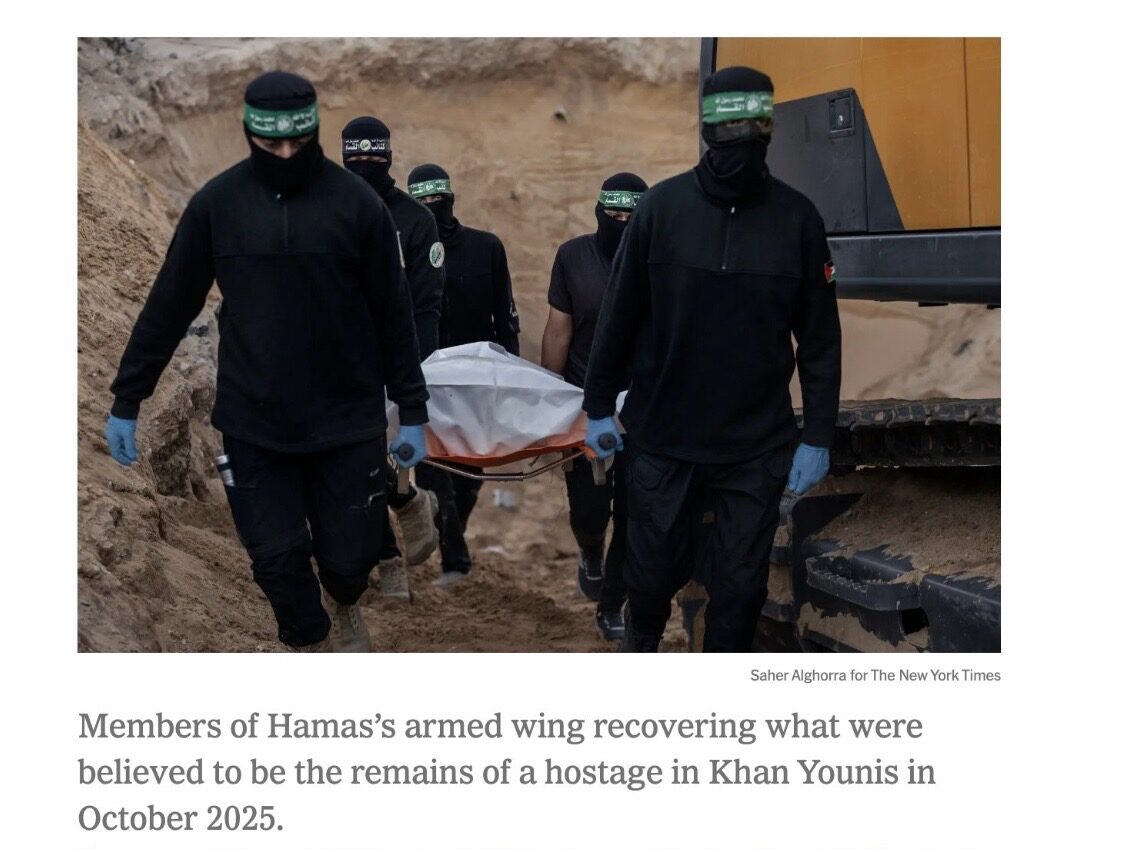
A body carried through sand by armed men, composed with clarity and control.
These are not just photographs anymore.
They are now part of the historical record.
That shift matters, because the question is no longer what the images show.
It is how they were made, what was selected, and what was left out.
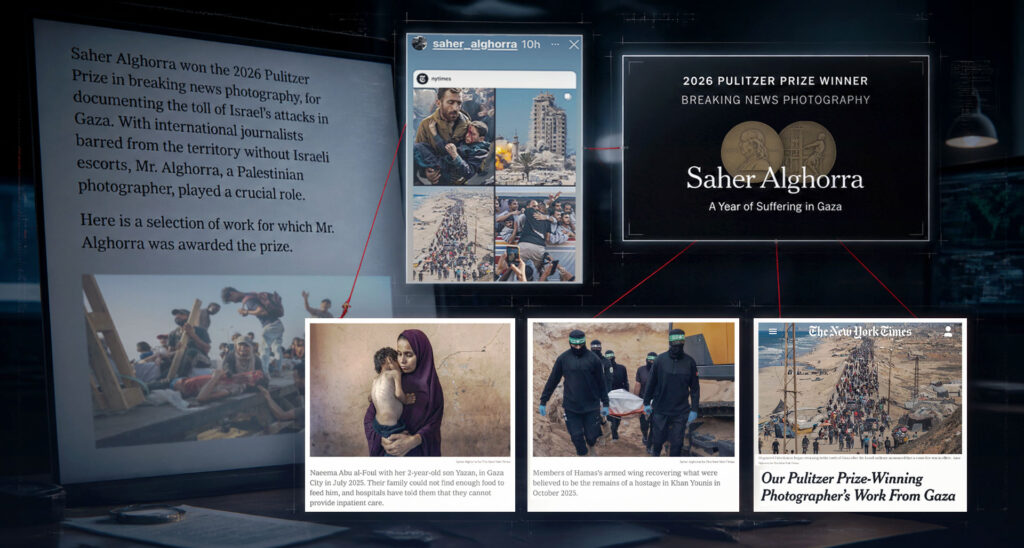
Based on the 2026 Pulitzer Prize announcement on May 4, 2026, Gaza-based photojournalist Saher Alghorra, a contributor to The New York Times, was recognized for his work documenting the war in Gaza.
This is just the latest example of how the Pulitzers have become part of a genre that has transformed the Palestinian narrative into a dominant, emotionally driven category, often built on sympathetically framed and manufactured Hamas-aligned storytelling.
Related reading:
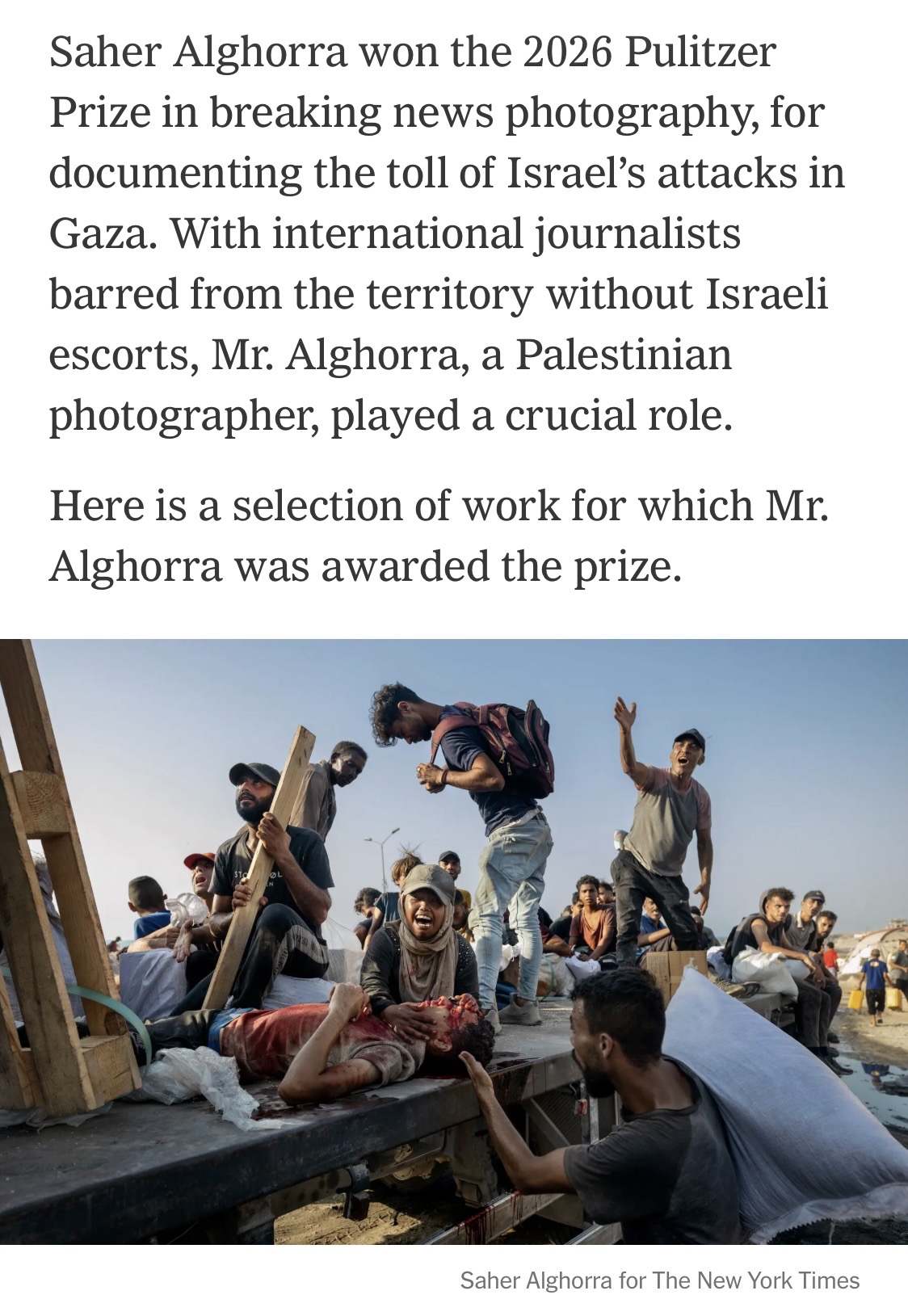
Alghorra was cited for a “haunting, sensitive series showing the devastation and starvation in Gaza resulting from the war with Israel,” and his work was highlighted for capturing the impact of the famine and destruction in the Gaza Strip.
The Environment
All imagery from Gaza operates within a closed system.
Photographers do not move freely. Access is controlled. Conditions are dictated by the governing authority on the ground, Hamas.
That context is not a footnote. It is the starting point.
Every image that leaves that environment is shaped by:
- where cameras are allowed to go
- who can be photographed
- what moments can be captured
- what cannot be documented at all
This is not an open visual field. It is a managed one.
And that management determines the raw material from which global narratives are built.
The Images
The Pulitzer-recognized portfolio presents a consistent visual language.
Subjects are tightly framed. Emotion is immediate. Context is minimal.
A two-year-old child becomes the face of starvation.
An injured civilian becomes the embodiment of conflict.
A mass of people becomes proof of displacement.
Individually, each image is powerful.
Collectively, they do something more.
They create a pattern.
The same subjects appear in repeated configurations.
The same emotional cues are reinforced across frames.
The same visual conclusions are reached before any caption is read.
This is not randomness.
It is selection.
The Repetition
One image centers on a child presented as a symbol of famine.
The wider context, noted elsewhere, includes additional family members who do not appear in the final editorial frame.
The same mother and child are photographed multiple times, by multiple agencies, in near-identical compositions.
That matters.
Because once a single subject is isolated, repeated, and distributed, it stops being documentation of a moment and becomes representation of a condition.
The image is no longer about that child.
It is about what the viewer is told that child represents.
The Access Problem
One of the awarded images shows armed, masked men identified as Hamas carrying what is described as the remains of a hostage.
This is not a distant image. It is composed. Controlled. Close.
That level of proximity is not incidental.
It requires access. It requires coordination. It requires trust.
In any other conflict environment, such access would be treated as a central question.
Here, it is not addressed.
The image is presented as documentation, without confronting the conditions that made it possible.
The Framing
The institutional framing that accompanies these images is clear.
They depict devastation. They depict starvation. They depict civilian suffering under Israeli action.
That framing is not hidden. It is explicit.
What is absent is equally clear.
There is no structural acknowledgment of the controlled environment in which the images are produced.
There is no interrogation of repetition or subject selection.
There is no examination of what cannot be photographed under those same conditions.
The result is a one-directional narrative.
Not because other realities do not exist.
But because they are not visible within the system that produces the images.
That framing extends beyond the images themselves. The New York Times, presenting its Pulitzer-winning work, describes how “the photographer Saher Alghorra reported on the Gaza conflict while enduring the dire conditions his images portrayed.”
This positioning does more than describe hardship. It aligns the photographer directly with the suffering shown in the frame, reinforcing the authority of the images while leaving unexamined the structural conditions under which those images were produced.
The Mechanism
Put the elements together.
A closed environment controls access.
Photographers operate within those constraints.
Images are selected that align with a consistent visual narrative.
Subjects are isolated, repeated, and amplified.
Context that complicates the image is excluded.
Then comes the final step.
Recognition.
An award does not just acknowledge images. It elevates them.
It signals that this is not only powerful work, but definitive work.
At that point, editorial choice becomes institutional truth.
Institutional Responsibility
This is not the work of a single photographer.
It is the product of a system.
When The New York Times publishes the images, when global agencies distribute them, and when the Pulitzer Prize recognizes them without addressing the conditions under which they were produced, responsibility is no longer individual.
It is structural.
What is being validated is not only the image.
It is the process that produced it.
This pattern is not isolated. As previously examined in From Description to Declaration: How World Press Photo Frames Gaza Differently, the same visual narratives are reinforced across major institutions, where recognition systems such as World Press Photo set the evaluative standard and awards like the Pulitzer Prize convert those standards into institutional authority.
Conclusion
Once awarded, these images no longer sit in the flow of daily coverage.
They are fixed.
They become reference points. Teaching material. Historical evidence.
And at that stage, the underlying questions become harder to ask.
How was access obtained?
Why do the same subjects appear repeatedly?
What was excluded from the frame?
Those questions do not disappear.
But they are pushed to the margins.
Because the image, once legitimized, no longer needs to defend itself.
It has already been accepted.
In modern conflict, the camera does not only record events.
It defines them.
And when that definition is drawn from a controlled visual environment, then elevated without scrutiny to the highest level of journalistic recognition, the result is not just documentation.
It is narrative, fixed in place, carrying the authority of the institutions that chose to endorse it.
UPDATE
The New York Times reached out after reading our article with a comment. The spokesperson’s statement is presented here in full:
Saher Alghorra has documented hundreds of starving and malnourished children in Gaza, conducting intrepid photojournalism at personal risk so readers can see the consequences of war. This attack on his work is baseless. Pulitzer jurors called Saher’s work a “distinguished example” of breaking news photography for his spontaneous coverage of these scenes in Gaza.
“Spontaneous coverage?”
There’s nothing spontaneous about Alghorra’s photo of Naeema Abu al-Foul and her son Yazan. A rudimentary internet search reveals that the two-year-old was also photographed by other Gazan photojournalists for other agencies, including:
- Jehad Alshrafi, Associated Press
- Omar al-Qattaa, AFP/Getty Images
- Haitham Imad, EPA
- Yousef Zaanoun, ActiveStills
Doesn’t sound like our exposé is “baseless,” does it?
Liked this article? Follow HonestReporting on Twitter, Facebook, Instagram and TikTok to see even more posts and videos debunking news bias and smears, as well as other content explaining what’s really going on in Israel and the region. Get updates direct to your phone. Join our WhatsApp and Telegram channels!
© Divuach Ne’eman R”A, 2025