Key Takeaways:
- Hamas’ own records contradict Breaking the Silence’s central claims about how the IDF identifies targets.
- Breaking the Silence relies heavily on anonymous, unverifiable testimony.
- Major media casualty figures blur the line between journalists and combatants.
“First we shoot, we kill, and then find a reason why it happened.” That is how Nadav Weiman, executive director of Breaking the Silence, described the Israeli army in an interview with France 24 last week. His organization posted the line on August 31, alongside an Associated Press article marking a year since the strike on Nasser Hospital in Khan Younis, which it offered as an example. This is referred to by Breaking the Silence as “retroactive incrimination.” The IDF, in this telling, kills whoever it kills and then sends its intelligence officers to trawl for a Hamas connection among the dead so that every shell can be justified after the fact.
It is a serious charge. It is made by an Israeli organization, in the pages of the world’s largest news agency, about the army in which its own members served. And it is false. Hamas itself had shown it to be false before Weiman ever said it.
What Hamas Said
The AP article rests on an anonymous soldier, introduced to the reporter by Breaking the Silence, who says the army “could find no evidence” linking the camera on the hospital roof to Hamas, and that none of the six men Israel named as Hamas-linked was the intended target. AP adds that one of those six “wasn’t on the hospital’s list of casualties” and that two others “were medical or emergency personnel,” and offers this as reason to doubt Israel’s account. The reader is left with a clear picture: Israel invented six terrorists to cover a mistake.
Hamas disagrees.
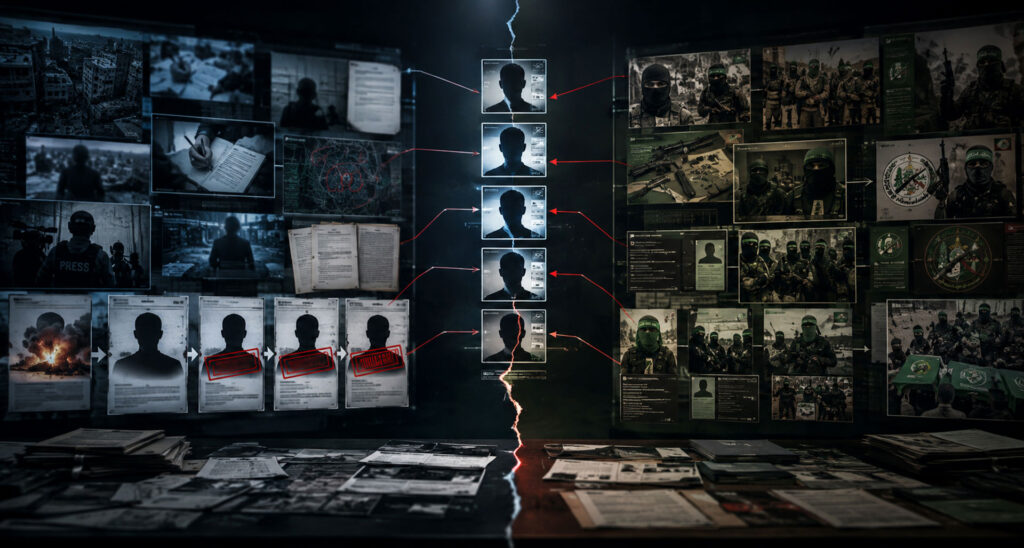
Hamas and Palestinian Islamic Jihad publish martyr notices for their fighters, and their affiliated channels publish detailed profiles of the dead. Three days after the AP piece, HonestReporting reviewed that material for the men Israel named. Imad Abd al-Hakim al-Shaer, whom The Independent presented as a Civil Defense worker who had just come off shift, appears in a Hamas martyr profile as a fighter in the Osama bin Zaid Battalion of the Khan Younis Brigade, with the rank of deputy group commander; the photographs on his family’s Facebook page match those on the Hamas poster. Salah Barbakh, 30, of Khan Younis, has a Hamas profile of his own. Muhammad Abu Hadaf, 23, killed at Nasser on August 25, 2025 according to Palestinian casualty records, appears on channels associated with Islamic Jihad as one of theirs. A fourth man killed in the strike whom Israel did not name, Ahmad Shaheen, is memorialized on Facebook in a military uniform holding a rifle.
These are not IDF dossiers. They are Hamas and Islamic Jihad telling their own people who died fighting for them, and where. Nasser is not an isolated case: since the terror groups began publishing their dead, their notices have corroborated the IDF’s identification of its targets in case after case, which is why the CPJ and other press-freedom bodies have had to strike names from their lists of “journalists.” At least three of the six men Israel named at Nasser, and a fourth it did not, are claimed by the terror groups themselves. Israel said Hamas was operating at the hospital. Hamas’ own channels say so too.
The “medical or emergency personnel” point deserves a direct answer. Al-Shaer was, it seems, both a Civil Defense worker and a Hamas deputy group commander. That is not a contradiction that undermines Israel’s account. It is a description of how Hamas operates. A day job in the rescue services is not an alibi for membership in the Qassam Brigades; in Gaza it is often the cover for it.
Weiman’s thesis requires that the “reason” be manufactured afterward. The reason, it turns out, was mourned by Hamas with the terrorists’ own names and ranks. That is not retroactive incrimination. It is corroboration from the enemy’s own obituary column.
The Shape of the Charge
“First we shoot, we kill” asks the reader to believe that the army of the Jewish state does not care whom it kills, or worse, kills deliberately and then lies about it. It presents the IDF’s targeting process, its intelligence, its post-strike review, as a machine for the manufacture of alibis. The Israeli soldier, in this telling, is not a young person fighting an enemy that hides among civilians. He is a killer with a paperwork department.
That charge has a history, and it is not a recent one. For most of two millennia the accusation against Jews was that we kill the innocent and then conceal it. The blood libel did not rest on evidence either. It rested on the assumption that Jews were the kind of people who would do such a thing, and that any denial was merely part of the cover-up. The costume changes. The accusation does not. Today it arrives wearing the language of human rights and accountability, and it is delivered by Jews, which is precisely what gives it its power in the non-Jewish world.
Not every critic of an Israeli strike is a bigot. But a claim which presents an entire army as killing first and inventing reasons later, and which collapses the moment Hamas publishes its own casualty list, is not analysis. It is a trope.
It also erases the one fact that explains every hard case in this war. Hamas does not wear uniforms. It does not do so by accident. Its fighters dress as civilians and fight from hospitals, schools, mosques and apartment blocks. They count on the confusion that follows when they die. When a “deputy group commander” is killed at a medical complex in civilian clothes, and his death is then reported as the death of a civilian, that is not an Israeli lie exposed. That is a Hamas strategy working as designed. Breaking the Silence knows this. Its members served in Gaza. Weiman himself served in Gaza. To describe the identification of a Qassam commander among the dead as “retroactive incrimination” is to describe Hamas’ camouflage as Israel’s crime.
“Almost None”
Weiman told France 24 that “almost none” of the army’s investigations lead anywhere. AP repeats the line: Israel “rarely holds troops accountable.”
The week before the AP piece appeared, the IDF announced military police criminal investigations into the killing of Hind Rajab and her family in 2024 and into the killing of 15 paramedics and rescue workers in Rafah in March 2025. The army’s fact-finding mechanism has completed roughly 150 probes and referred them to the Military Advocate General. In April 2024 the IDF dismissed two senior officers and reprimanded others over the World Central Kitchen strike, and said publicly that the strike was a “grave mistake.” The Nasser strike itself was acknowledged as flawed within a day: Chief of Staff Eyal Zamir conceded shortcomings in the operation on August 26, 2025 and ordered a fuller investigation, whose findings are to go to the MAG for a decision on criminal proceedings.
One may argue these investigations are too slow, or that too few end in charges. That is a fair debate, and it is the debate that a serious human rights organization would have. It is not the same as “first we shoot, we kill, and then find a reason.” An army that opens criminal probes into its own soldiers is not an army that has abolished the concept of a reason. It is doing, publicly and under enormous pressure, exactly what Weiman says it never does.
Who is Breaking the Silence?
Breaking the Silence presents itself as veterans telling uncomfortable truths. It is also several other things.
By its own admission, more than half of its funding comes from foreign governments. Its donor list includes the European Union, Norway, Switzerland, Spain, Denmark, the Netherlands and Canada. It is an Israeli organization in the sense that its staff are Israeli. It is a European project in the sense that Europe pays for it.
Its testimonies are anonymous. The organization states plainly that it will not assist Military Police investigations into the incidents its witnesses describe. In 2016 the State Attorney had to petition a court to obtain the identities of soldiers who had described what would be war crimes, because Breaking the Silence refused to hand them over. The organization that accuses the army of avoiding “real investigations” is the same organization that withholds from investigators the details that would make one possible.
When the testimonies have been checked, they have not fared well. In 2016 Channel 10’s investigative program HaMakor examined thirteen of them. Two were confirmed. Three were found to be false. Three were exaggerated or misleading. Four could not be checked at all, because the organization would not identify the witnesses. One of the testimonies rated as likely false was Nadav Weiman’s own: he had described the “mapping” of Palestinian homes as harassment; his commander said it served an intelligence purpose.
This is the organization that supplied AP with an anonymous soldier, “corroborated” him with its own unnamed sources, and then tweeted the result as proof that the IDF kills first and thinks later. It is a closed loop. The accuser produces the witness and vouches for the witness. Then it publicizes the verdict.
The loop is wider than one outlet. On August 23, The Independent published its own reconstruction of the strike, built on anonymous Israeli military sources, one of whom called the army’s process “retrospective framing.” Two days later came AP’s anonymous soldier. A week after that, Weiman gave France 24 “retrospective incrimination.” The same phrase, the same anonymous sourcing, three outlets in nine days.
The CPJ List
AP’s headline figure, that Israel has killed 207 Palestinian journalists, comes from the Committee to Protect Journalists. That number carries a great deal of weight in the world’s newsrooms. It should carry less.
In June 2026 the CPJ announced a “full review” of its database after, in its own words, “militant groups Hamas and Palestinian Islamic Jihad published obituaries identifying as combatants individuals previously listed by CPJ as journalists.” It had already removed twenty names, eight of them because they were, again in CPJ’s own words, “Hamas or PIJ combatants.” Organizations like HonestReporting identified terrorists posing as media workers throughout the war, and CPJ finally acted this year.
The review was promised for July. It has not been published. Since then Islamic Jihad has named more of its dead as commanders and combatants, and they remain on the list. And in July the CPJ’s board voted to affirm that its count includes people working for “media organizations connected to militant groups.” That is not a loophole. It is the policy. Employees of Al-Aqsa TV, Hamas’ own broadcaster, are counted as journalists killed by Israel. An HonestReporting audit of the 209 CPJ-listed names found 120 with ties to Hamas or Islamic Jihad, the majority through employment by their outlets, a substantial minority through the terror groups’ own martyr posters or the eulogies of their own families.
When the figure that anchors an article about Israeli impunity is drawn from a list that its own compilers admit contained combatants and are still reviewing, and that by policy includes the staff of Hamas’ television station, it is not a fact. It is a claim. AP presented it as a fact.
What the Story Leaves Out
The AP piece is long, but not one line of it records that Hamas and Islamic Jihad channels have claimed men killed at Nasser as their own. Not one line notes that the “emergency personnel” the article cites in Israel’s disfavor include a man Hamas honors as a deputy group commander. Not one line explains what the CPJ said about its own database in June. Not one line mentions that the organization which supplied its soldier is funded, by its own account, mostly by foreign governments. The article had a year to gather these facts. It gathered an anonymous soldier instead.
The objection will come that the deaths of Mariam Dagga and Hussam al-Masri are the point, and that the rest is deflection. Their deaths are not a small thing. They are precisely why the truth matters. If Hamas operatives were operating from the hospital where journalists worked, then Hamas chose to put those journalists in danger. Reporting the strike as if those terrorists were never there obscures how that danger arose.
“First we shoot, we kill, and then find a reason.” It is a good line. It traveled far. It is also, on the evidence of Hamas’ own obituaries, untrue of the strike it was coined to describe. An organization that will not help investigators, and whose executive director’s own testimony was rated likely false when it was finally checked, has told the world that Israel invents its reasons after the fact.
It should know. That is its method, not the IDF’s.
Liked this article? Follow HonestReporting on Twitter, Facebook, Instagram and TikTok to see even more posts and videos debunking news bias and smears, as well as other content explaining what’s really going on in Israel and the region. Get updates direct to your phone. Join our WhatsApp and Telegram channels!
© Divuach Ne’eman R”A, 2025