Key Takeaways:
- The Associated Press has appointed Erin Cunningham as its new Jerusalem news director, raising serious questions about how one of the world’s most influential news agencies will frame coverage of Israel and the Palestinian conflict.
- Cunningham’s professional record — from her role at The Washington Post to her own public statements and social media activity — reveals patterns that warrant scrutiny over her impartiality on one of journalism’s most sensitive beats.
- With AP shaping coverage consumed by more than a billion people worldwide, Cunningham’s appointment underscores why media accountability and close monitoring of editorial bias remain essential.
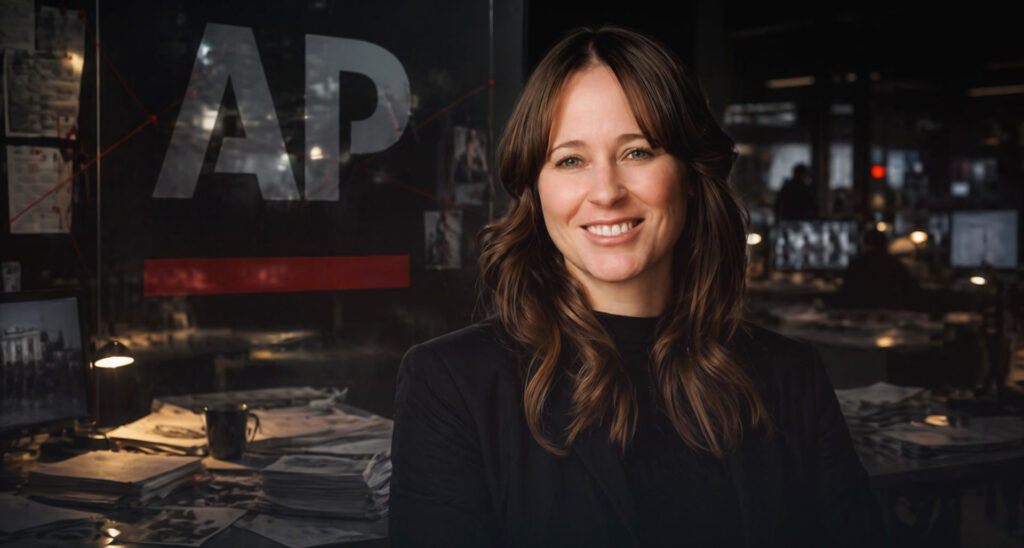
The Associated Press is relied upon by hundreds of media publications worldwide and reaches over 1 billion people daily. That’s why it matters who is in charge of the news coming out of Israel. Next week, Erin Cunningham will take up the role of AP’s Jerusalem news director. It is placing one of the world’s most contested and scrutinized beats in the hands of an individual whose reporting choices will shape how millions of readers understand the Israeli-Palestinian conflict.
So who is Erin Cunningham, and can we expect fair and balanced coverage from AP on her watch? We took a closer look, and the signs are not promising.
Overseeing Demonization of Israel at The Washington Post
We may already have seen a snapshot of how she relates to Israel from her time at The Washington Post as its Middle East news editor based in the U.S. capital, where, according to the AP, she “helped spearhead the Post’s coverage of the Oct. 7 attack, the war in Gaza and the subsequent conflicts it has ignited.”
On her watch, The Post published some seriously problematic content that we tracked throughout the war. At the shuttering of its Middle East bureau, we noted how systematic anti-Israel bias shaped The Post’s reporting through loaded framing, euphemistic language that whitewashed terrorism, moral equivalence that diminished Israeli suffering, and persistent skepticism toward Israeli claims while granting credibility to Hamas-linked sources.
Have you noticed the Washington Post’s anti-Israel bias? We have…? pic.twitter.com/GySKTrYaxA
— HonestReporting (@HonestReporting) July 5, 2024
It seems that Cunningham was part of a newsroom culture problem, including editors and reporters with openly hostile views toward Israel, that helped turn a legacy outlet into a platform for demonization and delegitimization of the Jewish state.
But Cunningham’s connections to the region go back much further. According to AP Middle East News Director Victoria Eastwood, “Erin’s deep knowledge of Israel and the Palestinian territories is born from her time as a correspondent in the region, based out of Cairo and Istanbul but reporting across the region, including in Gaza.”
In fact, Cunningham’s experience started before she became a correspondent.
An Emotional Attachment to the Palestinians
In a 2014 appearance on the Sources and Methods Podcast, Cunningham acknowledged that she did not enter the field under a mandate of impartial reporting. She explicitly stated: “I was working in the West Bank and I was working for an NGO…” before transitioning into journalism. This background indicates that her early professional frameworks were shaped by an organizational advocacy agenda rather than neutral editorial standards.
When asked about her focus on the Gaza Strip, Cunningham stated:
Absolutely. Gaza was the first place where I started. I felt like I started doing real reporting. I had gone there the last few days of Operation Cast Lead, which took place in 2008 and 2009. So I witnessed some of that operation. And, you know, it really sort of stuck with me, you know, the intensity of that and what the people were going through. And so I decided to move there in 2009. And yeah, it was because I thought it was an extraordinary place. And I really did enjoy my time there and telling the story. And I certainly was, you know, attached to it in that sense. And I think that helped. That definitely helped, you know, with the stories as well, when you know, you want to tell stories because you care about, you know, the populations and the people that you are writing about, and not necessarily because you want to be on the big story of, of, you know, the day or whatever.
For a journalist overseeing one of the world’s most contested beats, these admissions raise fundamental questions about professional impartiality.
Cunningham also makes a book recommendation:
I think that people should read Drinking the Sea at Gaza by Amira Hass. It’s a few years old. She’s an Israeli journalist that lived in Gaza during the 1990s, after the Oslo Accords were signed. And she really does a wonderful job of portraying, you know, the people of Gaza as just that, as people who love to go to the sea and the euphoria they get when the curfew is lifted… I would really recommend that for anyone who’s interested in that part of the world, for sure.
This is the same Amira Hass, a veteran Haaretz journalist who has caused controversy on numerous occasions with her anti-Israel screeds. She is even the proud recipient of an HonestReporting Dishonest Reporter Award for her blatant defense of Palestinian violence, only in the year before Cunningham’s podcast appearance: “Throwing stones is the birthright and duty of anyone subject to foreign rule,” Hass wrote in 2013. “Throwing stones is an action as well as a metaphor of resistance.”
As for the book? Critics note that the book gives comparatively little weight to Israeli security concerns or terrorism against Israelis, and frames Israel primarily as an occupying power.
Slanted Social Media
Cunningham’s social media is also revealing, most recently concerning Israel’s war against Hamas in Gaza.
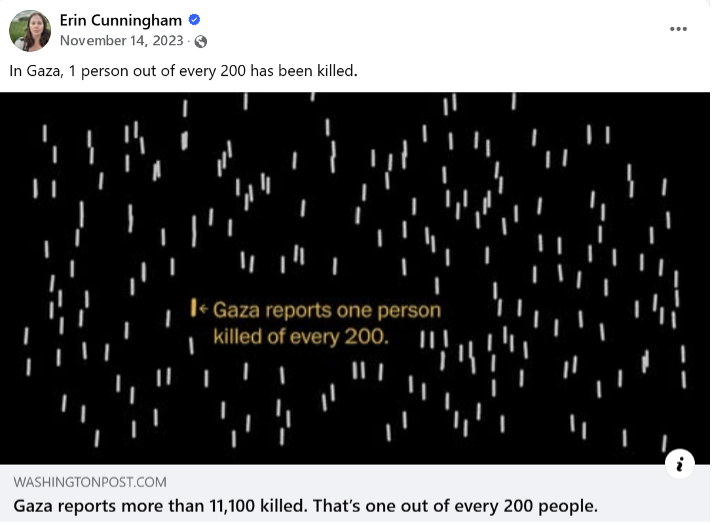
- Barely a month after Hamas’ October 7 massacre, Cunningham shared on Facebook a report from the Washington Post, without noting the report’s own caveat that there was “no breakdown between fighters and civilians” in the death toll — a critical distinction she omitted from her caption.
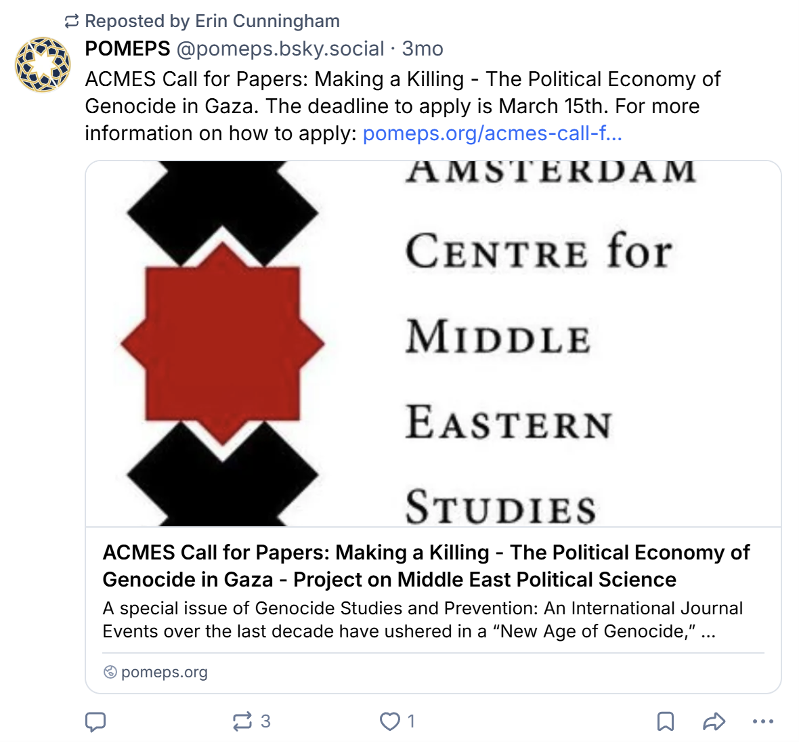
- February 17, 2026 (Bluesky): Cunningham amplified a post characterizing the situation in Gaza as a ‘genocide’ – a conclusion that goes further than the ICJ itself, which has never made such a finding against Israel.
We took a closer look at Cunningham’s social media. At the time of writing, she follows approximately 100 Instagram accounts that display clear pro-Palestine content out of her total of 1,813 followers. Some of those post explicit anti-Israel content and/or have confirmed links to Hamas.
For example:
- Ayman Aljedi: A photojournalist for Al-Quds Al-Youm TV, a channel affiliated with Palestinian Islamic Jihad (PIJ). The IDF confirmed that Aljedi was a combat propagandist and former Islamic Jihad naval operative.
- Motaz Azaiza: A photojournalist who has repeatedly praised the October 7th terrorist attacks and Hamas leaders, reframing terrorism and hostage-taking in ways that sanitize violence against Israelis.
- Hossam Shabat: Confirmed by the IDF as a sniper in Hamas’ Beit Hanoun Battalion who posed as an Al-Jazeera journalist.
- Gaza Martyrs / Gaza Shaheed: An account dedicated to eulogizing ‘martyrs killed by the occupation forces.’ In February, the account eulogized Ismail al-Ghoul, an engineer in the Hamas Gaza Brigade who was posing as an Al-Jazeera journalist.
- Anas Jamal / Anas al-Sharif: The IDF identified Anas Jamal as a Hamas squad leader and member of its elite Nukhba force.
- Ashraf Amra: Previously honored with kisses by Hamas leader Ismail Haniyeh on two occasions. On October 7th, Amra hosted an Instagram live from Khan Younis allowing co-host Abu Mostafa, who had just returned from Israeli territory, to display footage of the attacks captured at the breached border area.
- Hussam Abu Safiya: Dr Hussam Abu Safiya was previously identified by the IDF as a Hamas Colonel.
Of course, this doesn’t mean that Cunningham endorses anything published by these accounts. But five points are worth noting:
- She follows comparatively few pro-Israel accounts, which might undermine any claim that her engagement with this content is purely professional or balanced.
- If her rationale for following Hamas-affiliated accounts is to obtain on-the-ground intelligence, the reliability of that information must itself be questioned, given that it originates from sources with a direct interest in shaping an anti-Israel narrative.
- If professional curiosity were the primary motivation, one might expect her following list to reflect broader coverage of all conflict zones she has reported from – Lebanon, Iraq, Egypt, Afghanistan. The disproportionate concentration around the Israel-Hamas conflict, skewed distinctly in one direction, suggests something beyond journalistic due diligence.
- Cunningham’s credentials as a conflict-zone journalist risk functioning as a mitigating shield. Any scrutiny of her pattern of following Hamas-affiliated sources could plausibly be deflected by invoking her professional status.
- Even if Cunningham were unaware of specific Hamas affiliations, this would not explain the broader pattern, which extends to pro-Palestinian literary, visual arts, NGO, and charitable accounts.
What values will Erin Cunningham bring to the Associated Press in her new position? We’ll be watching to see.
Liked this article? Follow HonestReporting on Twitter, Facebook, Instagram and TikTok to see even more posts and videos debunking news bias and smears, as well as other content explaining what’s really going on in Israel and the region. Get updates direct to your phone. Join our WhatsApp and Telegram channels!
© Divuach Ne’eman R”A, 2025