Key takeaways:
-
A sacred phrase, repurposed: “Christ is King,” long a traditional Christian affirmation, has been increasingly co-opted online as a political signal intertwined with antisemitic and anti-Israel rhetoric.
-
Data shows a semantic shift: A report by the Network Contagion Research Institute (NCRI) found a fivefold rise in usage between 2021–2024, with extremist influencers driving over half of engagement and a growing percentage of posts containing hateful content — often linking the phrase directly to Jews and Israel.
-
Faith as a grievance brand: From figures like Nick Fuentes and Candace Owens to fringe and mainstream commentators, religious language is being fused with conspiracy narratives, turning theological expression into a tribal marker and algorithmic tool for monetized outrage.
Can an expression of faith ever be used in bad faith? Can a declaration of belief function as a dog whistle, signalling not devotion, but hostility?
So it would seem.
At least for a cohort of self-described Christians who have pivoted toward anti-Israel and anti-Jewish platforms, and in doing so have increasingly deployed the phrase “Christ is King.”
For centuries, “Christ is King” was precisely what it appears to be: a theological affirmation rooted in Christian liturgy, formalized in modern Catholic tradition with the Feast of Christ the King in 1925. It signified divine authority, moral order, and spiritual devotion.
Until recently.
Over the past few years, the phrase has proliferated online in ways detached from worship and that are increasingly entangled with politics. A report, “Thy Name in Vain: How Online Extremists Hijacked ‘Christ is King’,” by the Network Contagion Research Institute (NCRI), co-authored by Dr. Lee Jussim, Professor of Psychology at Rutgers University; Dr. Jordan B. Peterson, notable author and Professor Emeritus at the University of Toronto; Rev. Dr. Johnnie Moore, former U.S. Commissioner on International Religious Freedom; Dr. Joel Finkelstein, Chief Science Officer and Co-Founder of NCRI; and others, documents how the phrase has been co-opted by extremist actors spreading antisemitic and anti-Israel rhetoric.
It is not merely being repeated. It is being repurposed.
The Hijacking of Christian Faith
According to the NCRI analysis, mentions of “Christ is King” on social media platform X increased more than fivefold between 2021 and 2024. By 2024, more than 50 percent of all engagement around the phrase was generated by extremist or fringe political influencers.
The report identifies figures such as Nick Fuentes, Candace Owens, Jake Shields, Sneako, and Andrew Tate among the most influential amplifiers. During Easter 2024 alone, posts by some of these individuals amassed more than 13 million views and over 100,000 engagements.
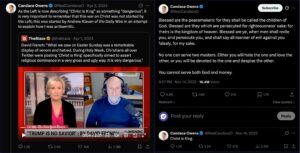
Candace Owens on X
The Easter spike is particularly revealing.
Historically, online interest in “Christ is King” followed predictable religious rhythms – seasonal rises around Christmas and Easter. But in March and April 2024, it reached historic highs. Nearly 10 percent of posts mentioning the phrase during that two-week peak included references to Jews or antisemitic content – significantly more than comparable mentions of other minority groups.
To be clear: in 2024, the single largest associated topic cluster alongside “Christ is King” was not “church,” “Easter,” or “salvation.”
It was “Jew.”
View this post on Instagram
Machine-learning analysis cited in the report shows that the proportion of posts classified as hateful rose from 9 percent in 2021 to 13.4 percent in 2024, with a monthly peak exceeding 17 percent in May 2024.
This was not simply an increase in devotional use.
It was a semantic shift that marked the transformation of a sacred affirmation into a political signal.
The report traces a pivotal moment to late 2020, when white nationalist activist Nick Fuentes was filmed at the “Million MAGA March” leading chants of “Christ is King.” Since then, the phrase has frequently appeared appended to posts attacking Jews, Israel, and so-called “globalist” conspiracies.
By Easter 2024, Candace Owens used the phrase in a viral post that helped catalyze the surge, embedding it within broader grievances against Jewish and pro-Israel figures. Within 24 hours, it was echoed by personalities from entirely different ideological ecosystems, including self-described “Muscular Muslim” influencers like Sneako and Andrew Tate, creating what the report describes as a convergence between far-right nationalist and Islamist extremist narratives.
When a sacred affirmation becomes a rallying cry shared by Holocaust deniers, conspiracy theorists, anti-Zionist provocateurs, and misogynistic “alpha” influencers, it is no longer functioning primarily as liturgy.
And – in many of these contexts – a declaration not simply that Christ reigns, but that Jews, and particularly Jews associated with Israel, are adversaries.
Turning Brethren into Foes
Millions of Christians say “Christ is King” in church, in prayer, and in worship music without hostility toward anyone.
This criticism is not directed toward them.
It is about a subset of online personalities who have discovered that invoking Christ, while simultaneously targeting Jews and Israel, is algorithmically lucrative.
Outrage drives engagement, engagement drives influence, and influence drives monetization.
Religious language, when fused with perceived grievance, becomes a powerful accelerant.
As a case study, consider Carrie Prejean Boller, whom HonestReporting recently spotlighted.
At the Religious Liberty Commission in Washington, D.C., the former Miss USA first runner-up rejected the Jewish people’s historic and inherent connection to Israel. She further argued that anti-Zionism is not antisemitism, despite the White House having adopted the IHRA working definition of antisemitism, which explicitly states that “the targeting of the state of Israel, conceived as a Jewish collectivity” can constitute antisemitism.
Following her remarks, she was dismissed from the panel.
View this post on Instagram
In the build-up to that moment, Prejean increasingly framed herself as a Christian truth-teller persecuted by “Zionist” forces. The rhetoric evolved from conventional conservative critique into a narrative of being “silenced” by Jewish influence, even as her posts were being amplified across social media.
The pattern is familiar: position yourself as a Christian victim of powerful Jewish actors, append “Christ is King,” and engagement spikes.
The message becomes less about theology and more about tribal boundary-drawing.
And she is not alone.
Lesser-known figures such as alt-right influencer Stew Peters have built their platforms around explicitly Christian nationalist framing, frequently combining “Christ is King” rhetoric with overtly antisemitic conspiracy narratives about Israel and alleged Jewish influence.
Owen Shroyer, associated with conspiracist platform InfoWars, has similarly deployed Christian nationalist language in attacks on Israel and so-called “globalist” institutions, using religious symbolism as part of a broader grievance-driven brand.
More influential and mainstream commentators have also contributed to the normalization of this fusion between religious identity and anti-Israel grievance. Tucker Carlson has increasingly framed global politics as a struggle for Christian civilization, platforming antisemites and self-styled “anti-Zionists” and casting suspicion on “elites” and foreign influence in ways that echo themes circulating in more overtly extremist spaces.
The phrase becomes a banner under which disparate extremist narratives can gather.
View this post on Instagram
A Sacred Phrase at a Sacred Season
With the arrival of Lent, the solemn Christian season preceding Easter and commemorating the crucifixion and resurrection of Jesus, the contrast becomes starker.
Jesus of Nazareth was born, lived, and died a Jew. The earliest followers of Christianity were Jews. Christianity emerged from Judaism.
For much of the past two millennia, Jews were persecuted, expelled, and violently targeted in Christian-majority societies, often justified by theological hostility. In the modern era, particularly in the United States, many Christians and Jews have instead forged strong theological, cultural, and civic alliances.
The NCRI warns that allowing sacred language to be weaponized carries broader consequences. The report argues that when religious phrases are co-opted to legitimize hatred, it does not merely distort language; it erodes the moral authority of religious participation in public life and risks normalizing extremism under the veneer of faith.
That is the real danger.
Not that Christians proclaim “Christ is King.”
But that the phrase is transformed into a dog whistle of exclusion.
No faithful people, Christians, Jews, Muslims, or otherwise, should allow sincere declarations of belief to be commandeered by those seeking to spread division.
There is another popular phrase in Christian culture, often seen on bumper stickers: “What would Jesus do?”
If some of these self-described defenders of Christianity truly believe that turning Jews into conspiratorial enemies is the answer, they may wish to revisit the New Testament.
Because weaponizing faith for hatred is certainly not what Jesus would do.
Liked this article? Follow HonestReporting on Twitter, Facebook, Instagram and TikTok to see even more posts and videos debunking news bias and smears, as well as other content explaining what’s really going on in Israel and the region. Get updates direct to your phone. Join our WhatsApp and Telegram channels!
© Divuach Ne’eman R”A, 2025