Key Takeaways:
- Gaza-based photographers and international wire services presented a Christmas Day graduation ceremony at Al-Shifa Hospital using selective framing that concealed rebuilt and operational sections, reinforcing a narrative of total destruction.
- The event relied heavily on statements from the Hamas-run Gaza Ministry of Health, quoted by major outlets without disclosure of its political affiliation or the senior Hamas role of its spokesperson.
- By staging a symbolic ceremony amid rubble while excluding context, the imagery transformed a medical milestone into a visual indictment, prioritizing narrative impact over journalistic accuracy and safety.
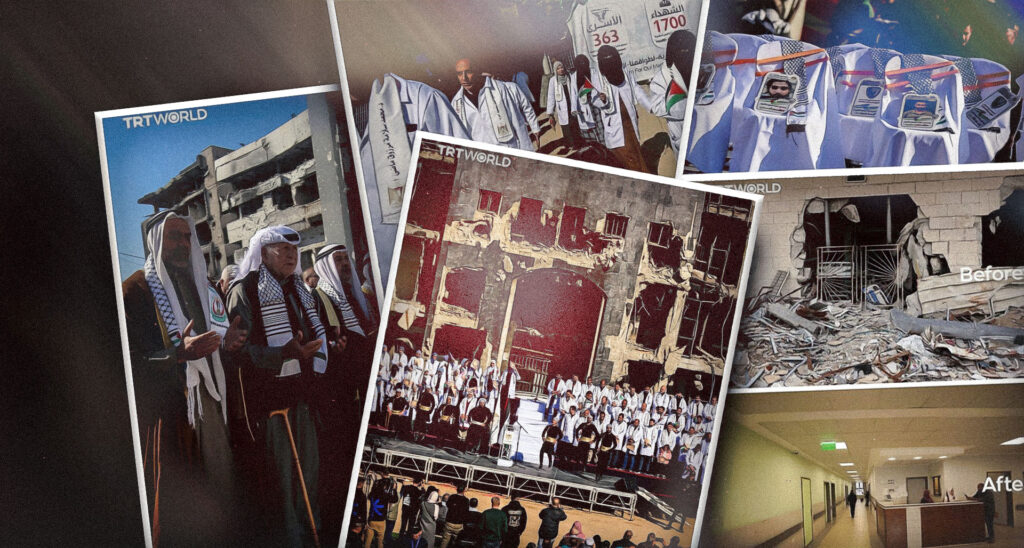
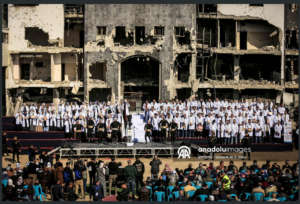
On Christmas Day, December 25, 2025, a graduation ceremony for newly certified doctors was held at the Al-Shifa Medical Complex in Gaza. Within hours, images of the event spread across international media. Doctors in white coats stood before blackened ruins. Rows of empty chairs honored fallen colleagues. The setting suggested devastation, endurance, and moral witness.
The photographs were powerful. They were also incomplete.
What audiences were shown was not the full reality of Al-Shifa, nor the full context of the event. Instead, the ceremony became another example of how imagery from Gaza is framed to advance a specific narrative through omission, selective angles, and unchallenged sourcing.
The Christmas Day Ceremony
The graduation marked the completion of specialist medical training for approximately 168 doctors, organized under the Palestinian Board. The cohort named itself the “Shield of Humanity,” a title emphasizing resilience and sacrifice.
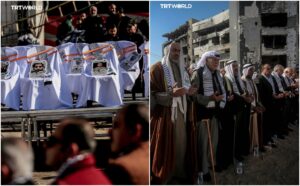
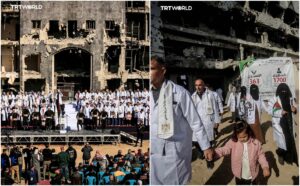
The ceremony took place outdoors in the courtyard of the Al-Shifa Medical Complex, positioned directly in front of heavily damaged buildings. Photographs showed doctors reciting their oath amid rubble, with a seated audience gathered in an area still surrounded by debris.
A row of empty chairs displayed photographs of medical workers killed during the conflict, creating a solemn visual memorial. Gaza Ministry of Health official Youssef Abu al-Reish described the graduation as emerging “from the womb of suffering, under bombardment, among rubble and rivers of blood.”
These elements formed the core of the imagery distributed globally.
What the Camera Missed Out
What was not shown matters as much as what was.
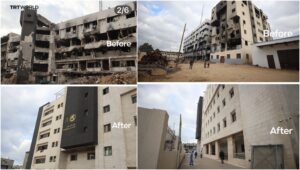
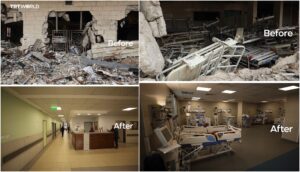
Al-Shifa is not a single ruined structure frozen in time. Portions of the hospital complex have been partially rebuilt and restored to operational use. Functional clinics and rehabilitated areas exist within the broader compound. None of these appeared in the images circulated by wire services.
Instead, lenses were directed exclusively toward the most destroyed sections of the site. Angles were chosen to eliminate surrounding context. The effect was to present Al-Shifa as a symbol of total loss, rather than a complex with a layered and evolving reality.
This was not achieved through digital manipulation. It was achieved through editorial choice.
Why Al-Shifa Matters
Al-Shifa’s symbolic weight makes it uniquely valuable as a visual stage.
Before 2005, the hospital was built and expanded with significant Israeli involvement and functioned as Gaza’s primary civilian medical center. After Hamas took control of the Strip, Al-Shifa became increasingly politicized. During multiple conflicts, intelligence and investigative reporting documented the use of areas beneath the hospital for Hamas command and operational purposes.
That history does not negate civilian suffering. But it does make Al-Shifa a contested site whose imagery carries political meaning beyond medicine.
Holding a ceremony at this location, and framing it exclusively against destruction, was a deliberate editorial decision designed to activate that symbolism.
The Gaza Ministry of Health: A Misrepresented Source
International coverage relied heavily on quotes from Youssef Abu al-Reish, presented as a medical official.
What most outlets failed to disclose is that the Gaza Ministry of Health is run by Hamas, and that Abu al-Reish is not an independent clinician but a senior official within that structure. He functions as part of Hamas’ governing apparatus.
By quoting his statements without attribution to Hamas or a contextual disclaimer, media outlets presented political messaging as neutral medical testimony. This is not a matter of interpretation. It is a factual lapse in sourcing.
Audiences were not told who was speaking or on whose behalf.
Safety and Spectacle
Beyond narrative framing, the event raised practical concerns.
The ceremony placed dozens of people, including alleged medical professionals and an assembled audience, in close proximity to unstable rubble. The choice to stage the event in a visibly hazardous area prioritized imagery over safety.
This mirrored a broader pattern seen throughout the conflict: symbolic visuals produced at the expense of context, risk assessment, and verification.
A Documented Pattern
This ceremony did not occur in isolation. It follows a pattern documented throughout this series: humanitarian moments transformed into visual indictments through selective framing, controlled access, and uncritical repetition by international outlets.
As with famine imagery, fence photography, and hospital coverage examined in earlier articles, the Al-Shifa graduation demonstrates how omission functions as narrative construction.
The graduation of doctors is, by any measure, a meaningful event. But meaning does not excuse misrepresentation.
By framing the ceremony exclusively against rubble, quoting Hamas officials without disclosure, and excluding surrounding reality, international media transformed a medical milestone into a political tableau.
This was not the result of a single photograph or one outlet’s bias. It was the outcome of a system that rewards emotionally charged visuals while discouraging scrutiny.
Until editors, agencies, and audiences learn to ask not only what is shown, but what is deliberately left out, Gaza will continue to be presented not as a place with complexity, agency, and competing truths, but as a stage upon which narratives are performed.
Liked this article? Follow HonestReporting on Twitter, Facebook, Instagram and TikTok to see even more posts and videos debunking news bias and smears, as well as other content explaining what’s really going on in Israel and the region. Get updates direct to your phone. Join our WhatsApp and Telegram channels!
© Divuach Ne’eman R”A, 2025