
Is Google Maps deliberately preventing tourists from visiting the West Bank in order to isolate the Palestinians? Writing in her Times of London column, Janice Turner raises the bizarre question:
A puzzle remains from my recent holiday to Israel. Why does Google Maps try to deter tourists from visiting the West Bank? After a morning bobbing about in the Dead Sea, we decided to have lunch in a famous chicken joint in Jericho. I typed in the destination but it came up “Can’t find way there. Try again.” Hebron, also within the Palestinian territories, was the same.
The roads were not blocked, there was no reported trouble ahead. In the end, we drove there, navigating by a paper map and the scant roadsigns, to be rewarded with a friendly welcome. Palestinian strangers shook our hands, thanking us for coming.
It is hard not to wonder who is trying to prevent such journeys. Does Google Maps conceal the routes to stop Israelis, who are technically forbidden to enter the West Bank, blundering in? Or is it to keep the area ever more isolated from the outside world?
Clearing up the ignorance and the false assumptions
In three paragraphs, Turner has exposed both her lack of background knowledge and some false assumptions. Here are some vital points that she clearly never considered:
- It’s not “technically forbidden” for Israelis to enter the West Bank. After all, some Israelis happen to live there. It is, however, illegal for Israelis to enter Area A of the West Bank, which is under the full administrative and security control of the Palestinian Authority. This would include major Palestinian cities such as Jericho.
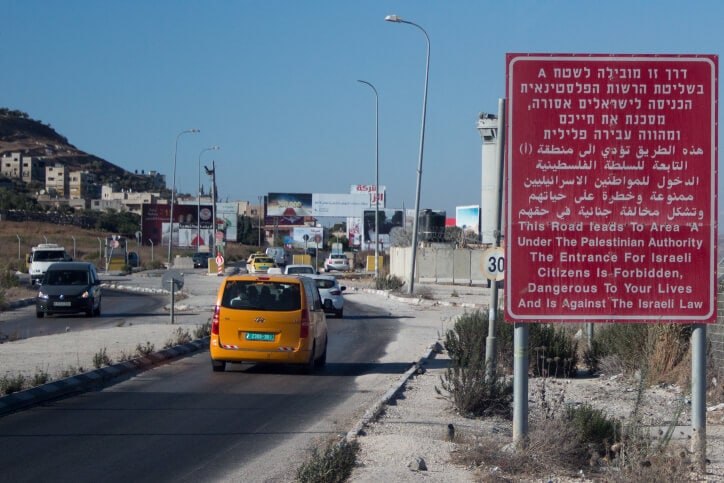
A red sign on the side of a road warns Israeli citizens from entering Nablus, West Bank on July 29, 2015. Photo by Garrett Mills/Flash 90
- Google Maps relies on location settings in mobile devices. It does not and cannot identify whether the user is an Israeli citizen or a tourist. Therefore, Google is acting responsibly by not sending drivers or navigators via routes that are potentially unsafe.
- It’s safe to assume that Janice Turner was traveling in a vehicle with Israeli number plates. Palestinians, some of whom have been known to throw rocks or shoot at Israeli vehicles, cannot tell from a distance if the vehicle’s occupants are tourists even if they may appreciate foreign visitors.
- GPS devices have, on a number of occasions, led Israelis into Palestinian areas where they or their vehicles have been physically attacked. For example, in February 2018, Israeli soldiers using Waze in a similar way to Google Maps, were attacked by Palestinians after accidentally driving through a Palestinian city.
So Google Maps may very well be making it overly difficult for drivers to navigate their way into Palestinian cities, towns and villages. However, it’s certainly not “to keep the area ever more isolated from the outside world” but to ensure that both Israelis and foreigners do not find themselves in dangerous situations.
Perhaps it is simply naivety and ignorance on Turner’s part that she has published both misinformation and uninformed speculation about the realities of life in the region. However, this isn’t the only example of her misreporting. UK Media Watch exposes a blatant falsehood in another Turner column where she claims, during the very same Israeli vacation, to have witnessed “ultra-orthodox settlers enter[ing] the Al-Aqsa mosque” to “pray” – an impossibility given that non-Muslims are not allowed in the mosque at all.
It’s wonderful that Janice Turner has ignored the hateful sentiments of the anti-Israel boycott campaign and chosen to vacation in Israel. She is also welcome to visit the West Bank. Trying to reinterpret her experiences to fit into her predetermined framing of the Israeli-Palestinian conflict is, however, definitely not welcome.
© Divuach Ne’eman R”A, 2025