Key Takeaways:
-
A documentary celebrating AFP’s Gaza journalists appears to suggest the agency was willing to pay for evacuating its journalists and their families from Gaza, apparently while Hamas still controlled the Rafah crossing, raising serious ethical and legal questions.
-
The film omits critical facts about AFP staff with documented ties to Hamas and excludes journalists who infiltrated Israel on October 7.
-
Through emotional editing and selective storytelling, the documentary erases Hamas, ignores Israeli hostages, and depicts Israel as striking Gaza blindly and without cause.
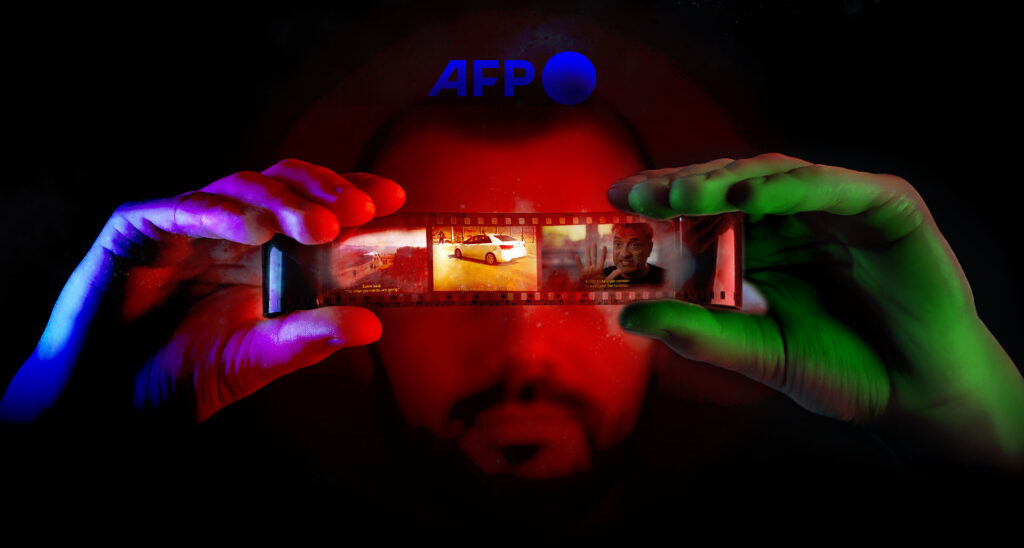
A recent documentary about AFP’s Gaza bureau during the Israel–Hamas war, produced by the European public service channel Arte and titled “Inside Gaza,” set out to portray the bravery and endurance of journalists working under fire.
Instead, it raises troubling questions about ethics, omissions, and the extent to which major news agencies are willing to look the other way when reporting from a territory controlled by a terrorist organization.
Most alarming is a moment late in the film suggesting that AFP was prepared to pay for the evacuation of its Gaza-based journalists and their families, apparently while Hamas was still in control of the Rafah crossing. According to the timeline presented, this would have been before Israel took control of the crossing in May 2024. That raises an unavoidable question: if money changed hands, to whom was it paid?
That is not a minor logistical detail. It goes to the heart of journalistic ethics and potentially to legal exposure.
But the issue of the apparent payment is only one of many problems with the film, which omits Hamas, ignores the hostages, and makes Israel look like a child slayer that strikes blindly at innocent civilians and not terrorists.
Payment to Hamas?
Roughly 45 minutes into the documentary, AFP photojournalist Mohammed Abed states that AFP was willing to pay 5,000 dollars to evacuate the agency’s journalists and their families from Gaza:
AFP was even prepared to pay 5,000 dollars per person to evacuate the families.
The film does not specify the exact timing of its journalists’ evacuation, and it’s not clear to whom AFP was willing to pay. But based on the sequence of events shown, it appears to have taken place while Hamas still controlled the Rafah crossing and was the only body able to grant such permission.
If that is accurate, AFP must explain who was paid and under what conditions. If no payment was ultimately made, that too requires clarification as to how the agency’s journalists were ultimately able to leave.
Problematic interviews
There are many other problems with the film.
First, the interviewees. The documentary is built around interviews with AFP journalists in Gaza. Yet it omits critical information about some of those featured and excludes others entirely.
Mohammad Abed, for example, was previously exposed by HonestReporting for appearing in a Hamas promotional video and receiving what Hamas described as a “Loyalty Award.” That background is not disclosed to viewers. Instead, Abed is presented as a neutral and reliable witness.
Another AFP photographer, Said Khatib, is conspicuously absent from the film. Khatib was inside Israel on October 7 after infiltrating with Hamas terrorists and taking pictures of a burning Israeli tank. His absence from a documentary about AFP’s Gaza team is difficult to explain, particularly because he appears briefly in the film later just to say that he is “very tired.”
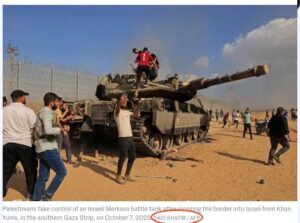
And veteran AFP journalist Adel Za’anoun is interviewed at length and speaks about October 7 as if AFP had no presence near the border that day. Yet his colleague Khatib was there. The question is not whether Za’anoun had prior knowledge, but whether the film is deliberately avoiding uncomfortable facts about AFP’s proximity to the attack.
People had started crossing the border. I told my team clearly, ‘were not to go near it. Some said, ‘the other journalists are going.’ I told them, ‘No, it’s too dangerous. Israel will fire back, and anything that moves will be a target.’
Related Reading: EXPOSED: Foreign Media Journalists in Gaza Participated in Hamas’ “Loyalty” Day
Lack of Objectivity
Second, and quite ironically, the documentary undermines its own premise that Gaza-based journalists can operate professionally. In one moment, Za’anoun acknowledges that Hamas has threatened journalists. This admission alone should prompt serious reflection about the reliability of reporting produced under such conditions, yet the film proceeds as if these constraints have not affected coverage.
I’ve been detained at least 20 times. With Hamas, it’s all bans and threats. Once, they put a gun to my head simply because I’d reported that a killing had been carried out by the Al-Qassam Brigades.
Third, the movie tries to make the case that Israel blocked the Strip for foreign journalists in order to target those who remained and commit unchecked atrocities. But by showing how AFP journalists had to leave their office, the film itself proves how Israel warned reporters ahead of strikes that could have endangered them.
Finally, the emotional editing starts to take over the narrative, as the screen gets filled with visuals of apocalyptic demolition and dead children. Hamas is nowhere to be seen, and the Israeli hostages — whose return could have ended the war much earlier — are not mentioned. The viewers are only fed footage of consecutive Israeli bombings and hundreds of body bags, as if the Jewish state is blindly demolishing the strip and its innocent civilians — not fighting against blood thirsty terrorists.
Lack of self awareness
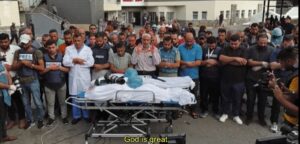
Taken together, the root problem of the film is that it is disturbingly self-indulgent. Every journalist is reflexively sanctified. The result is surreal footage of Gazan journalists’ funerals, presented without comment, even as the man leading prayers over their bodies is Salama Ma’aruf, Hamas’ head of media, as shown in the screenshot below.
The same lack of awareness is shown when Al-Jazeera’s journalist in Gaza, Wael al-Dahdouh, is brought as an example of journalistic courage under fire, because he had lost almost his entire family. But the film doesn’t mention his terror background.
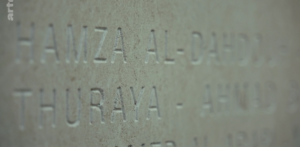
And one of the last shots of the movie is from a monument for Gazan journalists, showing names of two who were exposed by the IDF as terrorists: Al-Dahdouh’s son, Hamza, and Mustafa Thuraya, as seen in the screenshot below.
From the negligent comment about willingness to pay money, through the omissions of Abed’s past and Khatib’s infiltration, to the automatic glorification of anyone who wears a press vest — it’s clear that whoever edited the film did a good job evoking emotions but had no qualms about omitting Gazan journalists’ links to Hamas, out of bias or ignorance.
None of this diminishes the real dangers faced by journalists in Gaza. Many AFP staff members undoubtedly worked under extreme conditions and did an excellent job. But a documentary that omits material facts, glosses over ethical concerns, and frames journalism as untouchable sanctity rather than a profession bound by standards, does more harm than good.
Why were Abed’s Hamas’s “loyalty” promo omitted? Why was Khatib excluded entirely? And above all, did AFP consider paying a terrorist organization to evacuate its staff?
AFP owes the public clear answers. Until then, this film stands not as a testament to journalistic courage, but as a cautionary example of how easily emotion can be used to obscure accountability.
Liked this article? Follow HonestReporting on Twitter, Facebook, Instagram and TikTok to see even more posts and videos debunking news bias and smears, as well as other content explaining what’s really going on in Israel and the region. Get updates direct to your phone. Join our WhatsApp and Telegram channels!
© Divuach Ne’eman R”A, 2025