I remember being told that I was “antagonising them.”
It was days after September 11, 2001, and I was outside the Israeli Embassy in Kensington, photographing an Israeli flag being burned. The police wanted me to stop taking pictures. I argued with the officer and was threatened with arrest. Another photographer intervened, and I was not arrested.
Twenty-five years later, I still have some difficulty understanding how, in that situation, the press photographer became the problem.
I have been looking through my photographs from those years because the pieces I have recently written about London keep taking me back there. Cable Street, the Barghouti statue, and now the appropriation of the Remembrance Day poppy have all touched something personal. I grew up in that city and worked on its streets. Long before I moved to Israel, I was watching developments that made me increasingly uncomfortable about where the country was heading.
In one of my photographs, Abu Hamza stood behind a police barrier with a metal hook curled around the horizontal bar. He had lost both hands and used prosthetic hooks, giving the British press its nickname for him: “Captain Hook.” In the photograph, officers stand immediately in front of him, while demonstrators and black banners fill the space behind.
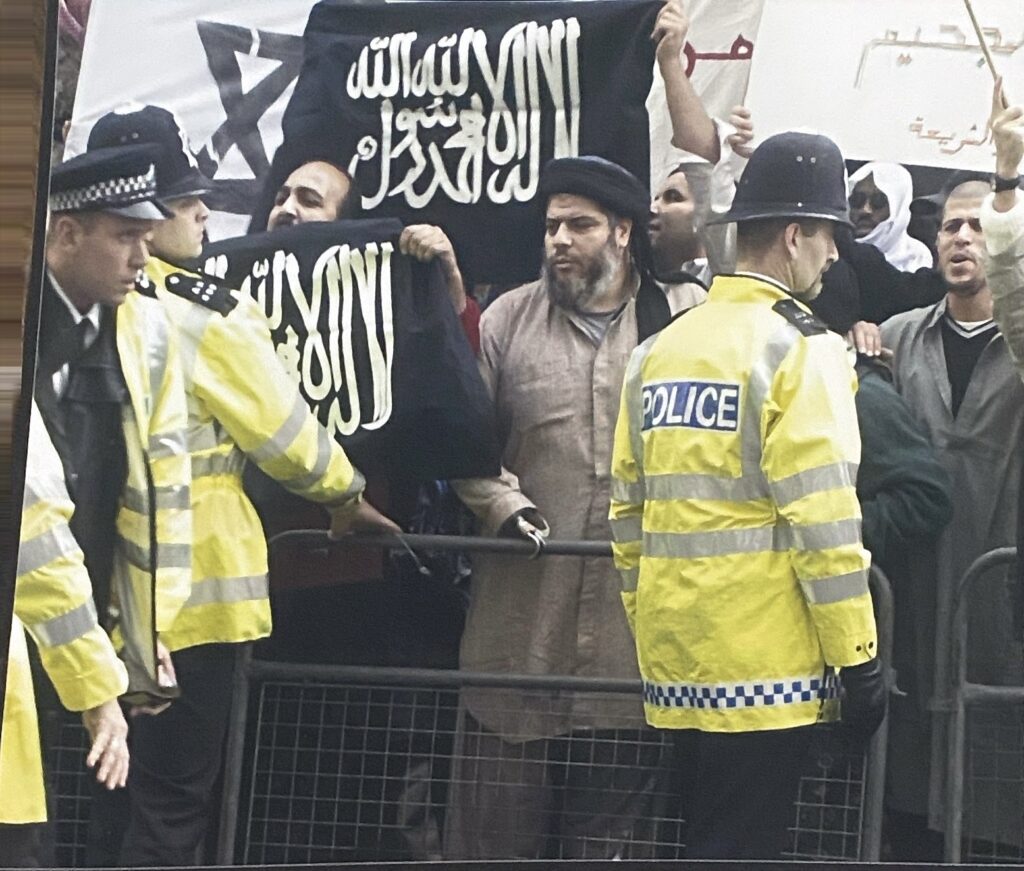
Photo By David Katz
The nickname lent itself to tabloid headlines. I found the man considerably more sinister than the cartoon name suggested. Years later, he would receive a life sentence in the United States for terrorism offenses involving a deadly hostage taking in Yemen, a planned training camp in Oregon, and support for al Qaeda in Afghanistan.
There were competing stories about how he had lost his hands. At his American trial, he said an accidental explosion in Pakistan had caused his injuries. Whatever the circumstances, the hook around the barrier is an unmistakable detail in my photograph of a man whose activities were already attracting official attention.
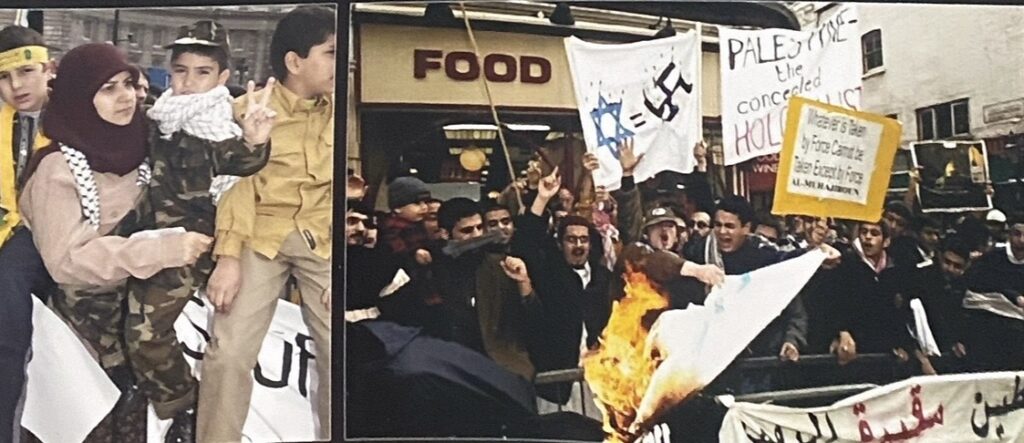
Elsewhere in the collection, an Israeli flag burned beneath a banner equating the Star of David with a swastika. Children appeared too, carrying Palestinian flags. One child had his face wrapped in a keffiyeh, another wore camouflage clothing. I cannot tell you what those children understood. I can show you the surroundings in which they were being brought into the street.
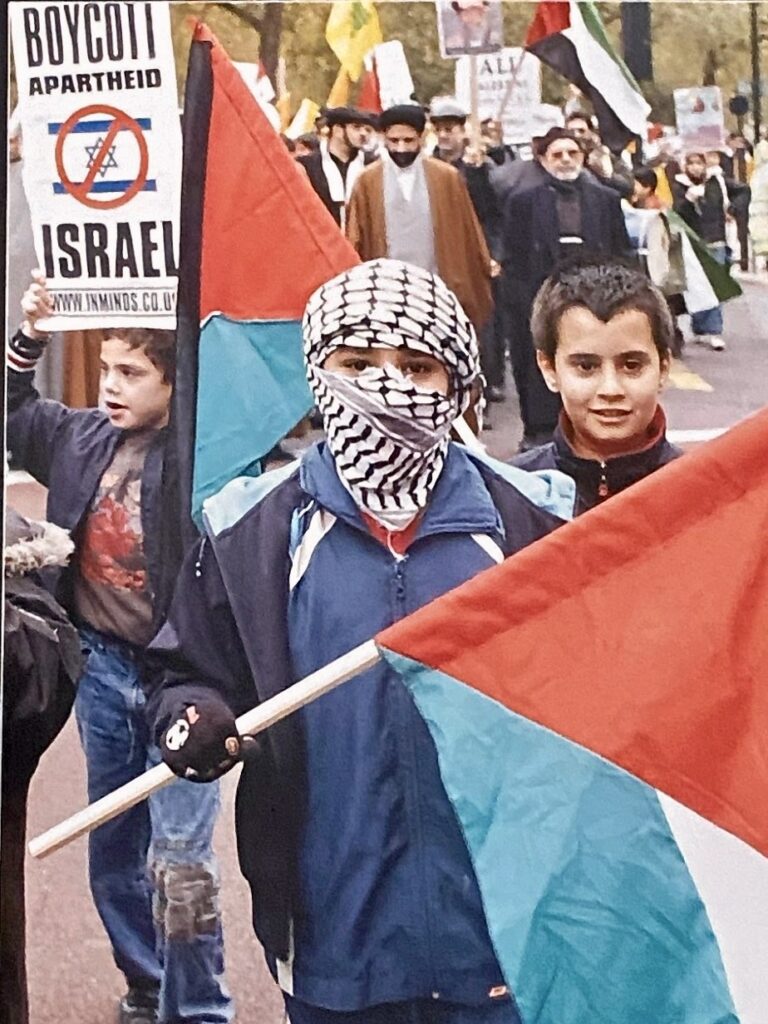
Photo By David Katz
I took these pictures in 2001. They belong to a much longer period of photographing demonstrations in London, from 1991 until I left Britain in 2007. Looking at them now, I remember the frustration of watching things unfold in public while wondering what would persuade the authorities to take the concerns seriously.
There had already been ample reason to listen.
On July 26, 1994, a bomb exploded outside the Israeli Embassy. Another struck Balfour House in north London early the following morning. In its report at the time, the Jewish Telegraphic Agency said the Foreign Office had acknowledged receiving an Israeli diplomatic security alert on July 18. The Foreign Office said it had promptly passed that warning to the appropriate authorities.
The same report described Jewish communal officials warning police at a meeting just hours before the second explosion. According to the reporting, police had not expected another attack on an Israeli or Jewish target after the embassy bombing.
Reading that now is uncomfortable enough. For those living with the threat at the time, these were questions about whether the people responsible for protecting them understood the danger.
I know firsthand that Jewish communal organizations repeatedly raised concerns with the Metropolitan Police, the security services and senior government. I will not identify the sources of that knowledge. My understanding then was that a reluctance to “rock the boat” formed part of the response. I cannot attach that explanation to every official decision, but I remember the concern and frustration very well.
The warnings were being reported in the newspapers. So were the arguments about Hizb ut-Tahrir.
In August 1994, The Independent reported Jewish students’ complaints about intimidation and literature invoking the killing of Jews. Farid Kassim, quoted as a spokesman for the organizers of a Wembley conference, rejected allegations of antisemitism and said the quotations had been taken out of context. Omar Bakri Muhammad was identified as Hizb ut-Tahrir’s national organizer.
The report also recorded Muhammad condemning the London bombings and the authorities saying there was no evidence of terrorist attacks by the group’s followers. That did not dispose of the concerns about what was being preached and circulated.
By the time I photographed Abu Hamza, officials were familiar with him too. A released Home Office document, dated September 11, 2000, described his activities, his Supporters of Sharia organization and his extreme views. A year before the attacks in America, he was already the subject of government paperwork.
In November 2001, answering questions concerning Al-Muhajiroun and Omar Bakri Muhammad, Home Office minister John Denham said enforcement units were “monitoring and evaluating” information that might support prosecution.
There were investigations, and eventually prosecutions. The government’s later account of the Hamza case described earlier decisions that the evidence was insufficient, followed by material supporting charges in 2004. Knowing that somebody holds extreme views is not the same as having the evidence to prosecute them. I understand that. But the official record makes it impossible to pretend the concerns had never reached the people responsible for acting on them.
What I witnessed on London’s streets contributed to my decision to move to Israel in 2007. London remained the city where I grew up, learned my profession and spent much of my working life. Leaving did not remove that attachment. It is why the photographs still trouble me, and why there is anger in the pieces I write about the city today.
I look at today’s images with memories of what I photographed decades ago. I remember the people raising concerns, the public arguments and the assurances that the authorities were paying attention. My archive gives those memories faces, places and dates.
Outside the embassy that day, nobody needed an intelligence briefing to establish that an Israeli flag was burning. It was happening in front of us. I was recording it, and the police decided that my taking pictures risked antagonizing the people doing it.
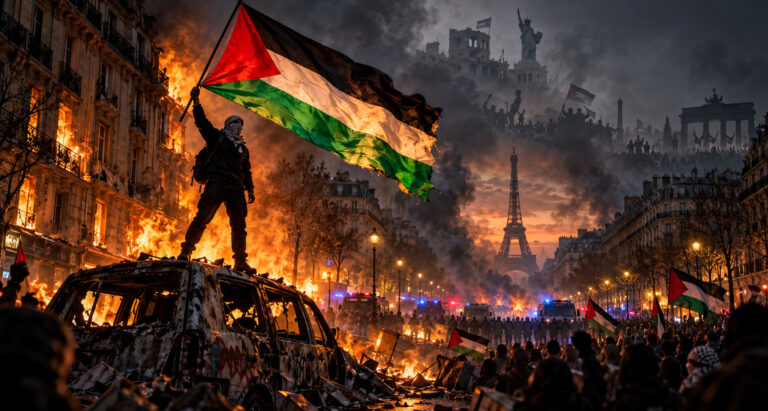
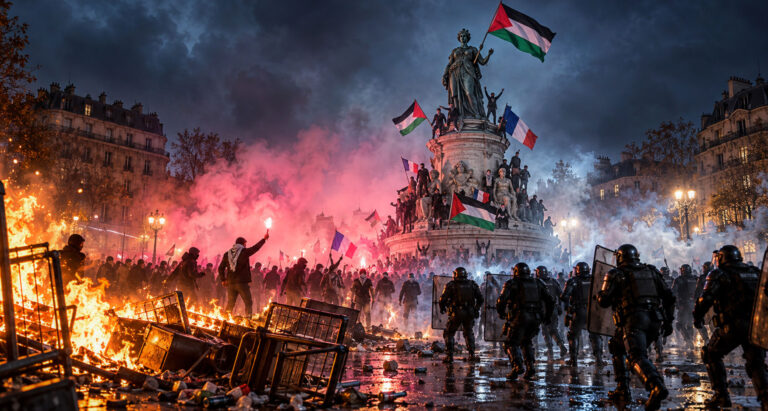
Watching the rioting and looting in Paris over the past few days, I find myself worrying about London again. The immediate causes are different, but the sight of another European capital struggling with violence on its streets brings back uncomfortable memories. I fear London could face scenes like these. That is my judgment, shaped by years of standing behind a camera in crowds that the authorities knew perfectly well were there.
The police were warned repeatedly. So were the security services and successive governments. Jewish communal organizations kept raising concerns, and the public record shows how long those concerns had been reaching officials. There were investigations and prosecutions, but there are still questions about the years in between. I remember being told to stop taking photographs because I was “antagonising them.” Looking at those photographs now, I wonder how much more people were expected to tolerate before their warnings carried sufficient weight.
Should London face the kind of scenes we are watching in Paris, I will have very little patience for anyone in authority who claims they could not have seen trouble coming.
Liked this article? Follow HonestReporting on Twitter, Facebook, Instagram and TikTok to see even more posts and videos debunking news bias and smears, as well as other content explaining what’s really going on in Israel and the region. Get updates direct to your phone. Join our WhatsApp and Telegram channels!
© Divuach Ne’eman R”A, 2025