Key Takeaways:
- Planning for development between Jerusalem and Ma’ale Adumim began in 1994, but international pressure froze construction.
- Major past peace proposals envisioned the E1 area remaining under Israeli sovereignty.
- International coverage that presents the E1 construction tender as “cutting the West Bank in half” omits the area’s planning history, land classifications, and transportation routes.
The E1 settlement plan has long made front-page news, with major international outlets repeatedly presenting it as Israel’s plan to divide the West Bank and, as a result, bury the two-state solution.
The plans for developing this area of land have been discussed for more than two decades. But over the past year, as the Israeli government moved toward approving and implementing construction in E1, international coverage has intensified, often portraying the project as a deliberate Israeli effort to prevent the creation of a Palestinian state.
The reality is more complicated.
What is E1?
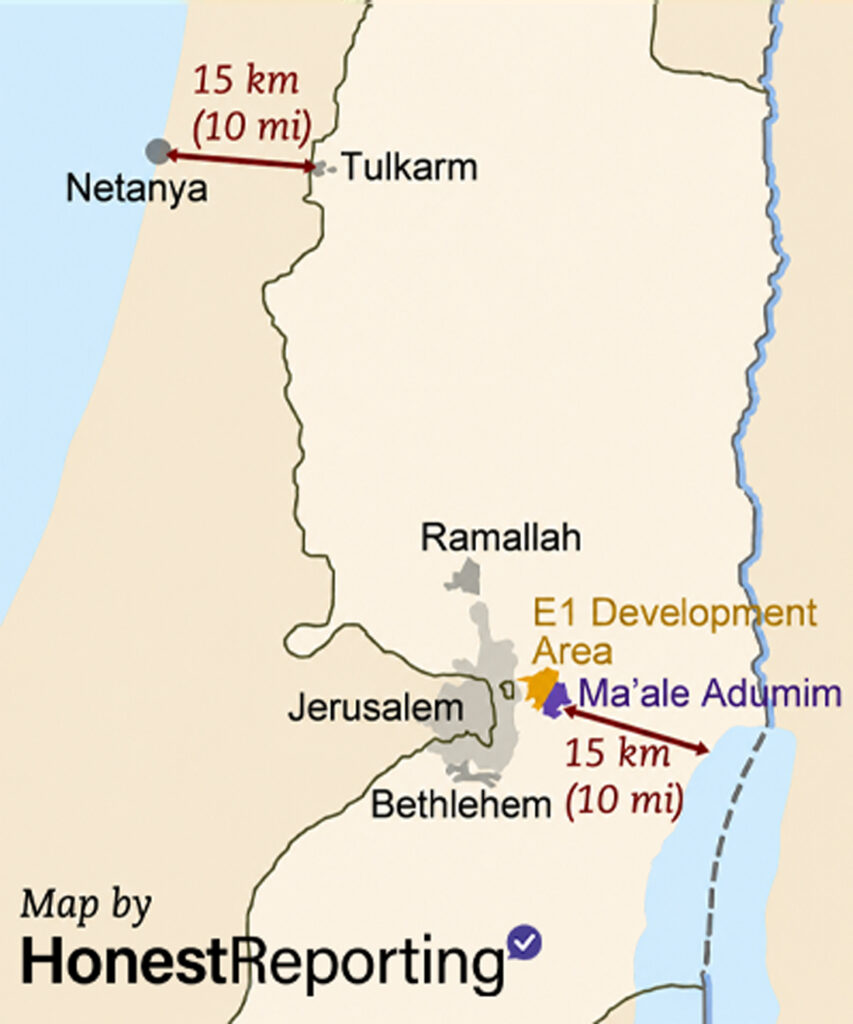
The Higher Planning Council of Judea and Samaria’s Subcommittee for Settlement first outlined the plan to expand Ma’aleh Adumim in 1994 under Prime Minister Yitzhak Rabin. Israel’s Ministry of Housing then adopted the name E1 to describe a 12-square-kilometer area of land outside Jerusalem’s municipal boundaries, on the hills between Ma’aleh Adumim and Jerusalem. Located within the municipal borders of Ma’aleh Adumim, the land effectively links the city together with Jerusalem.
From an Israeli security perspective, maintaining access and territorial depth east of Jerusalem has been essential to prevent the capital from potentially becoming encircled or isolated, as it was in 1948. After 1967, when Jerusalem was reunified, Israel developed a series of communities and infrastructure corridors around the capital. Ma’ale Adumim became one of the largest of these communities, eventually developing into a city of tens of thousands of residents. As the capital continues to grow, expansion in its periphery is limited by other surrounding cities such as Ramallah and Bethlehem, as well as by terrain and vegetation.
While some Israeli prime ministers did not accelerate the development of the land in E1, the planning designations have remained legally intact since they were first brought to the table by Prime Minister Rabin in 1994.
Now, after years of frozen plans, Israel’s Housing Ministry issued a notice inviting bids for the construction of over 1,200 housing units in E1. The tender, published on August 18, 2026, covers 1,234 of the total 3,401 housing units first approved for the area in August 2025, with bidding scheduled to close on October 19, just days before the Israeli elections.
Since talks first began of developing E1, successive Israeli governments refrained from implementing the construction, often due to international reservations. The tender effectively marks the first active steps in moving E1 from a proposal into facts on the ground.
Why the Controversy?
Because E1 is located within Area C of the Oslo Accords, the area remains under Israeli authority, leaving permanent-status issues reserved for future negotiations. Until today, those future negotiations have not taken place. Nonetheless, peace proposals since Oslo, including the Clinton parameters in 2000 and Donald Trump’s Deal of the Century, have almost always envisioned E1 remaining under Israeli sovereignty.
While the history of peace negotiations does not indicate that the presence of Israeli communities in certain areas of the West Bank automatically prevents a Palestinian state, much of the international community has effectively treated the political future and impact of E1 as set in stone. Conveniently, the context of E1’s status in peace deals is almost always missing from the media’s coverage.
For this reason, critics have been quick to label the planned construction as cutting the West Bank in half, as E1 is ostensibly the only remaining corridor between large Palestinian cities in the West Bank. Today, Highway 1, the main road connecting Jerusalem with the Jordan Valley, passes through the E1 area in the West Bank. Other bypass routes are being built to advance movement between the north and south West Bank, ultimately undercutting the claim that movement within the West Bank would be split in half.
The E1 planning area is not simply on privately owned Palestinian land that Israel has decided to take over for construction. The area contains different land classifications and ownership claims. Most of the land is designated by Israel as state land, meaning it can be allocated for the establishment of a new community.
These facts aside, the controversy surrounding E1 has led the British Labour Party to “consider” sanctioning Israel by banning imports, exports, and services connected with Israeli communities in the West Bank and eastern Jerusalem. More than 20 other countries, alongside the European Commission, released a joint statement condemning the Israeli government’s publishing of the construction tenders in E1.
Both the UK and the signatory countries on the joint statement used E1 as an example of Israel destroying any foreseeable solution with the Palestinians. This conclusion, however, can only be arrived at by overlooking the years of Israeli efforts for peace, Palestinian rejections of any peace offers, and the role of the E1 area in both efforts.
In effect, Israeli zoning decisions are made into international controversies, turning national government decisions that have been put off for over two decades into an issue that the international community frames as geopolitically insidious.
Despite the noise surrounding E1, one fact is clear: construction there does not, by itself, determine the outcome of any future peace agreement. Yet international coverage has repeatedly presented an imagined political conclusion as the current reality. But when the truth gets replaced with anti-Israel politics, the result is a disproportionate amount of headlines for housing units that otherwise wouldn’t be newsworthy.
Liked this article? Follow HonestReporting on Twitter, Facebook, Instagram and TikTok to see even more posts and videos debunking news bias and smears, as well as other content explaining what’s really going on in Israel and the region. Get updates direct to your phone. Join our WhatsApp and Telegram channels!
© Divuach Ne’eman R”A, 2025