Key Takeaways:
-
The Middle East is not a unified bloc: Shared fears of Iran have quietly aligned Israel and several Gulf states, even as political sensitivities keep that cooperation partly out of view.
-
Iran’s war has pulled the Gulf in: Years of cautious diplomacy with Tehran collapsed once Iranian missiles began striking Gulf states themselves.
-
The United States remains the region’s security backbone: Despite outreach to China and Russia, Gulf monarchies still depend on American military power when real threats emerge.
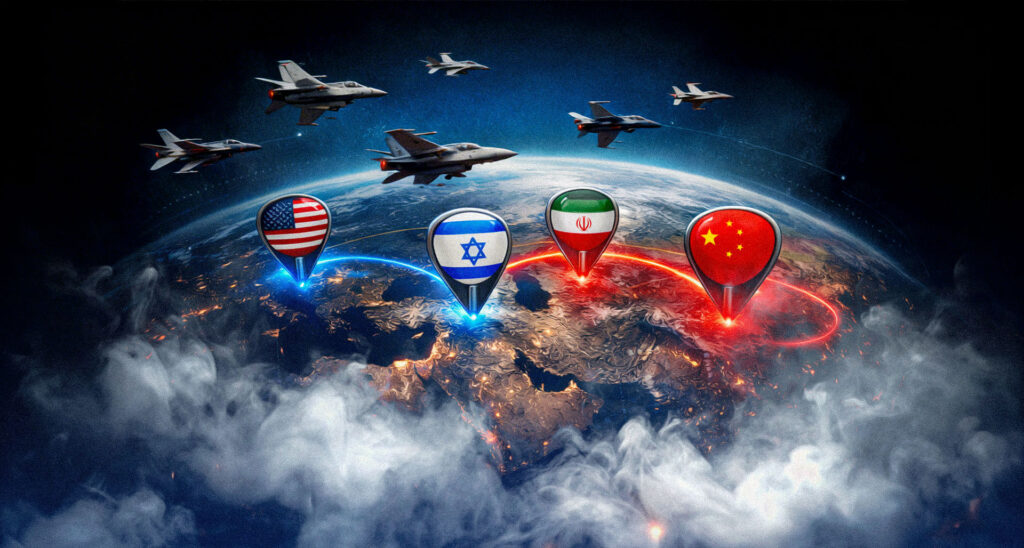
As the Iranian regime attempts to widen the 2026 war by launching attacks beyond Israel, including strikes on the United Arab Emirates and other Gulf states, many observers abroad are asking a basic question: where exactly does the rest of the Middle East stand?
For people outside the region, the Middle East is often imagined as a single political bloc in which Israel stands alone against a unified Arab world.
But the reality is far more complicated.
The region is a web of rivalries, temporary partnerships, and uneasy coexistence, shaped by ideology, religion, economics, and competing security concerns.
The Abraham Accords, brokered during U.S. President Donald Trump’s first administration, helped shatter some of the old assumptions that Arab states would never openly cooperate with Israel. The agreements normalized relations between Israel and several Arab countries, including the United Arab Emirates and Bahrain, demonstrating that strategic interests could outweigh decades of hostility.
But normalization did not eliminate tensions, nor did it create a unified regional alliance.
To understand the current war, and the reactions of different countries, it helps to look more closely at how the region’s relationships actually work.
Here is a guide to who aligns with whom, who tolerates whom, and who remains locked in open rivalry.
Israel and the Gulf States: Quiet Cooperation, Public Distance
The relationship between Israel and the Arab Gulf monarchies has changed dramatically over the past decade.
For decades, most Arab governments officially rejected diplomatic relations with Israel. That began to shift as Gulf leaders increasingly viewed the Iranian regime – not Israel – as their most dangerous regional rival.
Tehran’s support for militant networks across the region set alarm bells ringing across the Gulf monarchies, particularly in Saudi Arabia, the UAE and Bahrain. The Iranian regime backs Hezbollah in Lebanon, the Houthis in Yemen, and various Iraqi militias – all Shia groups that share Iran’s religious worldview. But Iran also funds and arms Hamas, a Sunni Islamist organization. The sectarian difference didn’t matter: what united them was a shared enemy in Israel.
For Gulf leaders, that willingness to bankroll anyone capable of advancing Iranian regional ambitions was deeply alarming. Combined with Tehran’s advancing nuclear program, it forced an uncomfortable rethink: perhaps Israel was not the most immediate threat in the neighborhood after all. Even before the Abraham Accords formally normalized relations between Israel and the UAE and Bahrain in 2020, there was quiet, unpublicized cooperation between Israeli and Gulf officials. Since then, that cooperation has expanded significantly, covering technology, trade, and security.
But the Gulf states are not a monolithic bloc, and how far each is willing to go depends on a delicate domestic calculation: the Palestinian issue still resonates powerfully with the Arab population, and Gulf leaders have had to weigh strategic interests against political sensitivities at home. The UAE and Bahrain moved furthest, maintaining full diplomatic ties and open cooperation with Israel across multiple sectors. Saudi Arabia quietly expanded security and intelligence coordination without formally normalizing.
Qatar, meanwhile, has long pursued a far more controversial balancing act. While hosting the largest American military base in the region and maintaining discreet communication channels with Israel, Doha has simultaneously served as Hamas’s primary diplomatic patron, providing financial lifelines and political sanctuary to its leadership. This dual-track foreign policy – simultaneously embedded in Western security structures while empowering terrorist groups committed to Israel’s destruction – has made Qatar one of the most diplomatically agile and politically contentious actors in the region.
Oman has continued to position itself as a discreet intermediary, while Kuwait, which has faced stronger domestic opposition to normalization, remains the most resistant to formal ties with Israel.
The Gulf States and Iran: Old Rivals, Attempted Peace
For most of the past decade, Saudi Arabia and Iran fought a slow-burning regional contest, backing opposing sides in Yemen, Lebanon, Iraq, and Syria. Iran built up a formidable network of allied militias and terror proxy groups that Gulf leaders viewed as a direct threat to their own stability.
Yet rather than confronting the Iranian regime head-on, several Gulf states chose cautious engagement. The logic was largely economic. Countries like Saudi Arabia and the UAE are pursuing massive domestic transformation agendas such as Vision 2030, economic diversification, and tourism mega-projects, none of which would survive a major regional war intact. Stability was not just a preference, but a business requirement.
The Saudi-Iran diplomatic thaw brokered by China in 2023, the UAE’s pragmatic channels with Tehran, and Oman’s steady back-channel diplomacy all reflected the same underlying calculation: that dialogue, however uncomfortable, was preferable to confrontation. Qatar maintained its own ties with Tehran partly because the two countries share one of the world’s largest natural gas fields. None of these states trusted the Iranian regime, but most of them preferred an uneasy equilibrium to open conflict.
That calculation is now in ruins. The joint US-Israeli strikes last year significantly degraded Iran’s defenses and nuclear program, while Iran’s response to the decapitation strikes, which killed Ayatollah Ali Khamenei within the first hours of the war, has been brutal and, more importantly, not directed only at Israel. Iran has fired more ballistic missiles and drones at its Gulf neighbors than at Israel itself, striking US military assets, energy infrastructure, and civilian areas across Bahrain, Kuwait, Qatar, Saudi Arabia, Oman, and the UAE.
View this post on Instagram
When those missiles hit Gulf capitals, they shattered more than buildings. They punctured the carefully maintained image of the Gulf as a stable, conflict-insulated region open for business.
Gulf states had told Washington clearly that their airspace and bases were not available for strikes on Iran. That did not stop Iran from targeting them anyway. The UAE has since closed its embassy in Tehran and recalled its ambassador. For now, the era of Gulf mediation between Washington and Tehran is over.
Yet Gulf leaders remain wary of the opposite as well. While they view Iran’s revolutionary regime as a destabilizing force, few Gulf capitals actually want to see the Iranian state collapse entirely. A weakened Iran – unable to project power through militias, missile networks, and proxy wars – is desirable. A fractured Iran, potentially unleashing internal chaos along the Gulf’s doorstep, is not. For many of these governments, the ideal outcome has always been containment rather than annihilation.
The Gulf States and Syria: From Civil War to Reconstruction
The fall of Bashar al-Assad’s regime in December 2024 reshuffled another key relationship. When Syria’s civil war began in 2011, several Gulf states backed groups fighting Assad. Saudi Arabia and Qatar, in particular, hoped to weaken Iran by toppling one of its closest Arab allies. As the war dragged on and extremist factions gained strength, Gulf governments pulled back, and some had even quietly reopened diplomatic channels with Damascus before the regime finally collapsed.
View this post on Instagram
When Assad fled, Gulf leaders wasted little time engaging Syria’s new leadership under transitional president Ahmed al-Sharaa, better known as Abu Mohammad al-Jolani. Saudi Arabia and Qatar have emerged as the principal external players, pledging reconstruction funds tied to governance benchmarks and rule-of-law reforms, conditions designed as much to protect future investments as to encourage good governance.
The money is already moving. Saudi Arabia confirmed a $2 billion investment in Syria’s energy, aviation, real estate, and telecommunications sectors in early 2026. A three-way deal between US energy giant Chevron, Qatar’s Power International Holding, and the Syrian government was also reached to develop Syria’s first offshore oil and gas field.
For Gulf leaders, rebuilding Syria is not simply about reconstruction. It is about reshaping the Levant’s geopolitical landscape after more than a decade of Iranian entrenchment. A Syria economically tied to Gulf investment and politically aligned with Arab partners would dramatically reduce Tehran’s ability to rebuild its proxy infrastructure along Israel’s northern frontier.
The Gulf States and the United States: Security Above All, For Now
Despite all the hedging, the China outreach, and the OPEC+ diplomacy with Moscow, one reality keeps reasserting itself: when things get serious, the Gulf monarchies need the United States.
American defense systems, including Patriot missile batteries, naval assets, air power, and US military bases across the region, remain the backbone of Gulf security. The current conflict has made that dependence even more visible. Iranian strikes have underlined just how limited Gulf military capabilities remain when facing a sustained regional threat without American backing.
That said, the relationship carries real tension. When Israel struck Hamas leaders in Doha in September 2025 and Washington stood by, it did not go unnoticed in Gulf capitals. Gulf governments had hoped to shape the scope and geography of any confrontation with Iran and its proxy network, to influence where the lines were drawn. Instead, they have found themselves on the receiving end of it. They had hoped for a short, contained conflict that weakened Iran’s most hardline leadership without collapsing the state. That is not what they got.
China remains the region’s largest energy customer, and Russia is deeply embedded in global oil markets through OPEC+. Both are attempting to expand their presence as the conflict deepens. But when missiles are incoming, there is only one phone number that matters, and it is still Washington’s.
The Bottom Line: A Region of Shifting Alignments
The geopolitical ripple effects of the conflict extend well beyond the Middle East itself.
Pakistan, which maintains deep military ties with Saudi Arabia and an informal mutual defense understanding with Riyadh, has been watching developments closely. Any direct Iranian confrontation with Gulf states could place Islamabad in the difficult position of balancing its strategic relationship with Saudi Arabia against its complicated border relationship with Iran.
Further north, Azerbaijan occupies another delicate position. The secular energy-rich state shares a border with Iran, maintains close security ties with Israel, and has long faced Iranian accusations of allowing Israeli intelligence activity near Iranian territory. As tensions escalate, Baku finds itself carefully balancing between powerful neighbors while quietly strengthening security cooperation with Israel and Western partners.
The Middle East cannot be mapped with fixed alliances and permanent blocs, and the current war is making that plainer than ever.
Israel now shares strategic interests with Arab states that not long ago refused to acknowledge its existence.
Gulf monarchies see Iran as a destabilizing regional force, but their preferred outcome remains carefully calibrated: a weakened and contained Iran, not a shattered state.
The United States remains the indispensable security partner, even as Gulf leaders quietly diversify their bets. Countries that spent years carefully insulating themselves from regional conflict have found missiles landing on their airports and oil terminals regardless.
What is taking shape, painfully and at real cost, is a new regional order in which the old labels of ally and adversary no longer quite fit. The chessboard is moving fast, and the pieces are no longer where they used to be.
One lesson, however, is already clear. In the Middle East, neutrality is rarely an option for long.
Liked this article? Follow HonestReporting on Twitter, Facebook, Instagram and TikTok to see even more posts and videos debunking news bias and smears, as well as other content explaining what’s really going on in Israel and the region. Get updates direct to your phone. Join our WhatsApp and Telegram channels!
© Divuach Ne’eman R”A, 2025