Key Takeaways:
- Trita Parsi, founder and former president of the National Iranian American Council (NIAC), published an analysis in Foreign Policy, arguing that Israel and the U.S. are the reason for regional instability.
- Parsi has a track record of unofficially advocating for policies on behalf of the Iranian regime. This analysis effectively reverses cause and effect, absolving the Iranian regime of any wrongdoing.
- By providing Trita Parsi with a platform to publish such an article, Foreign Policy lends credibility to Iranian regime talking points under the guise of expert analysis.
The founder of the Iranian regime’s de facto lobby in the U.S. is perhaps not the expert one should turn to for a nuanced, balanced read on an ever-shifting Middle East.
Yet that is precisely who Foreign Policy chose to elevate.
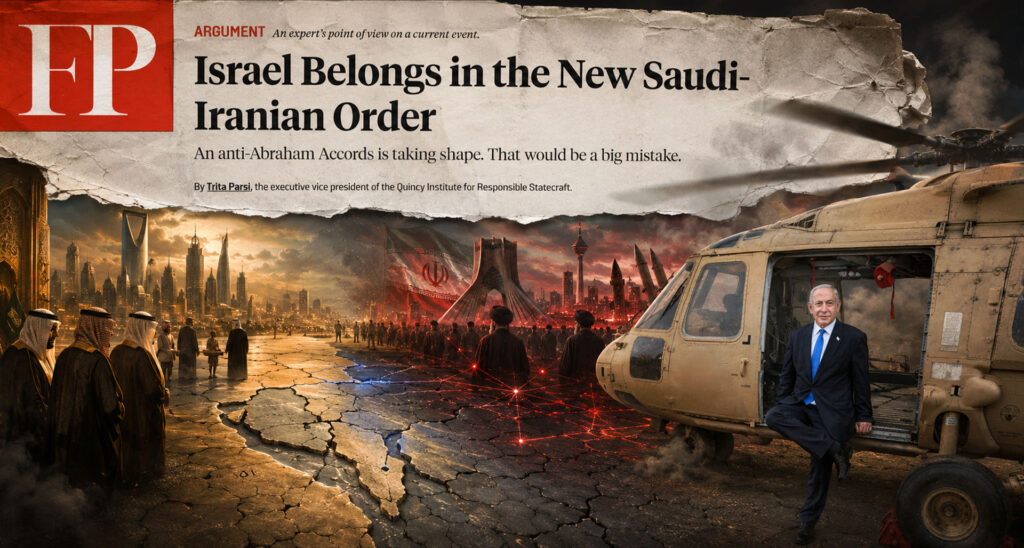
In “Israel Belongs in the New Saudi-Iranian Order,” the founder and former president of the National Iranian American Council (NIAC), Trita Parsi, argues that Israeli and American “unprovoked wars” against Iran have destabilized the Middle East more than the regime’s own conduct ever did, producing what he calls an “anti-Abraham Accords.”
A Lobbyist Posing as an Analyst
Parsi’s analysis is less surprising when viewed in light of his record of pro-Iranian-regime advocacy, and NIAC itself has long faced accusations of acting as a lobby for the Iranian regime. During the 2015 nuclear deal, NIAC advocated for lifting sanctions on the premise that engagement would moderate the regime’s foreign policy. Instead, Iran’s ballistic missile program and its support for regional proxies only expanded in the years that followed.
At the same time, NIAC also claimed that the regime’s anti-Israel messaging didn’t reflect the true policy of Iran – but October 7 and the missile barrages that followed left little ambiguity about the regime’s actual intent.
In 2012, a federal judge dismissed NIAC’s own defamation suit against a critic who’d made that claim, ruling the group’s conduct was not inconsistent with being “first and foremost an advocate for the regime.” With such a history of pro-regime messaging, including throughout the recent war, the U.S. opened a probe into Parsi.
The War the Iranian Regime Started
Throughout the wars Parsi dismisses as “unprovoked,” it was some of the Abraham Accords countries who found themselves in the Iranian regime’s crosshairs. In fact, the Iranian Regime’s regional aggression disproportionately impacted the UAE in comparison to other Gulf states. Other countries in the region repeatedly condemned the Iranian regime’s attacks, and Jordan had even taken part in shooting down Iranian drones heading toward Israel.
This did not prevent Parsi from amplifying Qatari Prime Minister Sheikh Mohammed bin Abdulrahman al-Thani, who sought to create a “regional security framework between [Qatar] and Iran.”
What Parsi ignored entirely was that until recently, Qatar has provided a place of refuge for Hamas leaders, who, on October 7, publicly celebrated the massacre while in Doha.
Parsi celebrates Qatar’s outreach to Tehran, but ignores an inconvenient truth: several Arab states have actively coordinated with Israel to strengthen air defenses against Iran. Israel even deployed an Iron Dome battery to the UAE during the war. This is not the behavior of a Middle East working to isolate Israel, but one working with shared interests.
Still, he continues with undermining the U.S.’ role in Middle East security:
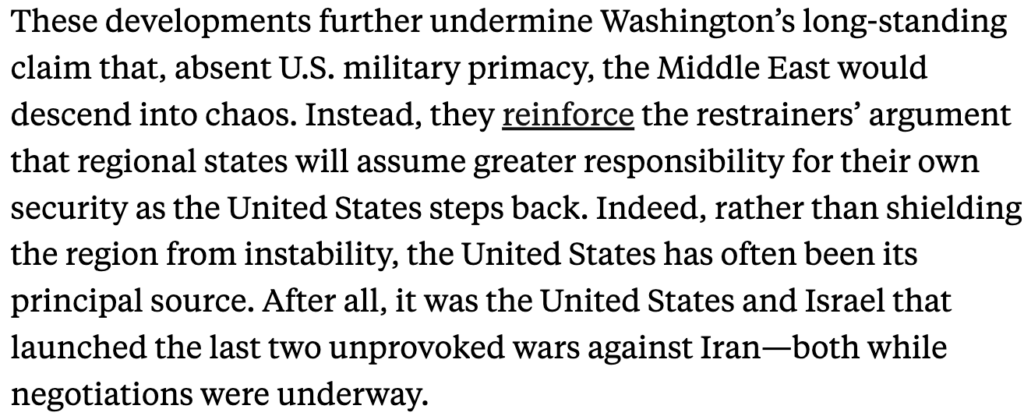
These developments prove the opposite of Parsi’s claim – regional states have deepened cooperation with the U.S. and Israel, and much of the war’s military successes came because of American involvement, not despite it.
Reversing Cause and Effect
Having failed to establish any legitimate reason that the U.S. is the principal obstacle to regional stability, Parsi then pivots to his next target: Israel.
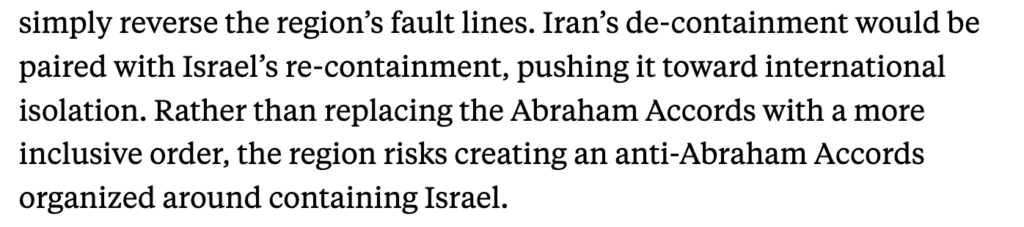
Since the Iranian revolution, the Iranian regime has worked tirelessly to destabilize the region, providing hundreds of millions of dollars every year to its proxy network. When Iranian dissidents took to the streets earlier this year, the regime answered with the same brutal crackdowns it has relied on since 1979.
For Parsi, it was easier to ignore this ugly truth than confront the country that needs containment, giving way to his next claim that Israel has “undoubtedly earned isolation.”
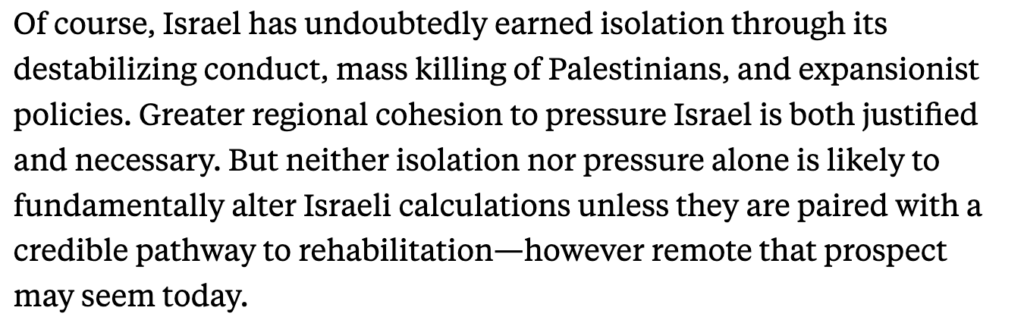
While some governments globally have distanced themselves from Israel, regional partnerships have increasingly treated Israel as a vital security partner, rather than an isolated pariah state. Parsi’s indictment of Israel’s “destabilizing conduct” never mentions what preceded it, ultimately reversing cause and effect. The regional and international pressure thus shouldn’t be on Israel, but on the regime that has spent decades laying the groundwork for a war that would destabilize the region.
Parsi’s argument concludes on the fallacy that the Iranian regime would accept Israel’s integration into the region if only the Palestinian issue were resolved. Yet this assumption is contradicted by decades of the Iranian regime’s aggression, which is driven by its clearly defined opposition to the existence of Israel.
Even as Arab states have moved towards normalization with Israel in recent years, the Iranian regime has only intensified its efforts to arm and fund proxies, expand its missile and drone production, and overall influence international perception of Israel. October 7 and the multi-front war that followed was only further evidence of a regime committed to Israel’s destruction above all else. The regime’s issue lies with the presence of a Jewish state, rather than the absence of a Palestinian one.
Foreign Policy handed its platform to a man whose own organization was found to be acting as an advocate for the Iranian regime, so he could argue that the region’s real problem is Israel and the U.S. rather than the regime funding terror across multiple fronts.
As much of the Middle East moves toward Israel, Parsi continues to frame the region through the lens of the Iranian regime. The result is not an honest analysis of the Middle East as it exists today, but a narrative shaped by Tehran’s strategic interests.
Liked this article? Follow HonestReporting on Twitter, Facebook, Instagram and TikTok to see even more posts and videos debunking news bias and smears, as well as other content explaining what’s really going on in Israel and the region. Get updates direct to your phone. Join our WhatsApp and Telegram channels!
© Divuach Ne’eman R”A, 2025