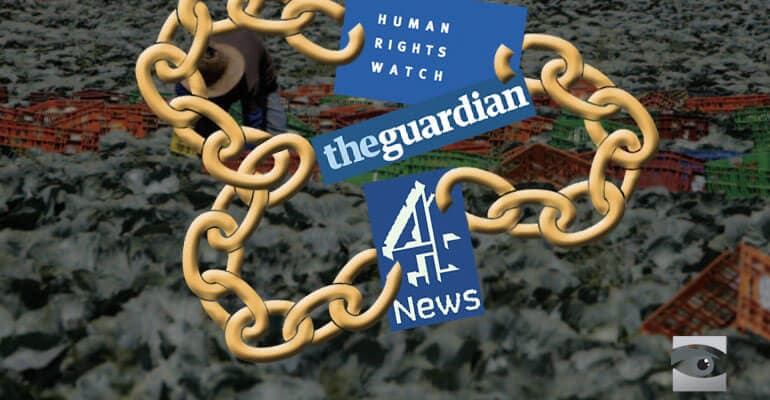
Only hours after Israelis were coming to terms with a Palestinian stabbing rampage on a Tel Aviv bus, Human Rights Watch chose to release a report accusing Israel of abusing the human rights of Thai laborers in the country. That this story was picked up by The Guardian and Channel 4 News is a case study in anti-Israel bias.
Why should a report that claims that Thai farmers in Israel face low pay, hazardous working conditions and excessive working hours be of such interest to UK media outlets?
For one thing, it demonstrates the symbiotic relationship between the media and non-governmental organizations (NGOs) such as HRW.
The obsession with and outright hostility towards Israel by Human Rights Watch has been well-documented. NGO Monitor notes that HRW disproportionately focuses on condemnations of Israel and that publications related to Israel often lack credibility. This is also the organization that promoted its anti-Israel credentials to go fundraising in Saudi Arabia, hardly a bastion of human rights.
As NGO Monitor notes, the evidence shows that many journalists simply reprint NGO reports without question or verification. This is known as the “halo effect”, and violates journalistic ethics, which require skepticism and independent verification.
But when a “highly respected human rights watchdog” such as HRW makes a statement, journalists tend to ignore the bias and repeat this as fact. Media outlets such as The Guardian and Channel 4 News are happy to do this, particularly if it involves bashing Israel. This issue is not only limited to treatment of Israel.
But let’s assume that there is a case to answer for Israeli treatment of foreign workers. Nobody is denying that Israel needs to improve the lot of its Thai workers. There are also many other states in the world where similar problems exist, including within the Middle East. For example, Qatar’s own government has admitted that almost 1,000 workers from Nepal, India and Bangladesh died in 2012 and 2013. The Qatari case has made news as a result of the country’s hosting of the 2022 soccer World Cup and the construction being undertaken by migrant workers to prepare the required infrastructure. This was also the case in Brazil where its own hosting of the 2014 World Cup exposed the appalling conditions for migrant workers there. And what about China’s migrant factory workers?
But it’s not just in the Middle East, South America and Asia. Take this post from the UK’s Migrants Rights Network from as recently as November 2014:
People coming to the UK from overseas are too often at risk of being abused by employers, gangmasters and employment agencies, who may seek to take advantage of their skills, energy and willingness to work.
Exploitation of foreign workers commonly takes place in low-paid and often casual work, within a range of sectors including construction, social care, cleaning and hospitality. Workers in these sectors are often subject to zero hours contracts and poor treatment including underpayment of wages, hazardous working conditions and long hours. Some people, and in particular some migrant workers, experience criminal levels of exploitation including bonded labour and slave-like conditions at work.
That’s right; according to a British NGO, the UK also treats its foreign workers poorly. But it seems that for The Guardian and Channel 4 News, there is only one country in the world that UK audiences should be concerned about the welfare of Thai workers: Israel.
Is it proportionate that every fault within Israel (and there are faults to be sure) becomes the focus of and is magnified by NGOs and an unquestioning foreign media? This is just one more example of the excessive over-reporting of Israel and the continuing quest by some to attack the country even beyond the scope of the Arab-Israeli conflict.
[sc:bottomsignup ]© Divuach Ne’eman R”A, 2025