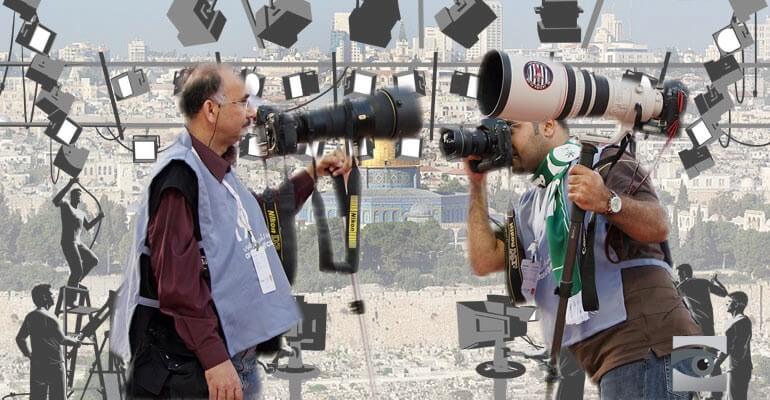
Former Associated Press Jerusalem bureau reporter and editor Matti Friedman created something of a sensation in August when he wrote an essay for Tablet magazine in which he explained how and why reporters get Israel so wrong, and why it matters.
Friedman is now back for more, this time in The Atlantic, giving another eye-opening insider’s look at what makes the media tick when it comes to reporting from Israel and the Palestinian territories.
A highly recommended read, Friedman’s essay covers issues such as how editors deliberately avoid publishing negative stories about the Palestinians, the unhealthy relationship between journalists and international organizations and how Hamas is able to manipulate a willing international press corps:
Most consumers of the Israel story don’t understand how the story is manufactured. But Hamas does. Since assuming power in Gaza in 2007, the Islamic Resistance Movement has come to understand that many reporters are committed to a narrative wherein Israelis are oppressors and Palestinians passive victims with reasonable goals, and are uninterested in contradictory information. Recognizing this, certain Hamas spokesmen have taken to confiding to Western journalists, including some I know personally, that the group is in fact a secretly pragmatic outfit with bellicose rhetoric, and journalists—eager to believe the confession, and sometimes unwilling to credit locals with the smarts necessary to deceive them—have taken it as a scoop instead of as spin.
During my time at the AP, we helped Hamas get this point across with a school of reporting that might be classified as “Surprising Signs of Moderation” (a direct precursor to the “Muslim Brotherhood Is Actually Liberal” school that enjoyed a brief vogue in Egypt). In one of my favorite stories, “More Tolerant Hamas” (December 11, 2011), reporters quoted a Hamas spokesman informing readers that the movement’s policy was that “we are not going to dictate anything to anyone,” and another Hamas leader saying the movement had “learned it needs to be more tolerant of others.” Around the same time, I was informed by the bureau’s senior editors that our Palestinian reporter in Gaza couldn’t possibly provide critical coverage of Hamas because doing so would put him in danger.
Read the full article here.
But don’t just take Matti Friedman’s word for it. Washington Post columnist Jackson Diehl weighs in on Twitter:
A dissection of the culture of “distaste for Israel” among Western press and NGO’s. All too true, in my experience http://t.co/kYhCOfmVjP
— Jackson Diehl (@JacksonDiehl) November 30, 2014
[sc:bottomsignup ]
Image: CC BY-NC flickr/Khaleel Haidar
© Divuach Ne’eman R”A, 2025