Key Takeaways:
- The London Review of Books consistently publishes essays that frame Israel as uniquely illegitimate, privileging activist narratives over balanced literary or historical analysis.
- Its editorial line amplifies voices that contextualize or justify Palestinian violence while omitting serious scholarship on Arab terrorism, Palestinian agency, and internal dynamics.
- Because the LRB shapes elite academic, media, and policy discourse, this imbalance narrows understanding of the conflict and turns a literary journal into a political echo chamber.
For decades, the London Review of Books cultivated a reputation as one of the world’s most serious literary journals: a place for long-form criticism, intellectual debate, and rigorous engagement with history and ideas that dictate international discourse. But when it comes to Israel, the LRB has increasingly ceased to function as a book review at all. Instead, it has become a political platform that consistently amplifies one side of a highly contested conflict while marginalizing, or ignoring, the other.
The pattern is not subtle. It is visible in whom the LRB chooses to publish, its editorial line, what kinds of pieces it prioritizes, and what it leaves out.
Before the Gaza ceasefire, the magazine published “Gaza under siege” — an essay by Tareq Baconi, a senior analyst at the International Crisis Group and a prominent voice in pro-Palestinian advocacy. Baconi’s essays consistently frame Israel as a colonial aggressor and cast Palestinian violence primarily as resistance. Readers are rarely offered competing analytical frameworks or scholars who challenge that narrative.
The issue is not that Baconi is published. It is that voices like his consistently reappear, while alternative perspectives are largely absent. That imbalance is reinforced by the magazine’s own editorial leadership. Adam Shatz, the U.S. editor of the London Review of Books, is another prominent example.
Shatz has used his platform to frame Israel in starkly delegitimizing terms. In his June 2024 LRB essay “Israel’s Descent,” Shatz wrote that Israel’s 2005 withdrawal from Gaza served “to enable Israel’s air force to bomb Gaza at will,” and described Israel’s treatment of Palestinians as involving “plunder, denial of the franchise, ghettoisation, ethnic cleansing and racist dehumanization.”
In a subsequent LRB essay published in July 2025, “The World Since 7 October,” Shatz wrote that Israel’s war with Iran was aimed at making itself “the master of the region,” and added that Israel “appears to be pursuing a long-range plan to weaken, if not to render defenceless, the other states in the region, so that none is in a position to challenge it.”
With such an editorial line, the London Review of Books no longer merely reviews books or publishes essays on the region, but actively advances a singular political narrative.
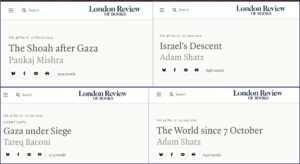
Last year, the magazine gave a platform to an article titled “The Shoah after Gaza,” by Indian author Pankaj Mishra. The writer asks questions like: “How can the Western political and journalistic mainstream ignore, even justify, its [Israel’s] clearly systematic cruelties and injustices?”
It also includes claims such as: “The liquidation of Gaza… is daily obfuscated, if not denied, by the instruments of the West’s military & cultural hegemony,” including “prestigious news outlets deploying the passive voice while relating the massacres carried out in Gaza.”
Another paragraph reads: “Why have Western politicians and journalists kept presenting tens of thousands of dead and maimed Palestinians as collateral damage, in a war of self-defence forced on the world’s most moral army, as the IDF claims to be?”
And there’s also, as the title suggests, an inevitable shoehorning of the Holocaust: “A strenuously willed affiliation with the Shoah has also marked and diminished much American journalism about Israel.”
While taking all of the above into account, readers of the magazine must consider what the LRB does not publish. In recent years, it has shown little interest in serious new scholarship on Arab rejectionism, Palestinian political violence, or the internal dynamics of Palestinian society. Notably absent is any substantive engagement with Oren Kessler’s Palestine 1936, a major historical work examining the Arab Revolt against British rule and Jewish immigration — a formative moment that shaped the conflict long before Israel’s founding.
Kessler’s book complicates the simplified morality play that often governs contemporary discourse. It highlights internal Palestinian divisions, violence against fellow Arabs, and strategic choices that had long-term consequences. That such a work has gone unreviewed in a publication that prides itself on historical depth is telling.
This imbalance matters because the LRB is not a fringe outlet. It is widely read by academics, writers, and policymakers. Mishra’s article, for example, was shared on social media by Reuters’ top editor Simon Robinson. The LRB’s long essays shape elite opinion.
When a publication with that influence consistently frames Israel as uniquely illegitimate while minimizing or omitting Palestinian agency, responsibility, and terrorism, it does more than express a viewpoint. It narrows the intellectual space in which the conflict can be understood.
A literary review is not obliged to be neutral. But it is obliged to be intellectually honest. When a journal consistently platforms one set of activists and narratives and ignores serious scholarship that complicates its preferred story, it crosses a line.
The result is not rigorous criticism of Israel. It is something far less literary: a political echo chamber wearing the prestige of book culture.
Liked this article? Follow HonestReporting on Twitter, Facebook, Instagram and TikTok to see even more posts and videos debunking news bias and smears, as well as other content explaining what’s really going on in Israel and the region. Get updates direct to your phone. Join our WhatsApp and Telegram channels!
© Divuach Ne’eman R”A, 2025