Key Takeaways:
-
The Muslim Brotherhood is a global Islamist movement founded in 1928 that promotes Islamic rule and opposes Western and Israeli influence.
-
It’s decentralized, so some national branches are more radical than others — but groups like Hamas grew directly out of it, and many countries classify parts of the Brotherhood as terrorist organizations.
-
Its influence spreads through charities, schools, activism, and business networks, funded by donations and support from states like Qatar and Turkey — prompting renewed calls for U.S. terror designations.
The Muslim Brotherhood has been in the news recently due to U.S. President Donald Trump’s order to begin proceedings to designate certain chapters as foreign terrorist organizations. This follows Texas Governor Greg Abbott’s designation of the entire organization and the Council on American-Islamic Relations (CAIR) as terrorist groups.
What is it about the world’s largest Islamist movement that has caused American leaders to take such a drastic step as designating it as a terrorist organization nearly 100 years after its founding? Why did Texas designate the entire movement, while President Trump’s order only pertains to certain chapters?
Why now, nearly 100 years after its founding? And why target specific branches instead of the whole movement?
To understand that, we need to look at the Brotherhood’s history, ideology, and global structure.
From Egypt to Across the Globe: The History of the Muslim Brotherhood
The Muslim Brotherhood was founded in 1928 by Egyptian teacher Hassan al-Banna.
The Sunni Muslim movement was founded as an alternative to reformist approaches to Islam and advocated against foreign influence in Muslim lands, the complete adoption of Islamic law in all parts of life, the establishment of states based on Islamic law, and ultimately the re-founding of an Islamic caliphate that would spread worldwide (the previous Ottoman caliphate had been disbanded in 1924).
Due to its populist ideology, the Muslim Brotherhood grew substantially throughout the 1930s, establishing affiliated mosques, schools, and welfare societies during this period.
During the 1940s, the movement began to expand outside of Egypt to other Arab and Muslim-majority countries. During the same time, the Brotherhood established an armed wing that was intent on attacking British officials in Egypt, Egyptian regime leaders, and the nascent Jewish state. The armed wing’s activities culminated in the assassination of the Egyptian prime minister in 1948. Likely in response, Hassan al-Banna was assassinated in 1949.
The movement went underground in 1952. In 1954, a member of the Brotherhood attempted to assassinate Gamal Abdel Nasser, one of the leaders of the new Egyptian regime, leading to a crackdown on the Muslim Brotherhood and the imprisonment of many of its leaders, including Sayyid Qutb, a radical ideologue who was executed by the Egyptian regime in 1966.
While in prison, he wrote a short book called “Milestones” (also sometimes referred to as “Signposts on the Road”) in which he called for active resistance against Arab and Muslim regimes, which he viewed as overly Westernized and divorced from Islamic ideals. Although his call for resistance was not inherently violent, many of his followers advocated violent resistance and terrorism, and “Milestones” became a key text for Islamist terrorists.
Since the 1960s, two factions have existed within the Muslim Brotherhood: The “moderate” faction and the Qutb-inspired “radical” faction. However, the term “moderate” is a bit of a misnomer as the faction still subscribes to fundamentalist views about Sharia law, supports the eventual conquering of the Western world by Islam, espouses antisemitic viewpoints, and condones terrorist attacks against Israel and foreign armies.
The Muslim Brotherhood has faced periods of growth and repression in Egypt since the 1960s. For example, in the 1990s, the organization entered Egyptian politics but also faced government repression due to an upsurge in Islamist attacks.
In 2012, following the Arab Spring, the Muslim Brotherhood attained the presidency of Egypt under Mohamed Morsi and his Brotherhood-affiliated Freedom and Justice Party. However, a military coup ousted Morsi in 2013 and the Brotherhood was designated as a terrorist organization by the Egyptian authorities in 2013.
The Muslim Brotherhood also has chapters in the United States and Europe. These chapters date back to the 1950s, when migration from North Africa and the Middle East combined with the arrival of several exiled leaders from Egypt to bring the Brotherhood’s theology to these non-Islamic shores, which the Brotherhood viewed as the “domain of preaching.”
The Muslim Brotherhood-inspired organizations in the United States and Europe are run under more innocuous names, such as “The Central Council of Muslims in Germany,” “The Union of Islamic Organizations of Italy,” and “The Council on American-Islamic Relations.”
The impact of the Muslim Brotherhood outside the Middle East has been so powerful that the United Kingdom currently hosts one of the largest populations in the world (the other being inside Turkey).
The Muslim Brotherhood’s political wings are outlawed or marginalized across much of the Arab world. But its media apparatus is a main pillar of its survival, “designed to amplify Islamist ideology, sustain its networks in exile, and project influence far beyond where its… pic.twitter.com/MZml4nVYWc
— The Free Press (@TheFP) November 18, 2025
Today, the Brotherhood exists as a loosely connected global network, not a single centralized body. This decentralized structure is why many governments target individual branches rather than the entire movement.
Lately, there have been calls for the Lebanese and Jordanian chapters to be designated as foreign terrorist organizations by the United States due to their specific history of engaging in violence.
What is the Muslim Brotherhood’s Core Ideology?
The core ideology shared by members of the Brotherhood (whether radical or moderate), as put forth by Hassan al-Banna in the early years of the movement, calls for:
- Full implementation of Islamic law in the lives of all Muslims at the personal and communal level.
- Assumption of power in traditionally Muslim lands and the overthrow of foreign-backed regimes.
- Replacing the old regime with one run according to the strictures of Islamic law.
- The coalescing of Sharia-run Muslim lands into one Islamic caliphate, which will then serve as the springboard for spreading Islam worldwide, replacing Western regimes and leading to the global dominance of Islam.
Where is the Muslim Brotherhood banned?
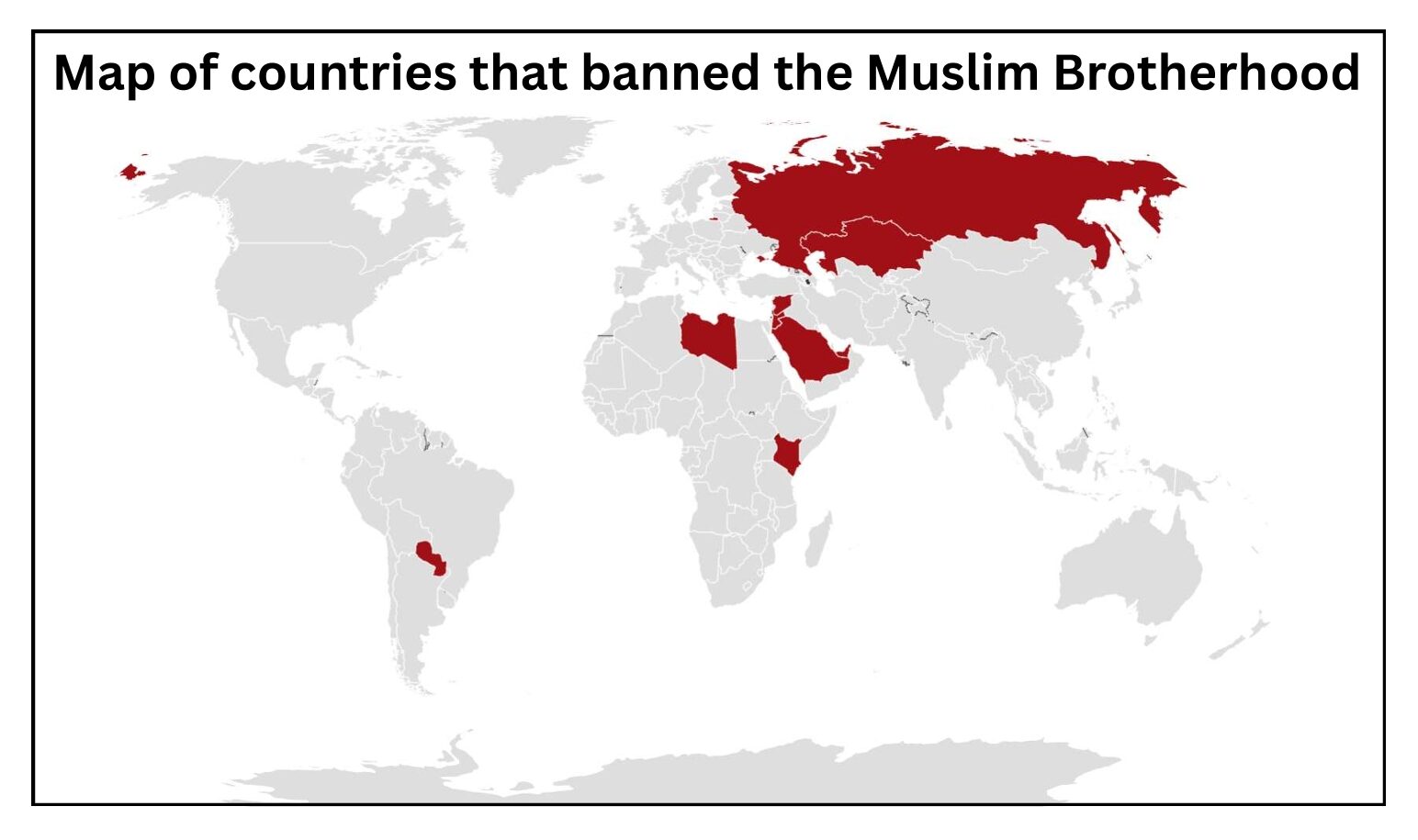
Due to the anti-establishment worldview of the Muslim Brotherhood and its inspiration of various Islamist terrorist groups that pose a threat to existing regimes, the Muslim Brotherhood has been banned and designated as a terrorist group in several countries, including:
- Syria (banned by the Assad regime in the 1980s).
- Russia (designated as a terrorist organization in 2003 due to its connection with Muslim separatists).
- Kazakhstan (designated as a terrorist organization in 2006).
- Egypt (designated as a terrorist organization in 2013).
- The United Arab Emirates (designated as a terrorist organization in 2014).
- Saudi Arabia (designated as a terrorist organization in 2014).
- Libya (designated as a terrorist organization by the Tobruk-based government in 2019; only relevant in areas where they have control).
- Comoros (designated as a terrorist organization in 2023).
- Paraguay (designated as a terrorist organization in 2023).
- Jordan (designated as a terrorist organization in 2025 following the discovery of a Brotherhood cell planning terrorist operations).
- Kenya (designated as a terrorist organization in 2025).
The Muslim Brotherhood v. the Jewish State
Even before the founding of Israel in 1948, the Muslim Brotherhood was opposed to the creation of a Jewish state in the Middle East.
This opposition arose from several sources: The view of Israel as a Western colonial implant in the Muslim Middle East, the theological argument that Palestine is part of the Islamic lands and non-Muslims are forbidden from ruling there, and the mixture of traditional Islamic antisemitism and modern European antisemitism that is intrinsic to the Muslim Brotherhood ideology.
The Muslim Brotherhood’s vehement opposition to a Jewish state has been expressed through the voluntary enlistment of Brotherhood members in the Egyptian military during the Israeli War of Independence, the withdrawal of the Brotherhood’s Jordanian chapter from the government after the signing of the Jordan-Israel peace treaty in 1994, and the terrorist actions of its Palestinian affiliate, Hamas.
Related Reading: The Hamas Charter: A Manifesto for Destroying Israel
The Muslim Brotherhood & Islamist Terror Organizations
In the 1970s, the Muslim Brotherhood renounced violence. To this day, the Muslim Brotherhood officially does not condone violent or terrorist acts, except those directed against Israel and foreign occupiers (such as Western military forces in Iraq and Afghanistan).
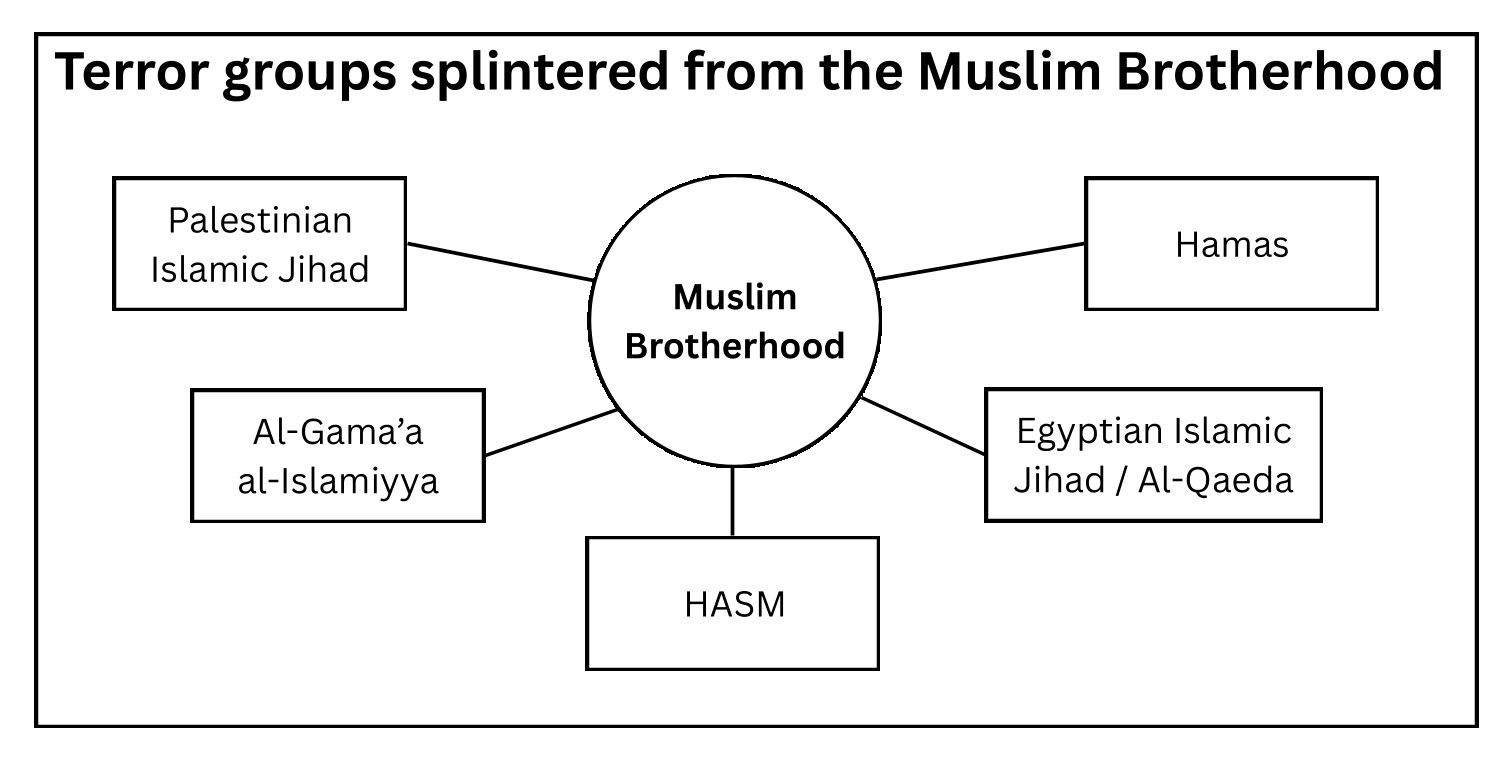
Nevertheless, the Brotherhood has inspired various Islamist terrorist organizations around the Muslim world, either through groups that have splintered off from the main movement or terrorist leaders that were educated in Brotherhood organizations.
Some of the terrorist organizations that have spread out from the Muslim Brotherhood movement include Hamas, Egyptian Islamic Jihad (a precursor to Al-Qaeda that was responsible for the assassination of Egyptian President Anwar Sadat), Al-Gama’a al-Islamiyya (involved in the 1993 bombing of the World Trade Center), HASM (the Arms of Egypt movement), and Palestinian Islamic Jihad.
Some of the Islamist terrorist leaders that had their origins in the Muslim Brotherhood movement include Hamas’ founder Ahmed Yassin, Abdullah Youssef Mustafa Azzam (Osama Bin Laden’s spiritual guide), and Ayman al-Zawahiri (former head of Al-Qaeda).
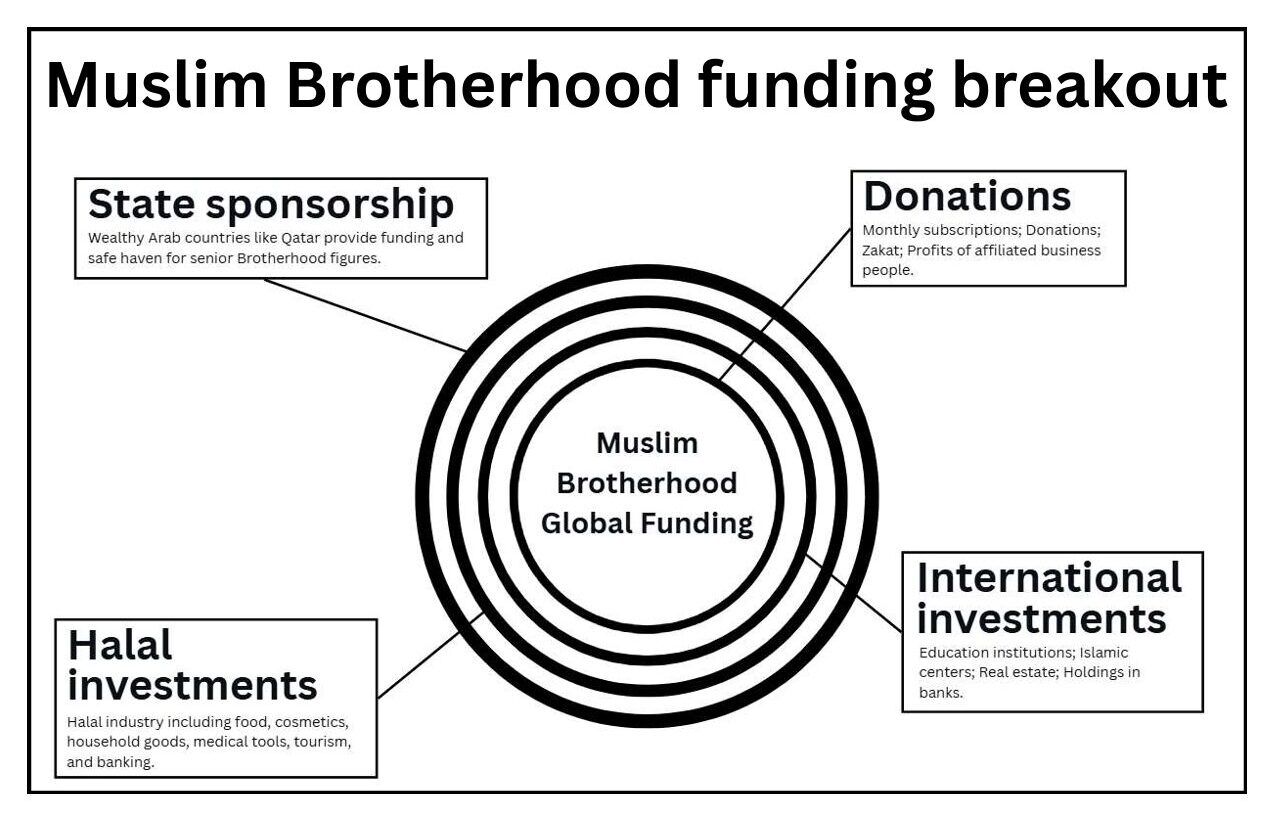
What are the Muslim Brotherhood’s Sources of Funding?
The Muslim Brotherhood has accrued vast global financial resources. Donations, subscriptions, and Zakat (the giving of alms required by Sharia law) from its members do not produce enough wealth for financial stability.
Muslim Brotherhood chapters also receive billions of dollars annually through investments in financial institutions and real estate, the establishment of schools, control over Islamic groups in Europe, Africa, and North America, authority over Halal food licensing, and the spread of other Halal trades (including tourism, banking, cosmetics, and medical tools).
According to one study, due to the use of front organizations and personal investments on behalf of the Muslim Brotherhood, it is unclear how much money goes into Muslim Brotherhood coffers every year.
Muslim Brotherhood chapters are also subsidized by sympathetic states, like Qatar and Turkey.
Written with the research assistance of Noy Etzion
Liked this article? Follow HonestReporting on Twitter, Facebook, Instagram and TikTok to see even more posts and videos debunking news bias and smears, as well as other content explaining what’s really going on in Israel and the region. Get updates direct to your phone. Join our WhatsApp and Telegram channels!
© Divuach Ne’eman R”A, 2025