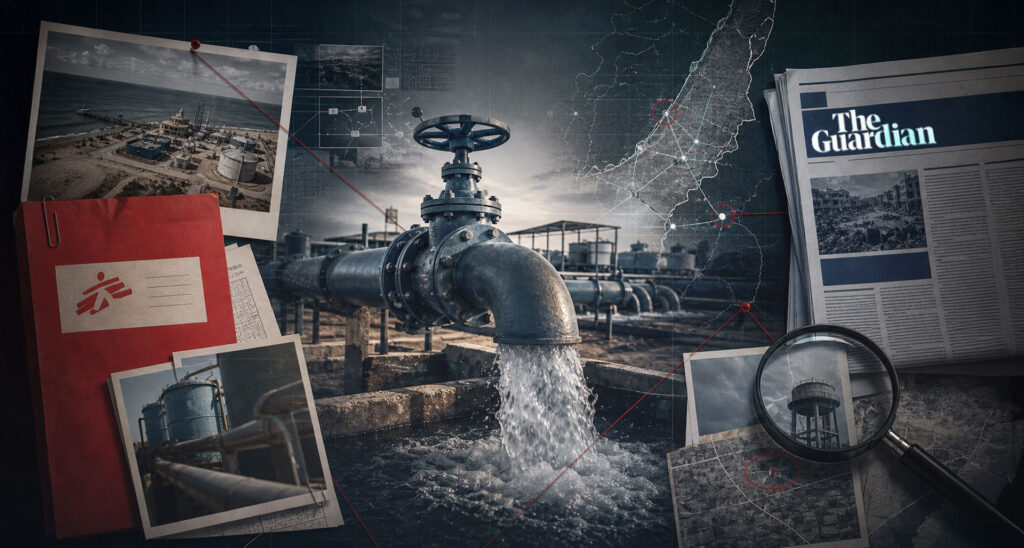
Key Takeaways:
- The “Water Libel” claim is an anti-Jewish accusation, built on selective omission, unverified allegations, and the deliberate erasure of Hamas’ central role in shaping conditions on the ground.
- The available evidence does not support the charge; it contradicts it, with Israeli coordination bodies detailing sustained water provision, infrastructure support, and humanitarian facilitation even in the midst of active conflict.
- This narrative is not new; it is a modern adaptation of an ancient libel, recasting Jews once again as a people who deny others the means of life, now projected onto the Jewish state.
A Libel Repackaged for the Present
1/4 We flatly reject the baseless claims by @MSF. Assertions that Israel uses water as a “weapon” are factually incorrect and ignore a simple truth: the only party weaponizing humanitarian aid is Hamas. It is disappointing, though not surprising, that an organization like MSF,… https://t.co/7SmtihQp63
— COGAT (@cogatonline) April 28, 2026
What the Evidence Actually Shows
COGAT also points to the activation of pipelines, coordination of repairs, provision of electricity to water infrastructure, and delivery of fuel required for pumping and desalination. It should go without saying that these are not the actions of a state attempting to engineer dehydration among civilians. They are the actions of a state attempting to sustain water access in the middle of an active war against Hamas, a group that embeds itself within civilian infrastructure and has repeatedly been accused of diverting and weaponizing aid.
This is the truth that has disappeared in much of the coverage. Hamas is either ignored or, if mentioned, is often treated as background noise, its role in shaping the conditions on the ground acknowledged only in passing, if at all. But that omission is not neutral. It is purposeful. It is what allows the narrative to function. Because if Hamas is placed at the center of the analysis, the situation becomes much clearer. Remove Hamas from the frame, and the story warps instantly. Israel becomes the sole malicious agent, Palestinian civilians become passive victims, and every instance of suffering can be traced back to a single source: the Jews.
HonestReporting has already highlighted this pattern in its analysis of coverage since the recent war began, noting how claims about Israel “weaponizing water” are presented without any context about Hamas’ role or Israel’s own documented efforts to maintain supply under wartime conditions. The result is not simply incomplete reporting, but a purposeful distortion that transforms a complex reality into a one-directional accusation.
While Israel works to ensure water supplies reach Gaza, @guardian pushes an anti-Israel narrative — even linking to an outdated UN update from May 2025.
Newsflash: things have changed.
For facts, not framing, see @cogatonline.? https://t.co/yjsxmXDADU pic.twitter.com/7qcDTbTI9b
— HonestReporting (@HonestReporting) April 28, 2026
NGO Monitor has also documented what it describes as systematic malpractice in Médecins Sans Frontières’s recent “genocide” campaign. It points to the use of unsupported claims, the erasure of Hamas’ role in shaping humanitarian conditions, and the amplification of unverified allegations presented as established fact. It argues that MSF’s framing is not simply advocacy, but part of a broader effort to construct a narrative of Israeli criminality that is detached from operational realities on the ground.
The historic roots of accusations of Jews and water must also be acknowledged. For centuries, Jews were accused of poisoning wells, of contaminating water, of spreading disease through the most basic sources of life. These accusations served a very specific function: to cast Jews as a threat not just to society, but to survival and humanity itself. To drink, to live, to sustain oneself became dangerous in the presence of Jews. The modern version is more refined, but the underlying logic is recognizable. The claim is no longer that Jews poison water, but that they control it and withhold it. The mechanism has changed. The meaning has not.
Evidence Ignored, Accusation Repeated
COGAT’s statement ends with a simple point: that despite the security environment and Hamas’ attempts to weaponize aid, Israel remains committed to ensuring that clean water reaches civilians. To believe otherwise, to ignore the evidence, is to ignore the background of the accusation being made against it. And they all follow a familiar pattern, one in which Jews are once again cast as uniquely cruel, uniquely inhuman, and uniquely outside humanity.
Liked this article? Follow HonestReporting on Twitter, Facebook, Instagram and TikTok to see even more posts and videos debunking news bias and smears, as well as other content explaining what’s really going on in Israel and the region. Get updates direct to your phone. Join our WhatsApp and Telegram channels!
© Divuach Ne’eman R”A, 2025