Key Takeaways:
- The General Jewish Labor Bund was a product of pre-state Eastern Europe, and its ideology reflected a stateless Jewish reality that no longer exists.
- While historically anti-Zionist, the Bund itself evolved after 1948 — acknowledging Israel’s significance and, in practice, accepting its existence.
- Modern attempts to revive Bundist ideas often overlook these historical shifts, drawing on a movement whose context, priorities, and trajectory differ markedly from today’s realities.
Why have Al Jazeera, Zeteo, The New York Times, and The Guardian recently revisited the Bund, a Jewish socialist movement founded in Eastern Europe over a century ago?
Much of this renewed attention follows the publication of Here Where We Live Is Our Country, a sympathetic survey of the movement by anti-Zionist artist and activist Molly Crabapple. The discussion has raised broader questions about the Bund’s history and its relevance in the modern era.
Origins and Ideology
The General Jewish Labor Bund (Union) was founded in 1897 in the Russian Empire, the same year as the First Zionist Congress.
A key component of the Russian Social Democratic movement, the Bund combined three central ideas: socialism (workers’ rights and equality), yiddishkeit (Yiddish language and secular Jewish culture), and Doikayt (“Hereness”) — the principle that Jews should pursue rights and security in the countries where they lived rather than through emigration to Palestine.
The Bund participated in both the 1905 and 1917 Russian revolutions. After the Bolshevik consolidation of power, it was dissolved by the Soviet Union in 1921, with many members persecuted. Its institutional center shifted to Poland.
Interwar Prominence and Wartime Collapse
In interwar Poland, the Bund became one of the largest Jewish political movements. It represented working-class Jews, organized trade unions, ran schools and cultural institutions, and published newspapers.
During the Second World War, the movement faced destruction. Initial efforts to build alliances with non-Jewish socialist groups proved largely unsuccessful. Bund members ultimately participated in broader Jewish resistance, including with Zionist and Communist groups in the Warsaw Ghetto Uprising.
The Holocaust devastated the Bund’s social base. After the war, it continued in diaspora communities, particularly in the United States and Australia, but never regained its earlier influence. Today, only a small organizational presence remains, notably in Melbourne.
Postwar Adaptation
Although the Bund opposed Zionism prior to 1948, its postwar positions evolved. At its 1955 world conference, it acknowledged the significance of Israel while maintaining a non-Zionist stance.
This shift was reflected in political activity: in 1959, a Bund-affiliated party ran in Israeli elections, albeit unsuccessfully.
In more recent years, remaining Bund organizations have expressed positions broadly aligned with elements of the Israeli peace camp — supporting Israel’s existence while remaining critical of aspects of its policies. In 2023, for example, the Melbourne Bund affirmed Israel’s right to self-defense following Hamas’ October 7 attacks, while also criticizing Israel’s military response.
Historical Context and Contemporary Comparisons
The Bund emerged in a specific historical context: a stateless Jewish population in Eastern Europe facing systemic discrimination and periodic violence. Its strategy — organizing locally for rights and cultural autonomy — reflected those conditions.
The establishment of the State of Israel in 1948 fundamentally altered that context. Today, Israel is home to the largest Jewish population in the world, and debates over Zionism take place in a different political and historical environment than that of prewar Europe.
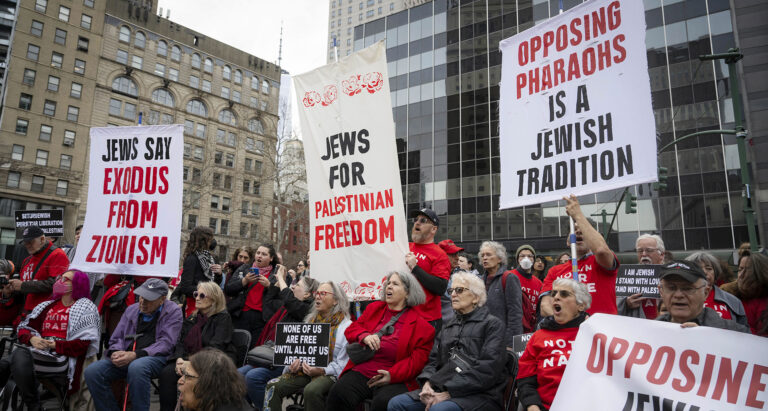
This shift hasn’t stopped ideological opponents of Zionism from drawing inspiration from the Bund for their own anti-Zionist activism, particularly in a post-October 7 reality.
The Crabapple book has generated reviews in this vein. The Guardian’s headline is “‘For leftist Jews, the Bund is a model’: the radical history behind one of Europe’s biggest socialist movements,” while The New York Times asks “What Does Judaism Look Like Without Zionism?”
Key Ideological Tensions
Several differences between the Bund’s historical framework and modern interpretations would suggest that the anti-Zionists’ attachment to the Bund of pre-Holocaust Europe is not fair or appropriate.
The Bund emerged in a fundamentally different historical context. In the early 20th century, Jews in Eastern Europe were a vulnerable minority without statehood, and the Bund’s strategy — securing rights through socialist solidarity — reflected those conditions. By contrast, the Zionist movement succeeded in forming a Jewish state while the Bund’s strategy failed. Its ideology was found to be most hollow in its greatest time of need, the Holocaust, when its belief in the alliance of other like-minded non-Jewish political parties proved false.
This shift alters the meaning of opposition to Zionism. Before 1948, it meant rejecting a political project; today, it entails opposition to an existing state and its continued existence.
As mentioned above, the Bund adjusted to the post-1948 reality in a way that demonstrates how these modern “neo-Bundists” have actually severed themselves from the original movement.
View this post on Instagram
A second way in which the contemporary anti-Zionist movement cannot transplant the Bund into the modern age is the contradiction within the concept of Doikayt (Hereness). For most of the world’s Jews, “Hereness” now means existing within Israel. How can an anti-Zionist movement condemn a Jewish presence in Israel while simultaneously advocating for an ideological concept that advocates for Jews around the world to fight for rights in their home countries?
As pointed out by Rokhl Kafrissen in a 2019 Haaretz piece, even if one were to claim that “Hereness” does not extend to Israel due to it being a “settler-colonial state,” the same argument could be applied to those neo-Bundists who live in states with their own tainted origin stories, such as the United States, Australia, and Canada.
This contradiction would lie at the core of any attempt to replicate the 20th-century Bund movement in the modern era.
Another contradiction that exists between the original Bund movement and its self-declared 21st-century ideological descendants is the fact that for the original Bund, its anti-Zionism was chiefly based in opposition to nationalism, no matter whose nationalism. Opposition to Jewish nationalism, Polish nationalism, Russian nationalism, etc.
The modern anti-Zionist movement is opposed to Jewish nationalism but simultaneously has (for the most part) picked up the mantle of Palestinian nationalism, advocating for the dismantling of the Jewish state and its replacement with a Palestinian one. Thus, while the modern movement and the traditional Bund may both be considered anti-Zionist, their opposition to Jewish nationalism appears to spring from different ideological sources that are in direct disagreement with each other.
The last problem with the attempt to transplant the Bund into the modern world is that the Bund was “Ashkenormative,” putting Yiddish and secular Ashkenazi culture front and center. This made sense for the time and place in which it existed, 20th-century Eastern Europe, where the vast majority of Jews spoke Yiddish. However, 100 years later, this focus on Yiddish and Ashkenazi culture by those seeking to resurrect the Bund marginalizes the vast majority of Jews today, who are either non-Ashkenazi or don’t speak Yiddish.
Not that the Jewish left of the early 20th century wasn’t important and even heroic, but this is simply not accurate. https://t.co/K4t4y3q3Px
— .portnoy. (@eddyportnoy) April 25, 2026
Conclusion
The Bund was a significant force in Jewish political and cultural life in Eastern Europe before the Second World War. Its institutions, ideology, and activism shaped generations of Jewish workers and intellectuals.
At the same time, the historical circumstances in which it developed — and the transformations of Jewish life since — mean that its legacy has been interpreted by those on the anti-Zionist margins of the Jewish community as an example of how Judaism can exist without a focus on the Land of Israel, no matter how irrelevant this ideology is to the vast majority of 21st-century Judaism.
Liked this article? Follow HonestReporting on Twitter, Facebook, Instagram and TikTok to see even more posts and videos debunking news bias and smears, as well as other content explaining what’s really going on in Israel and the region. Get updates direct to your phone. Join our WhatsApp and Telegram channels!
© Divuach Ne’eman R”A, 2025