Key Takeaways
-
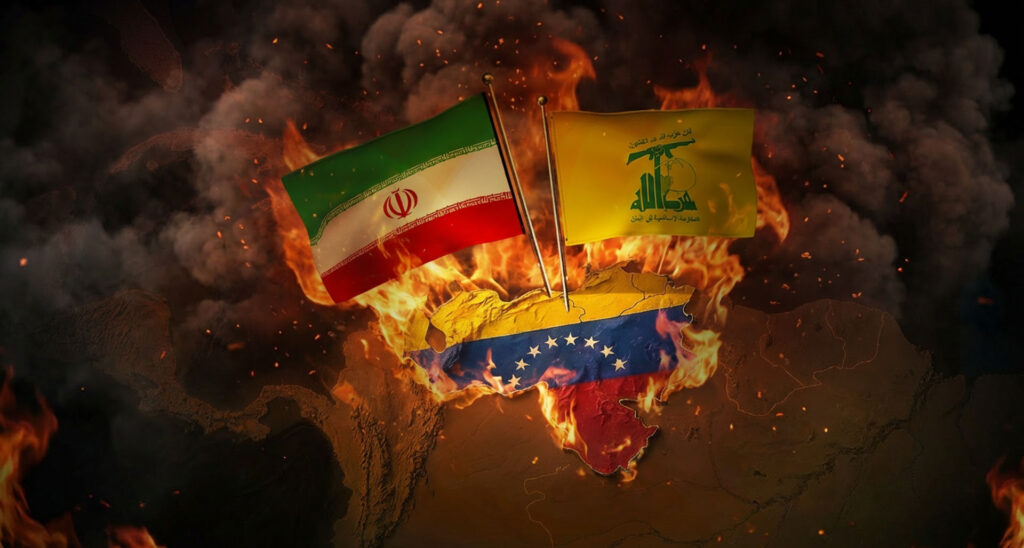
Iran built its presence in South America through state access, not secrecy. Embassies, energy deals, financial agreements, and diplomatic cover — especially in Venezuela — provided Iran with durable, protected entry into the region.
-
That access enabled Hezbollah to embed as a criminal-terror network. Using drug trafficking, money laundering, document fraud, and cartel-linked routes, Hezbollah operates across Latin America while funding terror activity abroad.
-
This network is proven, operational, and unresolved. Iran proved its willingness to carry out mass-casualty events in the 1990s, and the infrastructure still exists and still matters.
When people say Iran has “planted its flag” in South America, it’s often dismissed as rhetoric.
It isn’t.
What exists today was built deliberately, over decades, through formal state relationships, financial architecture, and protected logistics. Iran didn’t sneak into the Western Hemisphere. It walked in — invited by governments willing to provide cover, access, and protection.
At the center of that strategy sits Venezuela.
State Access, Not Infiltration
Venezuela did not drift toward Iran by accident. Political, diplomatic, and business elites actively facilitated Tehran’s entry, offering something Iran could not obtain elsewhere in the Americas: state protection.
Iranian access came through ministries, embassies, oil-for-gold swaps, banking mechanisms designed to evade sanctions, and opaque “commercial” flights between Tehran and Caracas with no transparent cargo or passenger manifests. These were not symbolic gestures. They were functional systems — designed to move money, people, and resources with minimal scrutiny.
This wasn’t ideology. It was infrastructure.
View this post on Instagram
Identity, Money, and Movement
Once embedded, that infrastructure expanded beyond diplomacy.
Hundreds of Venezuelan passports and citizenship documents were issued to foreign nationals tied to extremist networks, granting them legal mobility across Latin America and beyond. Iran didn’t need to smuggle operatives across borders when it could simply hand them documents.
At the same time, shell companies, oil trades, gold exchanges, and laundering routes linked Caracas, Beirut, and Tehran, allowing sanctioned funds to circulate freely. Travel agencies, import-export firms, and diplomatic postings provided logistical cover. What looked like commerce functioned as transit.
This is why Venezuela matters. It didn’t just cooperate with Iran — it shielded it.
Hezbollah’s Criminal-Terror Model
That state protection created space for Hezbollah to operate openly as a hybrid organization — part terror group, part transnational criminal enterprise.
Across Latin America, particularly in the Tri-Border Area of Argentina, Brazil, and Paraguay, Hezbollah-linked networks engage in cocaine trafficking, money laundering, counterfeit goods, weapons smuggling, and illegal gold mining. The proceeds don’t remain local. They flow back to Lebanon, then onward to Iran, funding terror activity abroad.
This is why U.S. and international agencies classify Hezbollah not just as a terrorist organization, but as a global criminal network.
Venezuela functions as the gateway — providing identity documents, air routes, and political insulation that eliminate the need for covert border crossings.
A Proven History of Violence
This network isn’t theoretical. It has already carried out mass-casualty attacks.
In 1994, a Hezbollah bombing destroyed the AMIA Jewish community center in Buenos Aires, killing 85 people and wounding more than 300 — the deadliest terrorist attack in Argentina’s history. Argentine prosecutors later concluded the attack was organized, planned, financed, and directed by the Iranian state, and executed by Hezbollah.
For decades, accountability stalled — not because evidence was lacking, but because political will was. That changed under President Javier Milei. In 2024, Argentina’s federal court formally ruled that the AMIA bombing was an act of Iranian state terrorism, reactivating Interpol red notices and pursuing accountability at the highest levels.
What matters is not only what happened in 1994, but what never disappeared afterward.
The same infrastructure that enabled that bombing adapted, embedded, and expanded.
View this post on Instagram
Convergence With Cartels — and the United States
U.S. law enforcement has repeatedly documented Hezbollah-linked networks moving money, drugs, and people through cartel-controlled routes in Latin America. Investigations like the DEA’s Project Cassandra exposed cocaine and laundering pipelines stretching from South America through Central America and into U.S. financial institutions.
In 2011, U.S. authorities uncovered a plot involving Hezbollah operatives working with Mexican cartel intermediaries, demonstrating how criminal logistics could be repurposed for terrorism.
The FBI has also arrested Hezbollah supporters inside the United States for surveillance, fundraising, logistics, and procurement — not attacks, but pre-attack preparation.
That’s how modern terror networks operate. They embed quietly. They wait.
Iran understands something fundamental: why threaten the United States directly when pressure can be built inside the hemisphere, using networks that already move across borders every day?
The Unavoidable Question
Iran’s presence in Latin America is not inferred — it’s documented. Sanctions, court rulings, intelligence assessments, and law enforcement cases all point to the same conclusion: Iran embedded itself inside a sovereign state and used that position to project power across the region.
Once that infrastructure exists, it doesn’t need to be rebuilt. Only activated.
Liked this article? Follow HonestReporting on Twitter, Facebook, Instagram and TikTok to see even more posts and videos debunking news bias and smears, as well as other content explaining what’s really going on in Israel and the region. Get updates direct to your phone. Join our WhatsApp and Telegram channels!
© Divuach Ne’eman R”A, 2025