Key Takeaways:
- Balance Isn’t Neutrality: ABC Australia treated a fringe activist group as equivalent to mainstream Jewish institutions – without clarifying its representative weight.
- Solidarity Became Controversy: A sympathy visit requested by grieving families was reframed as a political dispute.
- Claims Went Unchallenged: Outdated polling and decontextualised quotes were aired without scrutiny – turning “balance” into distortion.
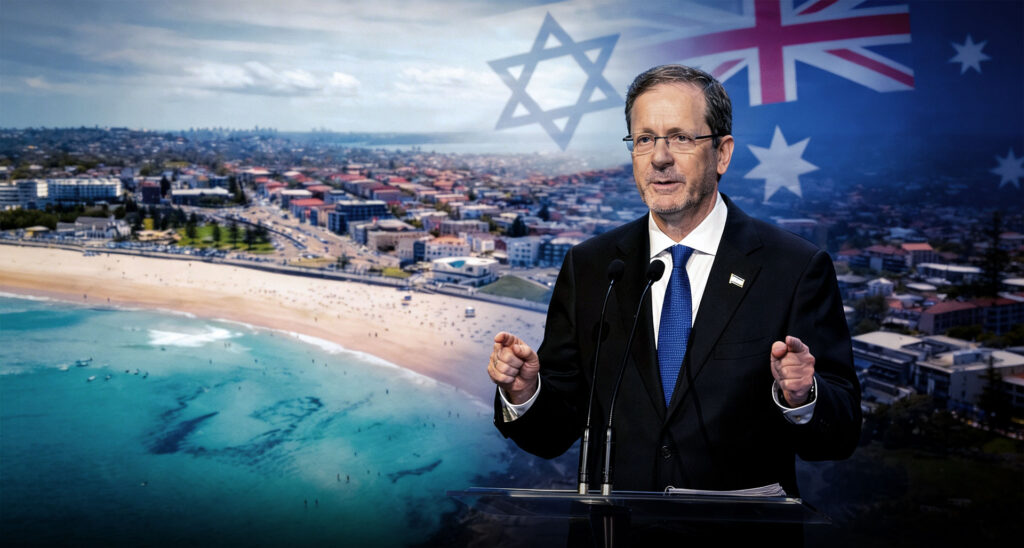
In the wake of more than two years of escalating hostility toward Australia’s Jewish community – including doxing campaigns, campus encampments, synagogue firebombings, and the murder of 15 Australians at Bondi Beach – Israeli President Isaac Herzog’s planned visit was intended as an act of communal solidarity.
But on 4 February 2026, the country’s publicly-funded ABC Radio National reframed that moment of mourning into a staged debate about internal Jewish division.
Hosted by Fran Kelly, the segment featured Lillian Kline (Project A) and Sarah Schwartz (Jewish Council of Australia, JCA). What unfolded was not simply a discussion about a presidential visit, but rather a case study in how “balance” can distort reality when fringe activism is presented as equivalent to mainstream communal representation.
View this post on Instagram
Manufacturing Division
Kelly opened by framing Herzog’s visit as inherently divisive: “Will he bring comfort and connection… or create new ruptures in our community?”
She introduced the guests as “two Jewish leaders,” immediately establishing equivalence between Project A – a grassroots group formed after 7 October to combat antisemitism – and the Jewish Council of Australia, a recently formed activist organisation with a limited signatory base.
That framing matters.
The ABC did not provide listeners with context about the JCA’s size, structure, or representative mandate. Nor did it explain that the group positions itself in opposition to mainstream Jewish institutions. By contrast, Project A was described as having formed “after the Hamas attacks,” subtly positioning its perspective as reactive rather than foundational.
This is not impartiality. Section 4.1 of the ABC Editorial Standards makes clear that impartiality is not merely about allocating equal airtime – it requires representing weight and context accurately. Without that context, listeners were left with the impression of a community evenly split over whether solidarity with grieving families was appropriate.
There is no evidence of such parity.
The Pivot: From Empathy to Prosecution
When asked whether it made sense that grieving families might find comfort in Herzog’s visit, Schwartz responded: “Of course so many Jewish people… are grieving… but the Jewish community is far from uniformly supportive of the state of Israel and President Herzog.”
The rhetorical pivot was immediate. Rather than addressing the humanitarian purpose of the visit, the discussion shifted to prosecuting Herzog’s political record.
Schwartz referenced claims that Herzog’s remarks had been cited internationally as evidence of genocidal intent. Yet the specific quote she invoked – that “an entire nation is responsible” – omitted Herzog’s accompanying clarification that Israel was operating “by the rules of war” and that civilians were not the target.
Context was stripped away.
Additional allegations about past remarks were presented in similarly decontextualised form. The host did not interrogate those claims or provide balancing clarification. Instead, later in the segment, Kelly adopted them as her own line of questioning, asking Kline whether she was being “naive” about the president’s record.
That word – “naive” – marked a shift from facilitation to moral adjudication.
Schwartz’s claims were treated as factual scaffolding. Kline’s defence of a sympathy visit was framed as political denial.
The Polling Problem
Schwartz further argued that significant portions of Australian Jews do not identify as Zionist, citing 2017 data suggesting 30% do not identify as such.
That figure combines those who explicitly rejected the label with respondents who were “unsure,” while omitting a critical finding from the same study: 88% reported feeling a strong connection to Israel.
More recent data paints an even clearer picture. The 2023 Crossroads survey found that 86% of Australian Jews believe Israel’s existence is essential for the Jewish people’s future. Post–7 October research indicates that identification with Zionism has, if anything, solidified in response to rising antisemitism.
Presenting outdated or partial statistics without challenge does not meet the ABC’s own accuracy standards (Sections 2.1 and 2.2).
View this post on Instagram
Asymmetry of Scrutiny
Throughout the interview, scrutiny flowed in one direction.
Kline was repeatedly pressed on allegations against Herzog and Israel. Schwartz was not asked about the JCA’s representational base, funding, or ideological positioning. Nor was the audience informed that the JCA has consistently positioned itself against mainstream communal bodies.
When Kelly asked whether Herzog’s visit might have “any positive benefit,” she framed the support as belonging to “some Jewish Australians,” reducing what mainstream organisations describe as widespread communal backing to a factional preference.
Language shapes perception. “Some” suggests marginality.
By the segment’s conclusion, a visit requested by grieving families had been reframed as a controversial political imposition.
The Inversion of Suffering
In her closing remarks, Schwartz argued that associating Herzog’s visit with the Bondi massacre “implicates Jewish people in a political environment” in which it is not responsible for them to be implicated.
But Bondi’s victims were not targeted based on political alignment. They were targeted as Jews.
The attempt to separate Jewish grief from Jewish solidarity reframes a terror attack as a branding risk rather than an act of hatred.
Communal diversity is real. But diversity does not erase overwhelming evidence that Australian Jewish institutions, families of victims, and major communal bodies supported the visit as an act of recognition and comfort.
To present that as merely one side of an even split is to manufacture division where there is none of comparable weight.
Spectacle Over Substance
The ABC had an opportunity to examine how a grieving minority community seeks solidarity after trauma. Instead, it produced a theatrical conflict between “two Jewish leaders,” flattening representative weight in pursuit of tension.
Impartiality requires context, accuracy demands scrutiny, and balance depends on proportionality.
When fringe activist groups are presented as equivalent to established communal bodies without clarification, the result is not fairness, but distortion.
The question is not whether Jewish communities contain diverse political views. They do.
The question is whether a national broadcaster should present a moment of communal mourning as a spectacle of internal rupture.
On 4 February, that is precisely what occurred.
Elahn Zetlin is an Australian video producer and editor with over 30 years’ experience in television and news production.
Liked this article? Follow HonestReporting on Twitter, Facebook, Instagram and TikTok to see even more posts and videos debunking news bias and smears, as well as other content explaining what’s really going on in Israel and the region. Get updates direct to your phone. Join our WhatsApp and Telegram channels!
© Divuach Ne’eman R”A, 2025