Key Takeaways:
-
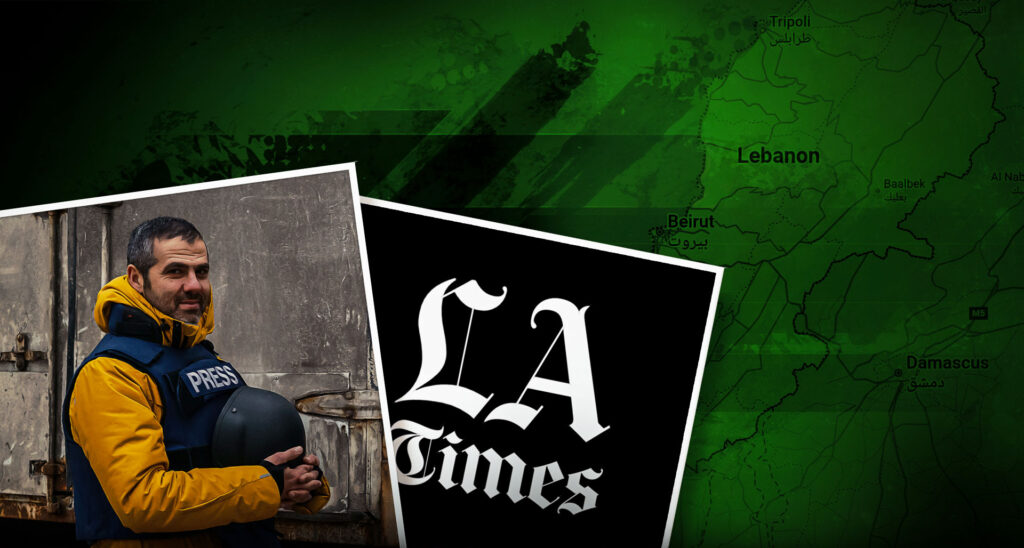
LA Times bureau chief Nabih Bulos routinely distorts history and assigns blame to Israel, pushing narratives that excuse Hamas, erase terrorism, and misrepresent key facts such as the origins of Hamas and the causes of regional instability.
-
Bulos’s reporting repeatedly sanitizes or glorifies terrorist organizations, from whitewashing Hamas operatives to framing the Jenin terror hub as “resistance,” while minimizing or ignoring decades of attacks on Israeli civilians.
-
His coverage of Hezbollah further demonstrates a clear anti-Israel bias, reframing precision counterterrorism operations as assaults on civilians and downplaying Hezbollah’s aggression, all while violating the journalistic standards the LA Times claims to uphold.
The Los Angeles Times seeks to hold itself above reproach. Unfortunately, its Middle East bureau chief, Nabih Bulos, has consistently published biased and inaccurate articles – as well as his own social media posts – that betray the very standards he is meant to uphold.
With over 63,000 followers on X and writing for the largest daily metropolitan newspaper, Bulos’s impact is unmistakable. But his anti-Israel bias speaks volumes about the narrative he is spreading and brings into question his capacity to report accurately on such a tense region.
Distorting History, Blaming Israel
Bulos repeatedly demonstrates an inability to recognize the complex and dangerous neighborhood in which he is reporting from. In one post on X, responding to a statement that “Israel is in a tough neighborhood,” Bulos questions, “Why did it become a tough neighborhood?”
The insinuation is clear: Israel is to blame for the instability and hostility in the region. This kind of historical revisionism distorts decades of regional dynamics, conflicts, and threats from terrorist organizations and countries that previously or currently seek Israel’s destruction.
Why did it become a tough neighborhood? https://t.co/4rJJCbzC6D
— Nabih (@nabihbulos) August 17, 2024
Similarly, in response to a statement by Piers Morgan that Hamas’ October 7th massacre cannot be compared to the Russia-Ukraine war, Bulos sarcastically suggested that Israel bears responsibility for the terrorist attacks because of the conditions that preceded them. In reversing the responsibility and denying Hamas’ initiation of the war, Bulos implied that the massacre was essentially a natural response to prior Israeli actions. This rhetoric presents a narrative that portrays Israel as the root cause of regional violence – a position starkly at odds with the neutrality expected from a major newspaper’s Middle East bureau chief.
This belief is not only found on his X feed but also in his published work. In one 2024 story covering the potential options for governance in post-war Gaza, Bulos suggested that because Israel “secretly helped create Hamas decades ago as a rival to the Palestinian Authority,” it would be concerned over any potential unity of Palestinians.
Except, Israel did not create Hamas. It gave money to the charity organization Mujama al-Islamiya in 1979 as a way to curb the violence that Israeli civilians were facing from the Palestinian Liberation Organization (PLO). When Mujama al-Islamiya began collecting arms, its leader, Sheikh Ahmed Yassin, was thrown in jail in the mid-1980s. After the outbreak of the First Intifada, Yassin and four other Palestinians created Hamas, but Israel was not the party responsible for its creation.
Did Israel create Hamas? ? pic.twitter.com/SS4nx1hA5d
— HonestReporting (@HonestReporting) November 17, 2023
Yet again, this is not the first historical inaccuracy Bulos has published. He has also once claimed that 750,000 Palestinians were expelled in 1948, distorting the fact that the vast majority were displaced, either in anticipation of or as a result of the war or in response to the Arab nations’ calls to leave the land while their armies invaded the newly formed Jewish state.
Glamorizing Terrorist Organizations
Bulos’s reframing of history is not an isolated lapse but part of a broader pattern woven through his coverage. His reporting goes beyond mischaracterizing Israel and has time and again crossed into sanitizing or outright glamorizing the actions of terrorist organizations and terrorists.
When Anas Al-Sharif was killed in an Israeli strike, Bulos posted that Al-Sharif was “one of the hardest working journalists in Gaza” and amplified Al Jazeera while doing so. Not only does this raise serious questions about why he is uncritically boosting a Qatari-funded outlet known for amplifying Hamas propaganda, but it also obscures the fact that Al-Sharif had well-documented ties to Hamas and regularly produced content aligned with the organization’s messaging.
View this post on Instagram
Bulos’s amplification of terrorism goes beyond individual Hamas actors. In his latest piece for the LA Times, “West Bank camp, a symbol of Palestinian resistance, lies in ruins after Israeli campaign,” he explicitly glorifies the Jenin refugee camp as a place of “resistance against occupation.” In other words, he is describing terrorism.
What Bulos omits is that the Jenin camp has long been a major hub for terror activity. It is a base from which terrorists have attacked Israeli civilians and threatened communities.
However, Bulos would be unable to recognize these key facts, as when he notes that the refugee camp gained its “reputation as the martyrs’ capital,” he deliberately excludes why. The name itself came from the fact that over one-third of all suicide bombings during the Second Intifada were carried out by terrorists from Jenin.
The Jenin refugee camp is the terror capital of the West Bank – the source of multiple acts of terrorist violence against Israeli civilians going back many years.
But to @latimes? It’s a “symbol of Palestinian resistance.” pic.twitter.com/ZIRw5dZIeD
— HonestReporting (@HonestReporting) November 26, 2025
This is perhaps why he also feels comfortable questioning the dangerous neighborhood Israel finds itself in. Whether Bulos likes it or not, Israel faces a threat from terrorist organizations on every front – all of which are either created, funded, armed, or directed by the Iranian regime, which is openly committed to eliminating the Jewish state. Given this reality, describing Israel’s neighborhood as dangerous isn’t a narrative choice but simply a fact.
Downplaying Hezbollah
Bulos’s inaccurate coverage of terrorist organizations is particularly biased when it comes to Hezbollah.
After a Mossad agent went on 60 Minutes to discuss Israel’s successful pager operation against Hezbollah terrorists, Bulos reframed the operation as one that targeted innocent civilians. While a limited number of bystanders in the direct vicinity of the terrorists holding the pagers also sustained injuries, the overwhelming majority of those injured were Hezbollah terrorists, as Israel intended. But Bulos’s portrayal distorts the nature of the operation and falsely recasts a precise counterterrorism operation as an assault on civilians.
How can @60Minutes regurgitate an objectively incorrect statement like this? The pager explosions *did* harm & maim people near the ostensible targets, as my colleagues and I documented. https://t.co/oxeazluVFm
— Nabih (@nabihbulos) December 25, 2024
Naturally, Bulos remained silent on Hezbollah’s frequent attacks deliberately targeting Israeli civilians, including a rocket attack that resulted in the death of 12 Druze children in Majdal Shams. In fact, his only recognition of this attack was regurgitating Hezbollah’s denial of the strike.
It appears as a pattern of deliberate inability to acknowledge that Hezbollah attacks Israel and its civilians. Even when describing how Hezbollah inserted itself into the war on October 8, 2023, by attacking Israel and launching rockets, Bulos simplifies it as fighting Israel.
Actually, @LATimes, Hezbollah did not “fight” Israel after the Hamas-led Oct. 7 attacks.
The terror org *attacked* Israel unprovoked on Oct. 8, escalating the conflict into a multi-front war. pic.twitter.com/kCA3H3AxwA
— HonestReporting (@HonestReporting) August 28, 2025
This past week, in an interview with CNN, Bulos held to the same narrative, claiming that Israel continues to fire on Lebanon, while the “Lebanese are ceasing,” and that Beirut is “accustomed to war.” Not once does he mention that Hezbollah has been actively working to rebuild its military infrastructure in southern Lebanon in direct violation of the ceasefire agreement. It is an unfortunate reality in which Hezbollah has hijacked Lebanon to feed its desire to destroy Israel. But Israel does not take action in foreign countries without reason; rather, the IDF takes preemptive actions to undermine the threats it faces.
Related Reading: What the Media Don’t Explain About Israel’s Fight With Hezbollah
Bulos has clearly demonstrated an inability to cover the region with the neutrality that is required by his title. Whether it is on his personal social media or in his articles, he consistently reports in a manner that violates the LA Times’s standards. It has led HonestReporting to request corrections from his editorials on six separate occasions in 2025 alone.
Bulos’ reporting does more than misinform. It gradually shifts public perception of conflicts in the region to be disproportionately hostile toward Israel. For a journalist with such a large platform and for a publication that claims to uphold the highest standards of accuracy and fairness, Bulos’s biased coverage underscores the urgent need for accountability and action.
Liked this article? Follow HonestReporting on Twitter, Facebook, Instagram and TikTok to see even more posts and videos debunking news bias and smears, as well as other content explaining what’s really going on in Israel and the region. Get updates direct to your phone. Join our WhatsApp and Telegram channels!
© Divuach Ne’eman R”A, 2025