


Key Takeaways:
- Coverage downplayed that the FBI probe predated Kent’s resignation, reshaping cause and effect.
- State-linked and extremist social media networks pushed the “Israel drove the war” claim at scale before it hit mainstream coverage.
- Outlets elevated the viral claim while sidelining Kent’s contradictions and track record.
Joe Kent is now at war with his former self, and the media seems remarkably uninterested in asking which version we are supposed to believe.
Because the Joe Kent of just a few years ago was unequivocal about one thing: the Iranian regime posed a serious and growing threat to the United States.
He said so repeatedly, on social media and in on-the-record interviews, issuing stark warnings about Iran’s ballistic missile capabilities and arguing that the United States had effectively been in conflict with the regime since 1979. On that point, he was hardly alone. The regime’s own “Death to America” slogan, alongside its long-standing support for terrorist proxies responsible for attacks on U.S. personnel, underscored the threat he described.
And then there is the Joe Kent of this week.
The man who resigned in a letter posted to X, claiming that Iran posed no “imminent threat” to the United States and that President Donald Trump had been “deceived” into war by Israel and its “powerful American lobby.”
It is a transformation so stark that it demands explanation.
But if anyone expected Kent to account for this dramatic reversal, they would have been disappointed by his appearance on Tucker Carlson’s show just hours after his resignation.
An appearance that, in truth, was entirely predictable.
1/
🚨 The @nytimes is now gushing over Joe Kent’s “bravery.”This is the same Joe Kent they previously exposed for his links to neo-Nazis and conspiracy theories.
Now he’s set to become a “star.”
Because suddenly, he’s useful. pic.twitter.com/Uz6ztYcVgY
— HonestReporting (@HonestReporting) March 18, 2026
Because where does one go, after turning against their own government, to recast themselves as a truth-teller? Increasingly, the answer is Tucker Carlson’s platform, where claims like these are embraced, not examined, and where questions about foreign influence, including Carlson’s reported Qatari links, continue to linger.
More curious still was the timing: Kent’s interview was lined up with remarkable speed, less than 24 hours after his resignation went public.
That curiosity was quickly answered. On Wednesday, it emerged that Kent had already been under FBI investigation for allegedly leaking sensitive intelligence, a probe that began long before his resignation.
Suddenly, the sequence of events looks very different. What was presented by much of the media as a principled stand began to resemble something else entirely: a preemptive exit.
And, perhaps anticipating the optics, Kent is now positioned to frame that investigation not as the cause of his resignation, but as retaliation for it.
Yet this sequence of events is going largely unexamined.
A number of mainstream headlines have, whether intentionally or not, muddied the timeline. Several outlets frame the FBI investigation as something that followed Kent’s resignation, rather than something that preceded it. The Hill, for example, reported: “Joe Kent under investigation by FBI, blasts killing of Ayatollah on Tucker Carlson.” Axios’ headline read, “Joe Kent under FBI investigation for alleged leaks,” while the BBC ran with: “Former counter-terrorism head investigated by FBI over alleged leaks.”
A reader scanning these headlines could easily conclude that the investigation was a response to Kent’s resignation or his public statements, rather than an existing probe that precipitated them.
Kent’s interview itself was not short on material. He made a series of conspiratorial, attention-grabbing and, at times, outright absurd claims, entirely consistent with his long and well-documented record of promoting such theories, as HonestReporting highlighted in the immediate aftermath of his resignation. Among them were suggestions that assassinated Turning Point founder Charlie Kirk had attempted to extract a promise from Kent that the United States would not go to war with Iran shortly before his death, alongside insinuations that any investigation which might implicate Israel or pro-Israel actors had been deliberately suppressed.
Yet these were not the claims that came to dominate the conversation.
To understand why, one has to look beyond traditional media and examine what unfolded across social media platforms in the hours following Kent’s appearance. Within a remarkably short time, one particular claim from the interview began to circulate at scale: Kent’s assertion that Israel had effectively driven the United States into war with Iran. HonestReporting’s AI Labs tracked more than 65 direct instances of this narrative being pushed, within a wider ecosystem of over 1,100 Kent-related posts across X, Facebook, Instagram and TikTok.
The pattern of amplification is revealing. This was not simply organic virality. State-aligned actors were among the first to move. Russian outlets such as RT spread the claim within minutes, alongside pro-Kremlin commentators who framed Kent’s remarks within a broader anti-Western narrative. Their messaging was quickly mirrored by pro-Iran and aligned networks, which adopted language consistent with Iranian state framing, portraying the war as Israeli-instigated aggression and Iran as the victim.
🧵 THREAD: This was coordinated.
Joe Kent goes on Tucker Carlson. Within minutes, the exact same clip, same caption, same outrage floods the internet.
Not organic. Not coincidence.https://t.co/JyoNJTTBSh Labs tracked it in real time.
What we found will shock you. pic.twitter.com/U7Mdg7ygCH— HonestReporting (@HonestReporting) March 19, 2026
From there, the narrative spread across Pakistani and Kashmir-linked networks, including pages such as Kashmir Tales and Kashmir Publish, which pushed the claim with overtly anti-Israel framing. It also extended into wider international media ecosystems, including Latin American accounts, suggesting rapid translation into Spanish-language discourse.
What emerged is not a fragmented conversation, but a convergence. Actors with varying ideological positions aligned almost immediately around a single, highly specific message: that Israel had manipulated the United States into war.
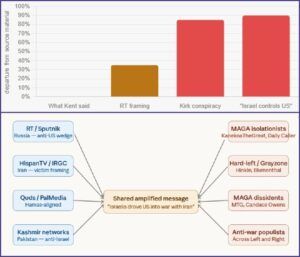
There are clear indicators that this amplification was not organic. Identical phrasing appeared across multiple Facebook groups simultaneously, while certain accounts posted the same content across platforms at the same time – patterns consistent with coordinated, inauthentic behavior.
This is where the story becomes more consequential.
Because when we turn back to mainstream media coverage, we see a similar emphasis begin to take hold. CNN, for example, highlighted Kent’s claim as a central takeaway from the interview: “Repeated claims that Israel drew US into Iran war.” The Associated Press ran with a headline stating: “Joe Kent’s resignation over Iran war reignites antisemitism fears and debate over Israeli influence,” while ABC News used nearly identical framing.
In other words, the same narrative that was rapidly amplified across state media, ideological networks, and coordinated online ecosystems began to shape the contours of mainstream reporting.
This does not mean that journalists are deliberately echoing propaganda. But it does illustrate how modern information flows operate.
Narratives are selected, amplified, and made salient on social media, often by actors with clear agendas. Those narratives then seep into mainstream coverage, not always as explicit endorsements, but as framing choices: which claims are foregrounded, which are repeated, and which are allowed to define the story.
And once that happens, the feedback loop is complete.
Joe Kent is not an anonymous account or fringe activist. He is a former senior counterterrorism official. That status gives his words weight, allowing a narrative that might otherwise be dismissed to travel further, faster, and with greater legitimacy.
That is what makes this moment so significant. Not just what Joe Kent said, but how it spread.
And how quickly it was absorbed into coverage that should have been interrogating it.
Liked this article? Follow HonestReporting on Twitter, Facebook, Instagram and TikTok to see even more posts and videos debunking news bias and smears, as well as other content explaining what’s really going on in Israel and the region. Get updates direct to your phone. Join our WhatsApp and Telegram channels!