Key Takeaways
- Demonization is not criticism. Criticizing AIPAC’s policies, influence, or political positions is part of democratic debate. Describing a prominent Jewish-associated organization as “monstrous” moves beyond criticism and into demonization, portraying an institution as inherently illegitimate rather than merely wrong.
- Jewish approval does not make anti-Jewish rhetoric harmless. The presence of Jewish supporters or political allies does not automatically absolve rhetoric directed at Jewish institutions. History shows that the participation of some Jews has never prevented broader hostility toward Jewish communities or Jewish collective life.
- Words shape the environment in which violence becomes possible. Political violence rarely begins with violence itself. It begins with narratives that portray people and institutions as uniquely evil, dangerous, or undeserving of legitimacy. When Jewish-associated organizations are repeatedly depicted in these terms, the consequences extend far beyond a single political rally.
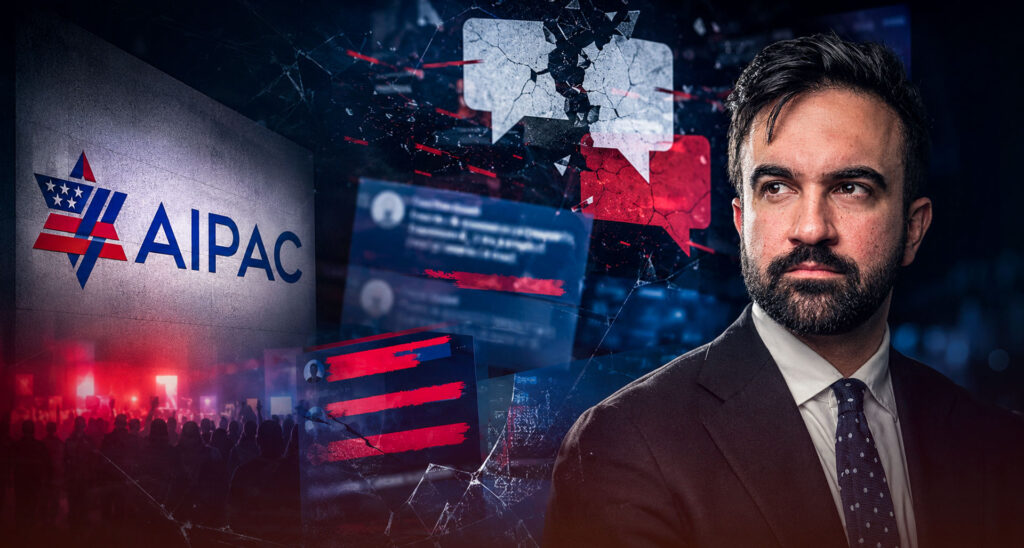
At a campaign rally days before New York City’s Democratic Congressional primary, Zohran Mamdani led a crowd in denouncing AIPAC. Referring to the pro-Israel lobbying organization, he declared that “AIPAC and all its cronies have to be shown that they are not welcome in our city. They are not welcome in our state. They are not welcome in our country.” He then described the organization as “monsters.”
The crowd cheered.
That reaction is worth dwelling on. Not because political organizations should be immune from criticism. But because there is a meaningful difference between arguing that an organization is mistaken, influential, misguided, or even harmful and describing it as monstrous.
Democracy works because it understands that ideological opponents remain part of the political community. We argue with them, defeat them, criticize them, and sometimes despise them. But they remain participants in public life. They remain people and institutions whose views deserve engagement.
Monsters occupy a different category. They are not people whose arguments deserve rebuttal. They are presented as embodiments of evil. The purpose of describing something as monstrous is not to persuade others that it is wrong. It is to convince them that it is illegitimate.
Defenders of Mamdani will immediately object. They will point out that he did not call for violence. They will note that criticizing AIPAC is not antisemitic. They will argue that describing a lobbying organization in harsh terms is simply part of democratic politics. But if they are honest this is not criticism, it is demonization.
View this post on Instagram
When Criticism Becomes Demonization
AIPAC is a political organization. Its positions can be challenged. Its policies can be debated. Its influence can be scrutinized. Many Jews themselves disagree with AIPAC on a range of issues. None of that is controversial.
What should concern us is the portrayal of Jewish-associated institutions not merely as political actors but as uniquely sinister forces deserving public contempt. The language varies. The pattern remains remarkably consistent.
AIPAC is not simply another lobbying organization. It is one of the most prominent institutions associated with American Jewish support for Israel. Whether one supports AIPAC’s positions or opposes them, everyone understands what it represents. When politicians speak about AIPAC, they are speaking about an organization that millions of Jews view as connected to Jewish security, Jewish self-determination, and the relationship between the United States and the world’s only Jewish state. That is precisely why language matters.
Jewish institutions are increasingly discussed in terms that would be regarded as unacceptable if directed at almost any other minority community’s collective organizations. We are told that Jewish organizations exercise undue influence. We are told they corrupt political systems. We are told they distort public debate. We are told they operate as obstacles to justice. The language changes. The underlying message remains familiar.
For centuries, anti-Jewish movements portrayed Jewish institutions as uniquely malevolent. Medieval Europe accused Jews of poisoning wells and corrupting society. Modern antisemites spoke of hidden influence, secret networks, and malign power operating behind the scenes. The details changed from one era to another. The structure remained remarkably consistent. Jewish collective life was not merely opposed. It was portrayed as inherently suspect.
Ultimately, Mamdani describing one of the most visible Jewish-associated organizations in America as monstrous contributes to an atmosphere in which Jewish institutions are increasingly viewed not as legitimate participants in democratic life but as uniquely sinister actors.
The Shield of Jewish Approval
Supporters of Mamdani have another defense readily available. Standing alongside him was Bernie Sanders. Mamdani was speaking at a rally supporting Brad Lander. If prominent Jewish politicians support him, surely concerns about anti-Jewish rhetoric must be overblown.
It is an argument that surfaces with remarkable frequency whenever Jews raise concerns about rhetoric directed at Jewish institutions. Some Jews approve, therefore everyone else should stop worrying. It settles nothing.
The existence of Jews willing to legitimize rhetoric directed against Jewish collective institutions does not make that rhetoric harmless. History provides countless examples of Jews participating in movements, ideologies, and political projects that ultimately proved hostile to Jewish interests.
Internalized anti-Jewishness is real. Members of every minority group can absorb narratives about their own community. Jews are not exempt from that reality. Simone de Beauvoir famously observed that “the oppressor would not be so strong if he did not have accomplices among the oppressed.” Whether one agrees entirely with the formulation or not, it captures an uncomfortable truth. Members of minority communities sometimes help legitimize narratives that ultimately harm their own group.
The appeal to Jewish validation is particularly revealing because it avoids the substance of the criticism. Instead of asking whether describing Jewish-associated institutions as “monsters” is responsible, critics are told that concern is unnecessary because some Jews approve.
History offers little reason to find comfort in that argument. The participation of some Jews has never prevented anti-Jewish movements from targeting Jews as a whole. Nor does Jewish participation magically transform rhetoric into something benign.
From Demonization to Violence
The larger issue extends far beyond a single rally or a single politician. Words shape how societies understand the people and institutions around them. Political violence rarely emerges from nowhere. Before violence comes demonization. Before someone becomes a legitimate target, they must first be transformed into something less than fully human. Individuals become symbols. Symbols become caricatures. Caricatures become threats.
The connection between rhetoric and violence is not theoretical. In recent weeks alone, investigators have alleged multiple plots in which perpetrators explicitly identified support for Israel or association with pro-Israel organizations as a justification for violence.
One suspect accused of plotting an attack at a UFC event attended by President Trump at the White House allegedly identified elected officials who had received support from AIPAC and the pro-Israel lobby as intended targets. According to investigators, these individuals were not selected because of their personal actions but because they were viewed as representatives of a broader political and ideological enemy.
That logic should sound familiar. It is the same logic that transforms institutions into symbols and symbols into targets.
That is why a recent federal indictment in Florida should concern all of us. Prosecutors allege that a man planned a mass shooting at what he believed was an AIPAC office and intended to target Jewish employees because of their association with the organization. According to investigators, he viewed the employees not as individuals but as representatives of a cause he had come to see as deserving of violence.
It would be foolish to pretend that public rhetoric plays no role in shaping the environment in which such ideas develop.
Most people who hear inflammatory rhetoric will never commit violence. Most will simply absorb the message and move on. Yet societies do not get to choose which individuals internalize the stories they are told. They do not get to choose which people begin to see institutions as evil, which people become consumed by that belief, and which people eventually act upon it.
Nobody wakes up one morning believing that Jewish institutions are evil. Nobody begins by imagining that Jewish organizations are legitimate targets. Those beliefs are cultivated. They are reinforced. They are normalized through years of rhetoric that transforms ordinary institutions into sinister forces and political opponents into moral monsters.
That process is already visible across large parts of Western society. Jewish organizations are routinely portrayed as uniquely corrupt. Jewish concerns are dismissed as bad faith. Jewish attachment to Israel is treated as evidence of divided loyalties or malign influence. Increasingly, Jewish collective life itself is framed as something suspicious that must be exposed, resisted, or defeated.
Zohran Mamdani did not invent that trend. But when the leader of America’s largest city stands before a cheering crowd and describes one of the most prominent Jewish-associated organizations in the country as “monsters,” he is contributing to it, and it would be foolish to pretend otherwise.
Liked this article? Follow HonestReporting on Twitter, Facebook, Instagram and TikTok to see even more posts and videos debunking news bias and smears, as well as other content explaining what’s really going on in Israel and the region. Get updates direct to your phone. Join our WhatsApp and Telegram channels!
© Divuach Ne’eman R”A, 2025