Key Takeaways:
- While the U.S. has announced the start of the second stage of the ceasefire, Hamas has yet to fully uphold its phase one commitments, including returning hostages and maintaining the ceasefire.
- The success of phase two depends on Hamas disarming, allowing the NCAG to administer civilian affairs in Gaza. This transitional framework aims to reduce terrorist influence, stabilize daily life, and create conditions for long-term reconstruction and opportunity.
- Lessons from the Oslo Accords show that failure to enforce obligations and curb incitement has long-term consequences. Without oversight and adherence to agreements, a renewal of violence in Gaza could undermine prospects for sustainable peace.
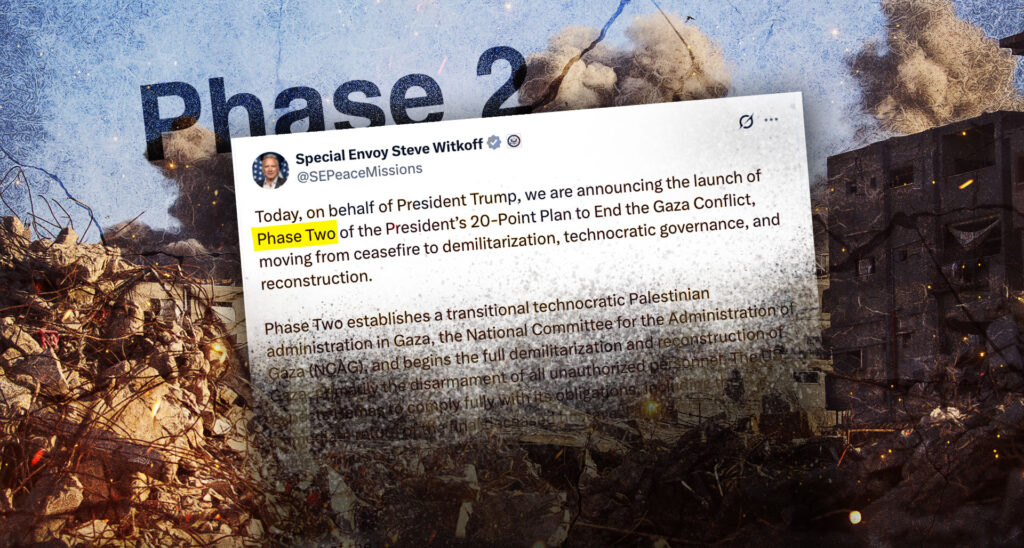
The U.S. has announced that the second phase of the ceasefire agreement between Israel and Hamas has now begun. While officials worry that not moving on to the second stage could encourage renewed fighting, the movement towards the second phase is also met with trepidation from the Israeli perspective.
Notably, Hamas has yet to uphold its end of the agreement, consistently violating the ceasefire since its implementation by launching attacks on Israeli soldiers, crossing the yellow line into territory controlled by the IDF, and not returning all hostages within the first 72 hours of the agreement.
Related Reading: Ceasefires in Name Only: How the Media Ignores Hamas and Hezbollah Violations
While all hostages, both living and deceased, were meant to return home 72 hours after the initial agreement was signed, Hamas has consistently delayed releases or indulged in misdirection and cover-ups. As phase two begins, the body of Ran Gvili, the final hostage being unlawfully held in Gaza, has yet to return home. It raises serious doubts about the extent to which the terrorist organization can be trusted to honor its commitments.
View this post on Instagram
What Does Phase Two Entail?
The second phase of the ceasefire is meant to establish a transitional technocratic Palestinian administration in Gaza, known as the National Committee for the Administration of Gaza (NCAG). It will also begin the full demilitarization and reconstruction of Gaza, focusing specifically on the disarmament of all unauthorized personnel, such as Hamas and Islamic Jihad.
While Hamas is now supposedly signaling willingness to disarm, it has in the past made it explicitly clear that it is not interested in disarming until there is a clear process that will result in the establishment of a Palestinian state, least of all if Israel is still present in the Gaza Strip. Yet this requirement must be met at this stage for Israel to continue its withdrawal.
Since the beginning of phase one, the IDF has been working tirelessly on the demilitarization of Gaza. Areas beyond the yellow line – the area of withdrawal controlled by the IDF – remain far from clear of terrorist infrastructure as the IDF continues to uncover more tunnel systems.
All of these key components of the second phase need to work in synchronization. Hamas’ military grip on the Gaza Strip currently puts the terrorist organization in a position of de facto governance. If it relinquishes its military powers by disarming, it will create the possibility for the NCAG force to begin administering the civilians there.
The NCAG is meant to be an apolitical body overseeing daily life in Gaza. In this capacity, it could help support stabilization efforts, reduce the influence of terrorist organizations, and create space for long-term initiatives focused on education, reconstruction, and economic opportunity – key elements in fostering a more sustainable future. Additionally, the International Stabilization Force (ISF) will also be implemented at this stage to help establish and support a police force, allowing for further Israeli withdrawal.
The successful implementation of the second phase lays the groundwork for a stable and functional civilian administration in Gaza. Thus, this phase is not only about immediate security and withdrawal, but rather about building the institutional foundations necessary to ensure a stable future in post-war Gaza.
A Reminder From Oslo
This is not the first time Israel has entered into agreements with the Palestinians, only to face challenges stemming from a lack of enforcement, limited accountability, and differing interests. In 1993, Israelis and Palestinians were similarly excited about the process of moving towards a future free of terrorism, incitement, and hatred.
The Oslo Accords called for the Palestine Liberation Organization to formally recognize the right of the State of Israel to exist. In contrast, Israel recognized the PLO as the representative of the Palestinian people. Over the course of five years, the two parties were meant to reach a formal and comprehensive agreement. However, no such agreement was ever reached between the parties, and the breakdown of the process was followed by the launch of the Second Intifada, during which weapons originally intended for Palestinian security forces were turned against Israel.
Perhaps one of the most important requirements from the Palestinian side of the Oslo Accords was a commitment to education reform, intended to promote tolerance within the Palestinian education system. A lack of enforcement meant that this crucial factor was never implemented.
As a result, the Palestinian education system has to this day been one that indoctrinates Palestinian children with a vehement hatred of the State of Israel and the Jewish people, and calls on children to become martyrs by committing terrorist attacks. This means that the terrorists who committed the atrocities of October 7, 2023, grew up using textbooks that glorified terrorism after the fallout from Oslo.
While the world and the media may be ready to move on to phase two, it is crucial that Israel ensures the other side are held to their obligations. The aftermath of the Oslo Accords illustrates the consequences of failing to uphold commitments. The repeated disregard of terrorist organizations’ negotiated commitments ultimately undermined long-term stability. The current phase in Gaza presents a similar crossroads. Without careful oversight and accountability, a history of broken commitments and renewed violence could repeat itself.
Liked this article? Follow HonestReporting on Twitter, Facebook, Instagram and TikTok to see even more posts and videos debunking news bias and smears, as well as other content explaining what’s really going on in Israel and the region. Get updates direct to your phone. Join our WhatsApp and Telegram channels!
© Divuach Ne’eman R”A, 2025