Key takeaways:
- Mosab Abu Toha won the Pulitzer Award last May for his New Yorker Essays about the war in Gaza.
- HonestReporting exposed Abu Toha’s social media posts against Israeli hostages, but his award was not revoked.
- His recent posts further taint his win, revealing profanity-filled criticism of fellow journalists, as the award ceremony nears.
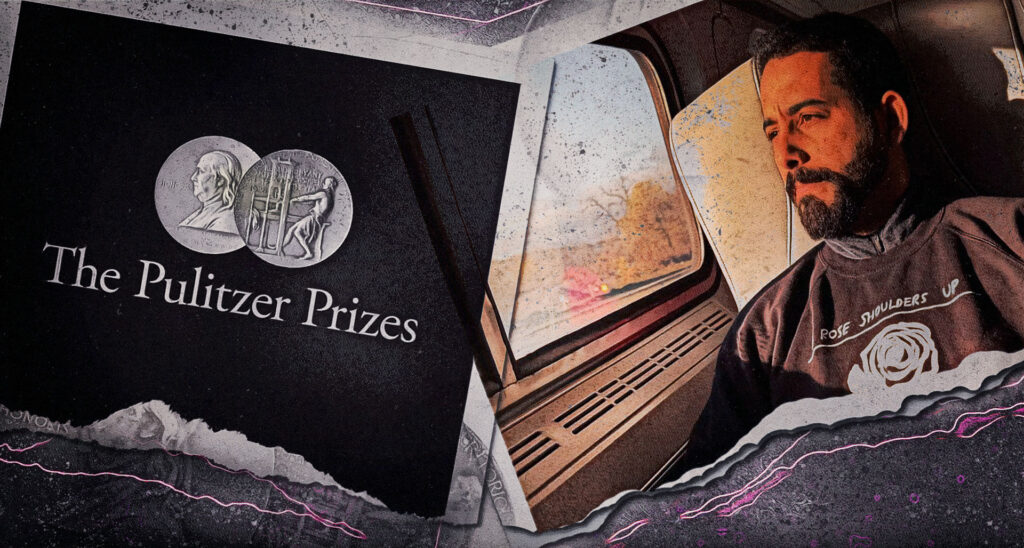
It has been several months since the Pulitzer committee announced that journalism’s highest honor would go to a Palestinian author who justified Hamas’ abduction of Israelis — and he is now set to receive the prize this October.
Ahead of the prestigious ceremony, we examined Mosab Abu Toha’s recent media activity and found disturbing truths that further taint his win.
The Gaza-born poet never apologized for his comments, manipulated words, and even used profanity to attack fellow journalists whose coverage did not complement his twisted ethics.
Related Reading: EXPOSED: New Pulitzer Prize Winner Excused Abduction of Israelis by Hamas
Abu Toha, who won the award for five essays published in the New Yorker about the ongoing war in Gaza, specifically disparaged female Israeli hostages, questioned their hostage status, and implicitly justified their abduction.
When HonestReporting exposed him after his win last May, his prize was not revoked, and he proudly went on a narcissistic media blitz where softball questions from timid interviewers allowed him to manipulate language — the very tool a Pulitzer winner should respect most of all.
On MSNBC, for example, he attacked the only journalist out of three who dared challenge him for his comments against Israeli hostages. In a masterful display of gaslighting, which also used victimization as manipulation, Abu Toha did not answer her questions but wondered how she could ask him “about language” when his family in Gaza was suffering:
But Abu Toha’s criticism of fellow journalists has worsened since then. Feeling entitled, he has used profanity to slander and attack journalists and news outlets that did not align with his anti-Israeli views.
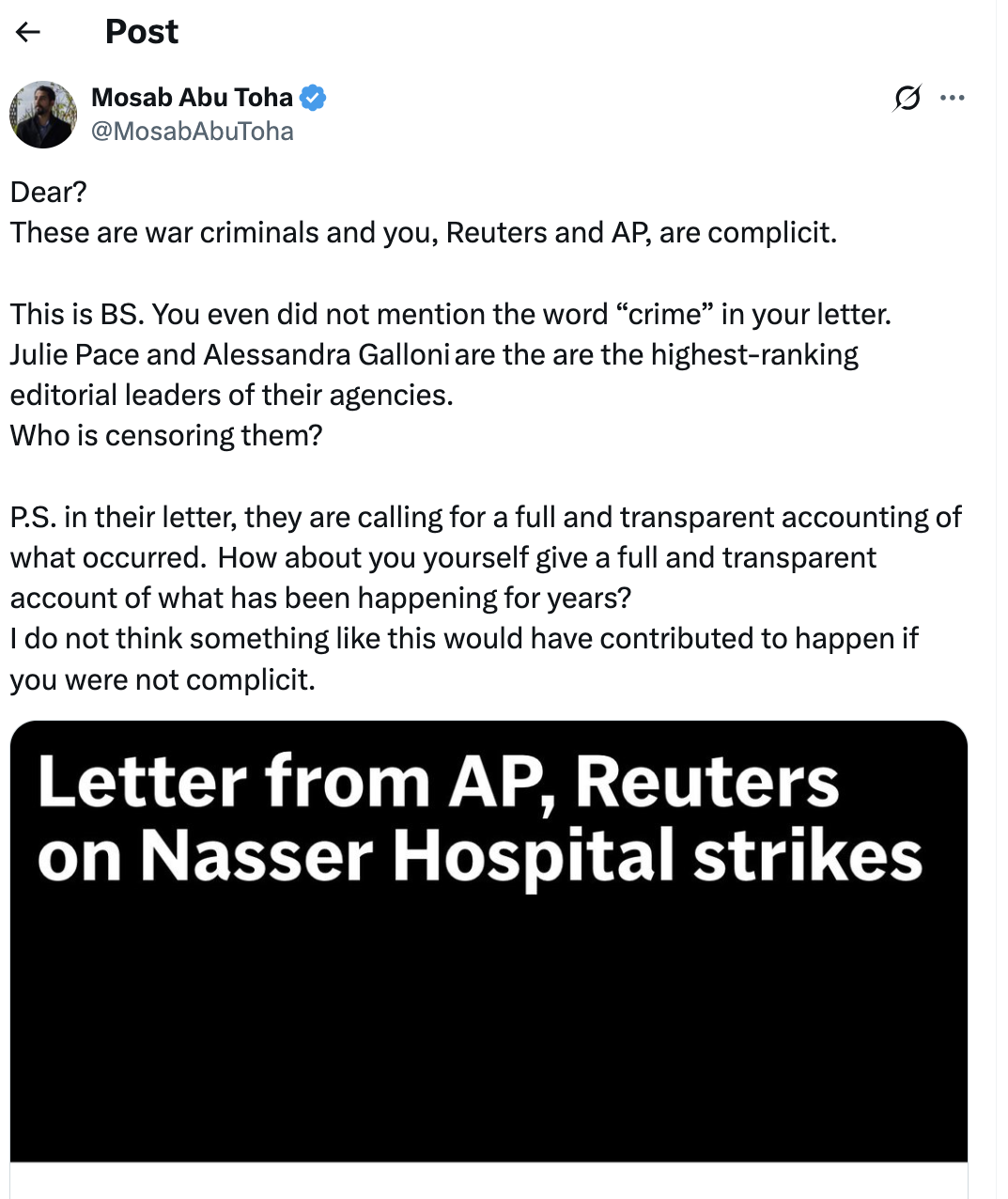
This week, he suggested on social media platform X that the world’s two leading news agencies — Reuters and AP — are complicit in Israel’s war crimes:
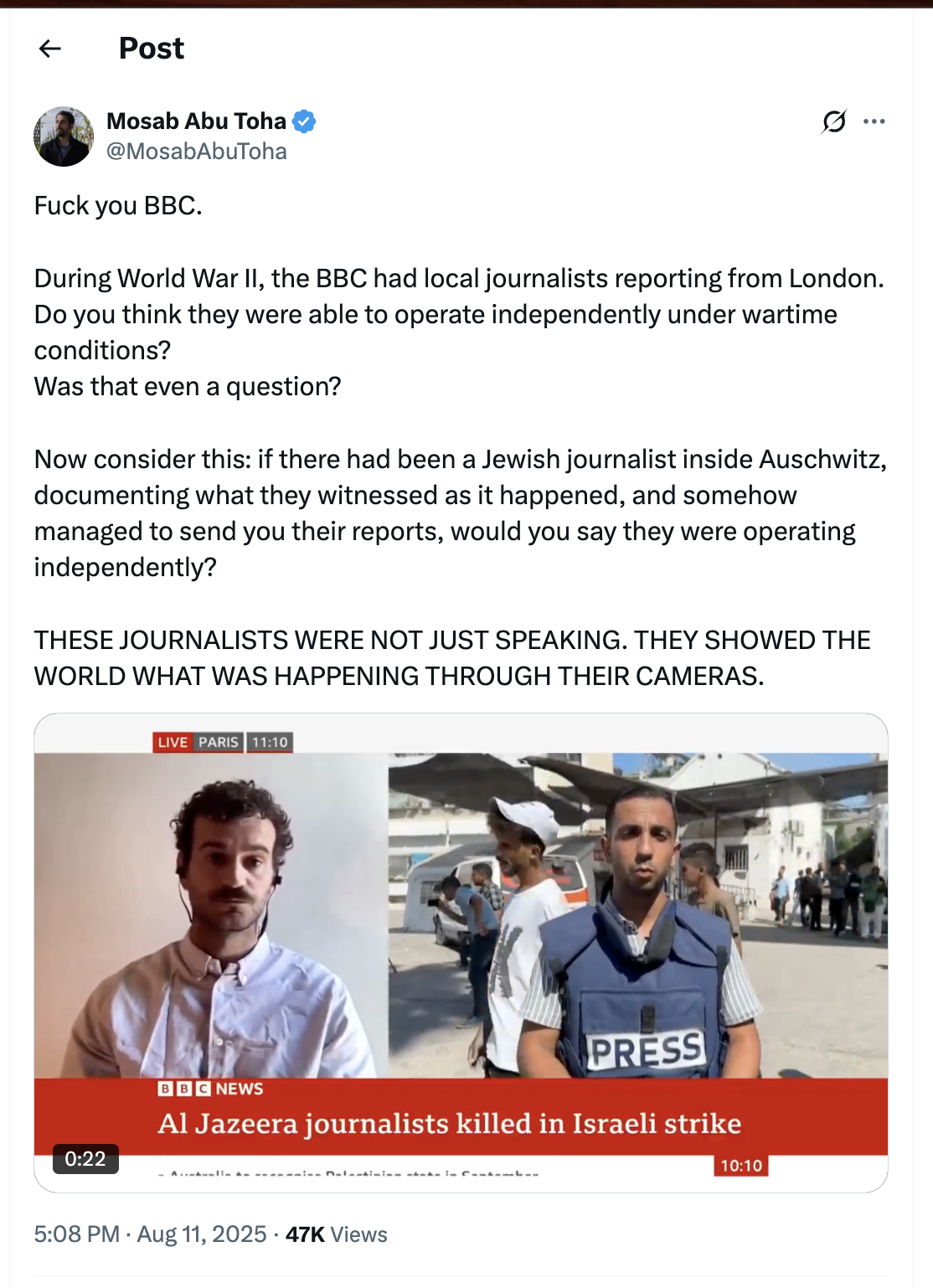
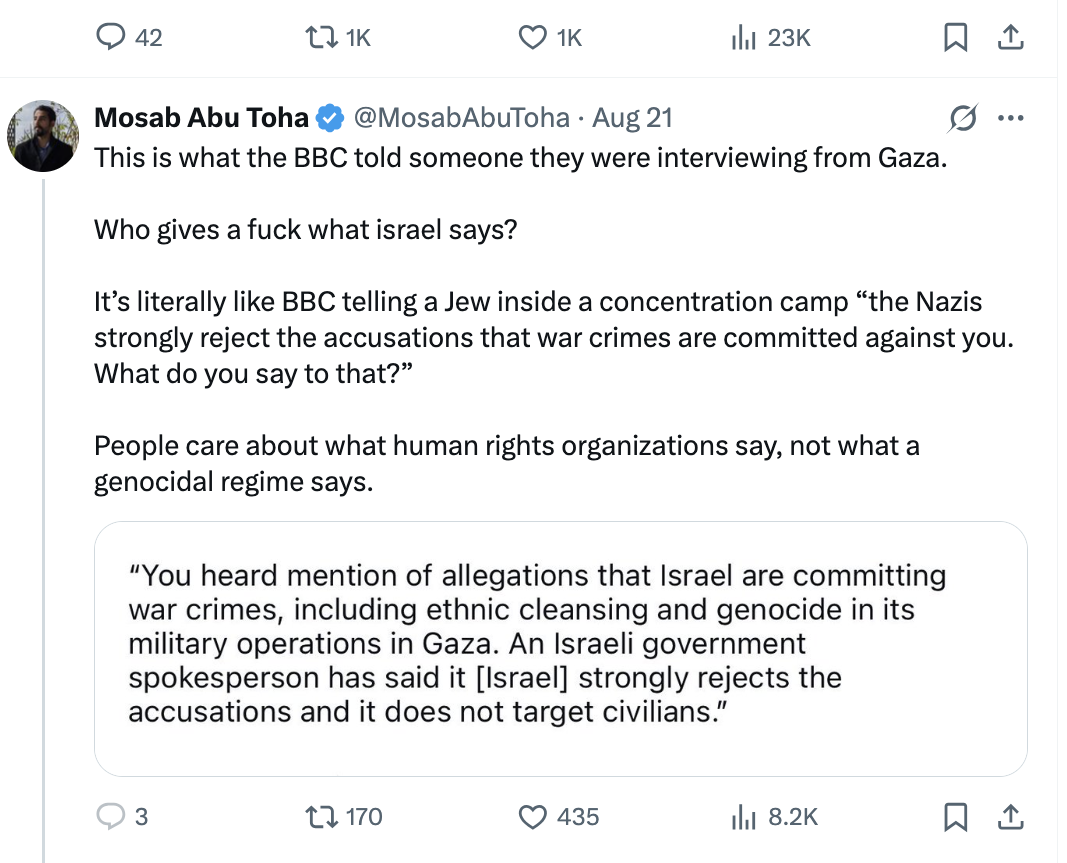
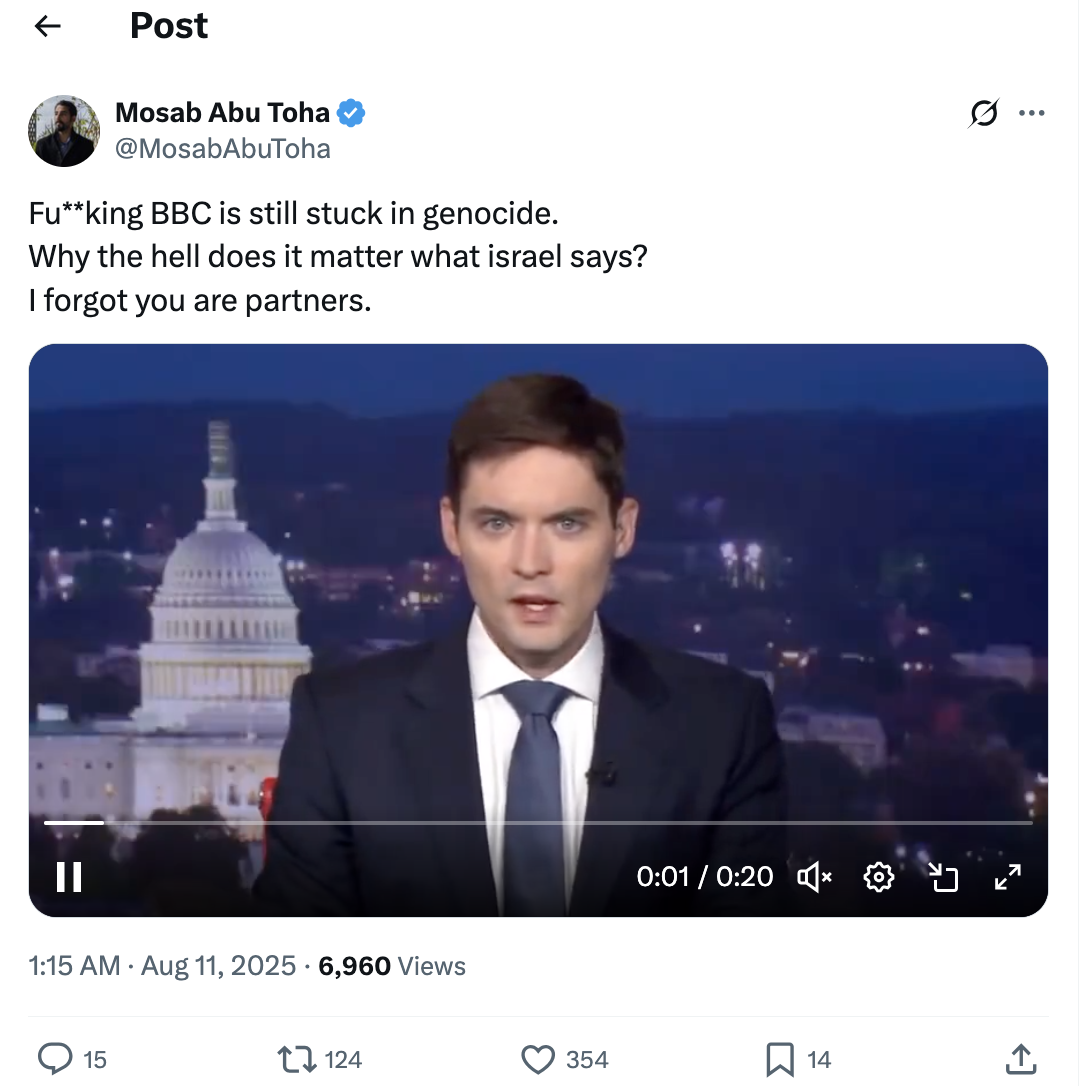
Earlier this month, he also attacked the BBC with profanities like: “F-ck you BBC” and “Who gives a f-ck what Israel says.” His posts also carried an antisemitic tone, comparing Israel’s actions to those of the Nazis during the Holocaust:
The same antisemitic comparison, which violates the IHRA definition of antisemitism, flew under the radar of American host Jon Stewart, who nodded — cluelessly or approvingly — as Abu Toha sneaked it in during a recent interview:
Abu Toha also violently criticized fellow journalists who attended a news conference by “criminal” Israeli Prime Minister Benjamin Netanyahu.
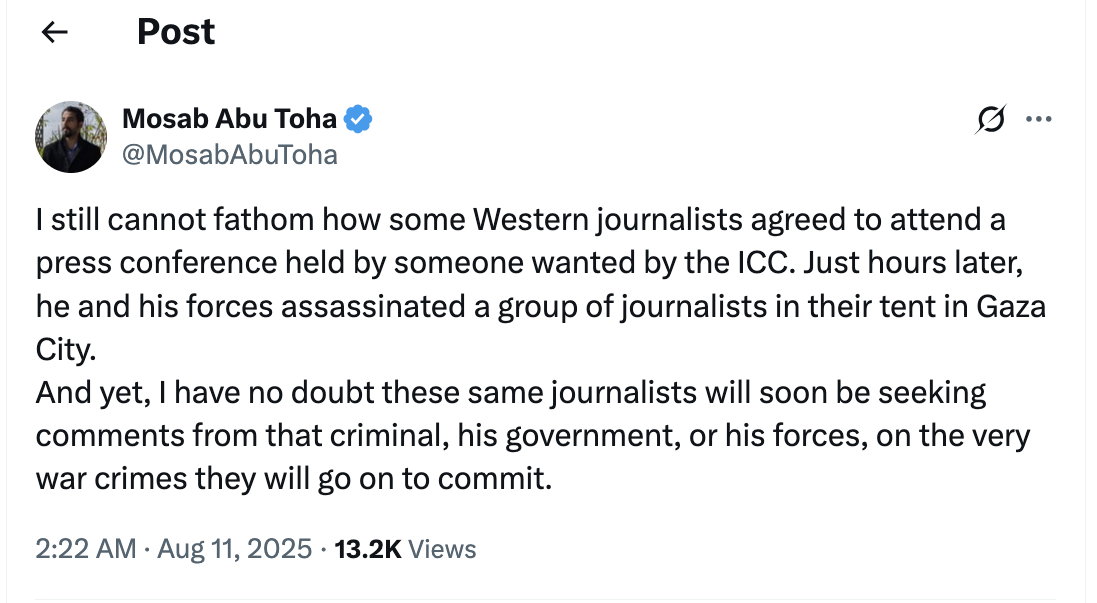
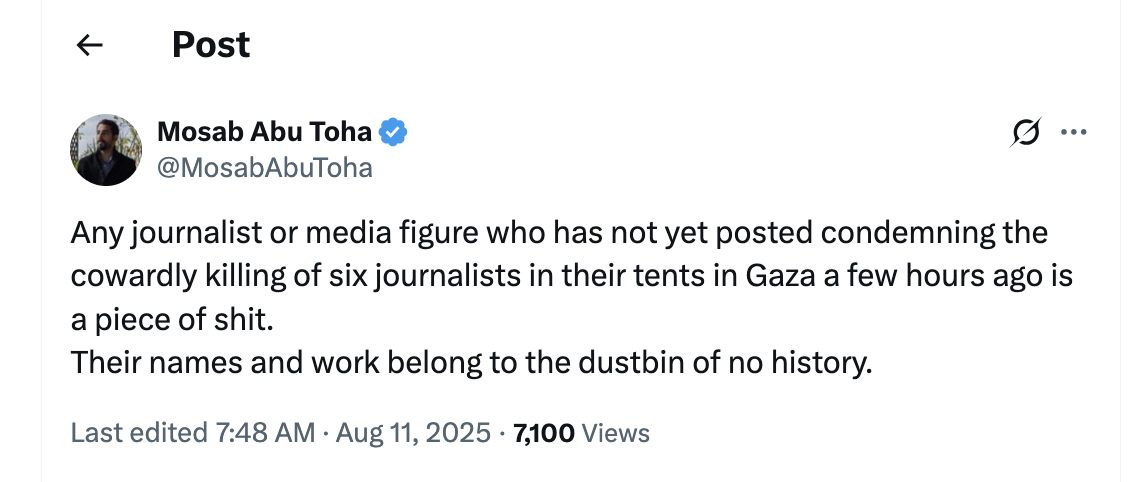
He even declared that any journalist who did not condemn the killing of six journalists in Gaza on August 11 (one of whom was a terrorist) was a “piece of sh-t” whose work belongs to “the dustbin of no history.”
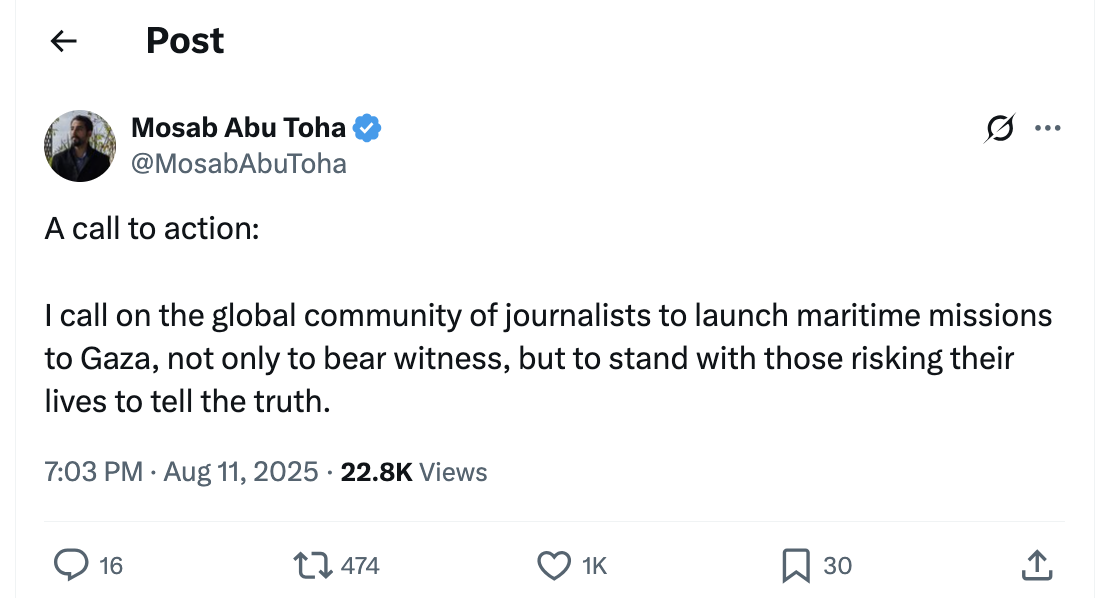
And he even urged journalists — apparently believing they should all be pro-Palestinian activists — to break international law and launch a maritime mission to Gaza:
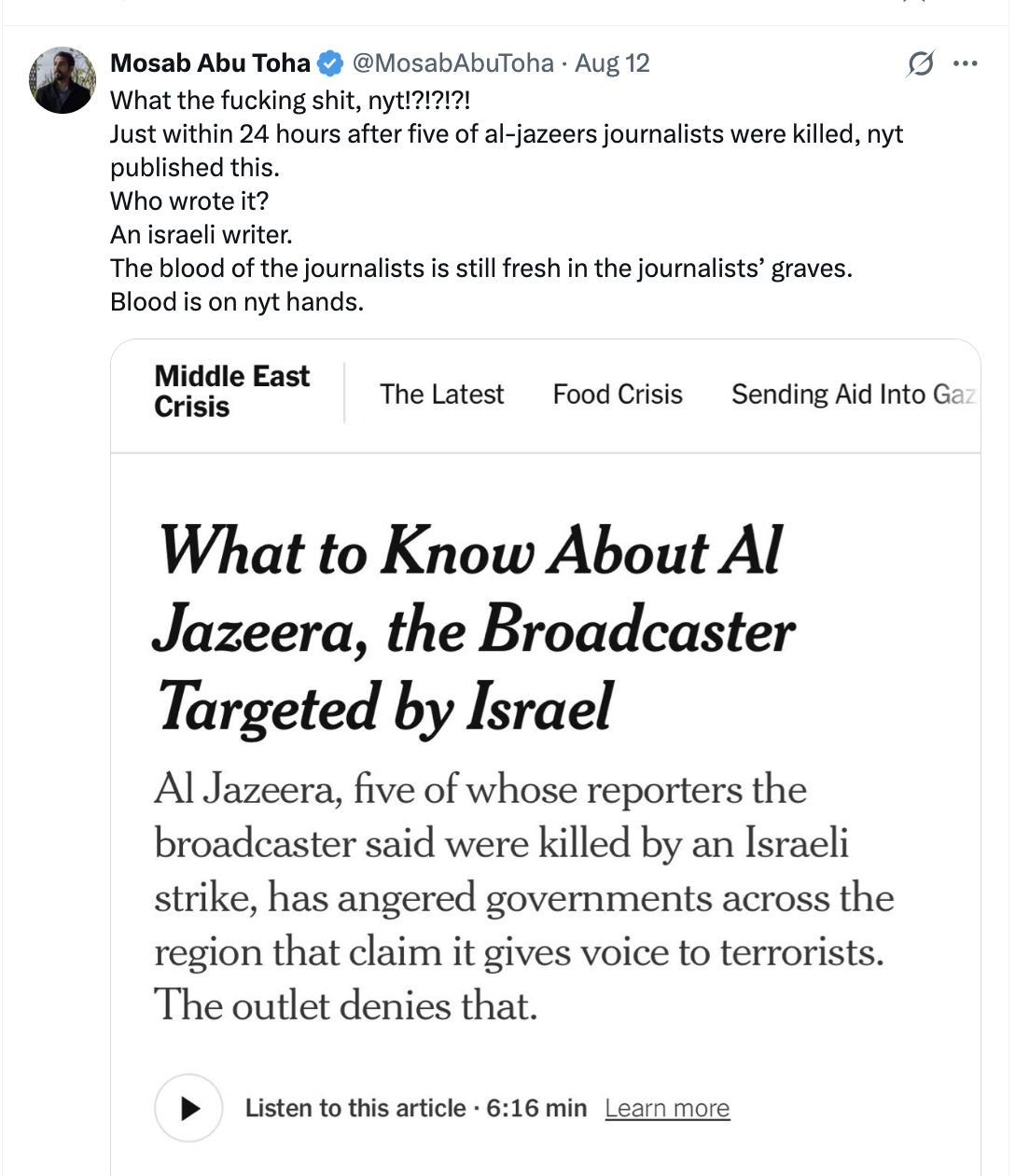
Abu Toha’s attacks were not only general, but personal. In a post against The New York Times, he said “what the f-cking shi-t, nyt!?!?!?!” and “blood is on nyt hands” because of an article written by an Israeli author.
Is this the language of a Pulitzer winner?
Is this the ethical stance of someone who should respect fellow journalists, especially after receiving the industry’s highest badge of honor?
These questions must be asked because the award is not just for a person’s work. Every winner is also an industry role model, and Abu Toha is the opposite.
So the Pulitzer Committee and Columbia University, which administers the prizes, must provide answers.
Do they stand behind Abu Toha’s recent comments, especially as their representatives prepare to shake his hand and give him a certificate in the upcoming ceremony?
These bodies did not comment on Abu Toha’s posts against Israeli hostages, but perhaps this time –- if they still won’t revoke the once respected award — they will have something to say on his attacks against fellow journalists?
It’s not too late to act — urge the Pulitzer committee and Columbia University to reconsider their decision by writing to [email protected].
Liked this article? Follow HonestReporting on Twitter, Facebook, Instagram and TikTok to see even more posts and videos debunking news bias and smears, as well as other content explaining what’s really going on in Israel and the region. Get updates direct to your phone. Join our WhatsApp and Telegram channels!
© Divuach Ne’eman R”A, 2025