Key Takeaways
- Reports that dozens of schoolgirls had been killed in a strike in Minab spread globally before independent journalists had access to the scene.
- In the absence of ground reporting, major outlets turned to satellite imagery, cross referenced video clips, and official statements to reconstruct the event.
- The Minab case highlights a growing challenge in conflict reporting: when access is restricted, journalism increasingly relies on indirect forms of verification that can shape narratives before full evidence is available.
From Verification Gap to Verification Pivot
When reports surfaced that dozens of schoolgirls had been killed in a strike in the southern Iranian city of Minab, the story spread across global media within hours. Headlines appeared before independent journalists had reached the site. Casualty figures circulated widely, sourced primarily to Iranian outlets operating inside a controlled media environment.
In the days that followed, the reporting entered a second phase. With access to the scene still restricted, major news organizations began reconstructing the event from afar using satellite imagery, previously circulated footage, and official statements. What began as a verification gap gradually turned into a reconstruction effort that illustrates how modern conflict reporting increasingly operates when direct observation is impossible. The Minab story is not only about what may have happened at the site, but about how modern journalism constructs certainty when direct evidence is out of reach.
As the story continued to circulate, the reporting did not stop. Instead, major outlets began publishing explanatory reports and visual reconstructions using satellite imagery, official statements, and short video clips distributed through regional media channels.
What began as a reporting gap evolved into a reconstruction effort. The event was no longer being observed directly, but being pieced together from afar.
The Verification Gap
In the immediate aftermath of the reported strike, the evidentiary environment was limited.
Independent reporters did not have access to the site. Casualty figures originated primarily from Iranian sources, and the early images circulating online were largely distributed through official or state linked channels.
In modern conflict reporting, such conditions are not unusual. Governments often restrict access to sensitive sites, particularly when military or security installations may be involved.
But when direct observation is unavailable, journalists face a critical decision. They must decide whether to slow reporting until evidence can be independently verified or to continue reporting while relying on secondary sources.
In the Minab case, the story moved quickly even as independent visual confirmation remained limited.
The Visual Guide Response
As the story evolved, several outlets began publishing detailed explainers attempting to reconstruct what had happened.
These reports typically combined satellite imagery, previously circulated footage, and official statements to build a timeline of events.
For example, reporting by The Times of London and BBC Verify described how analysts compared satellite imagery and publicly available video clips to identify the location and possible impact of the strike.
Similarly, Reuters and CNN explained how journalists and investigators examined imagery, damage patterns, and statements from officials in order to piece together what may have occurred.
In the absence of independent reporters on the ground, many outlets treated satellite analysis and state distributed footage as substitutes for direct observation.
The result was a narrative that continued moving forward even while the underlying evidence remained limited.

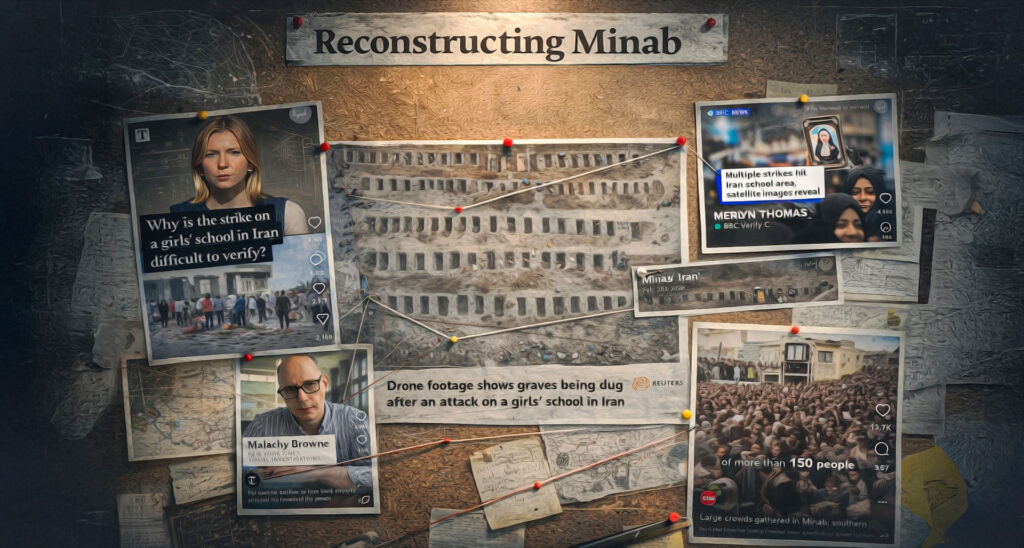
Visualizing the Void: A screenshot from The Times (posted 06.03.2026) asks the critical question: ‘Why is the strike on a girls’ school in Iran difficult to verify?’ The admitting of ‘difficult to verify’ did not stop the global media from constructing a narrative around the numbers they were already publishing. This is the definition of the ‘Verification Pivot.’
Satellite Evidence and Remote Analysis
Satellite imagery has become an increasingly common tool in modern conflict reporting.
By comparing images taken before and after a reported strike, analysts can identify damage patterns, structural changes, or debris fields that may indicate the impact of a weapon.
In the case of Minab, satellite images provided one of the few forms of independently accessible data.
Reports noted visible damage at the site and used geolocation techniques to confirm the location of the building referenced in early claims.
These methods can offer valuable insight.
But they also have limits.
Satellite imagery can show that damage occurred. It cannot independently confirm casualty figures, identify victims, or reconstruct the full sequence of events on the ground.
As a result, satellite analysis often becomes one piece of a larger evidentiary puzzle rather than a complete account of what happened.
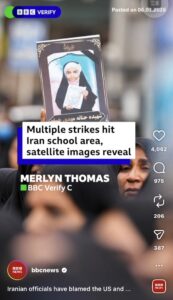
Mapping the Claim: A BBC Verify broadcast (posted 06.03.2026) uses satellite imagery as a visual substitute for ground observation. The graphic claims ‘Multiple strikes hit Iran school area,’ but this data point—showing a hole in the roof—provides no confirmation of the reported 108+ casualties moving through the headlines.
Official Investigations Enter the Narrative
As coverage continued, official investigations began to play a larger role in shaping the narrative.
In the absence of independent access to the site, journalists increasingly relied on statements from investigators and government sources examining the strike.
For example, the New York Times reported that investigators were reviewing available evidence to assess the likely cause of the incident.
Such investigations can provide important insight.
But when direct observation is limited, institutional authority whether from governments, military investigators, or intelligence agencies can become a central source of information.
In these situations, the distinction between reported evidence and interpreted evidence becomes especially important.
The Role of State Distributed Imagery
In the days following the reported strike, images of funerals and mourning ceremonies began circulating through regional media channels and international wire services.
Some of these photographs were distributed through agencies or press organizations operating within Iran’s media environment.
For instance, images credited through Anadolu showed funeral gatherings in Minab.
Such imagery can document the human impact of an event.
At the same time, understanding the origin of these images and the conditions under which they were captured remains an important part of evaluating the broader evidentiary picture.
In conflict reporting, the source of visual material is often as significant as the images themselves.
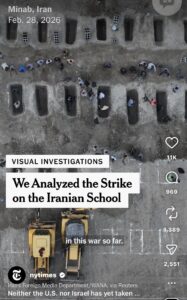
The Supply Chain: This drone footage of the Minab cemetery, syndicated via Reuters (March 3, 2026), is explicitly credited to the ‘Iranian Press Center.’ This image validates our analysis from Articles 15 & 16: global news giants are dependent on state-controlled visual factories to produce ‘evidence’ when independent access is denied.
Asymmetry in Verification Standards
The Minab coverage also raises a broader question about consistency in how evidence is treated.
In reporting on Israeli military operations, news outlets frequently emphasize the limits of available information, noting when claims cannot be independently verified or when casualty figures originate from official sources.
Such caveats reflect awareness of the challenges involved in reporting from conflict zones.
In the Minab case, casualty figures originating in a tightly controlled Iranian media environment circulated widely before comparable scrutiny was applied to the visual record supporting them.
The result was an unusual sequence in which numbers spread quickly while independent visual confirmation remained limited.
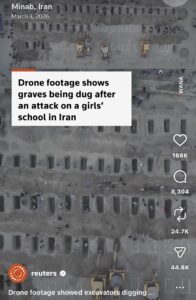
The Supply Chain: This drone footage of the Minab cemetery, syndicated via Reuters (March 3, 2026), is explicitly credited to the ‘Iranian Press Center.’ This image validates our analysis from Articles 15 & 16: global news giants are dependent on state-controlled visual factories to produce ‘evidence’ when independent access is denied.
A Wider Context
The contrast with other events inside Iran is also notable.
Earlier this year, reports of large scale violence against Iranian civilians circulated widely among activists and human rights organizations. Yet independent imagery from those incidents appeared far more limited in international coverage.
The Minab strike, by contrast, generated immediate global headlines despite similar restrictions on access.
This difference illustrates how certain events can move rapidly through the global media ecosystem even when the evidentiary conditions surrounding them remain incomplete.
A New Model of Conflict Verification
The Minab case highlights a broader transformation in how wars are reported.
In many conflict zones, journalists cannot reach the scene of major events. Security restrictions, government controls, or battlefield conditions make independent access impossible.
When that happens, reporting often shifts toward a combination of methods:
• satellite imagery
• open source geolocation
• cross referenced video clips
• official investigations
• expert analysis
Together these techniques form a model sometimes described as remote verification.
It is a method increasingly used in conflicts around the world.

Numbers Over Evidence: A CNN broadcast asserts ‘Iran Holds Funerals for School Strike Victims’ with a reported ‘more than 150 people’ killed. This is a classic example of asymmetry. In other contexts (like an IDF strike), the media would likely demand independent verification before puting such a massive number in a headline.

Constructing the Scene: Malachy Browne of the New York Times Visual Investigations team presents an analysis of ‘the Strike on the Iranian School.’ This highlights the series’ core thesis: when direct evidence is out of reach, journalism increasingly uses remote analysis to construct a narrative of ‘certainty’ that has not been independently verified.
The Bottom Line
The reported strike in Minab illustrates how modern conflict reporting evolves when journalists cannot reach the scene directly.
The story did not unfold through independent observation alone. Instead it was reconstructed through satellite imagery, official statements, and cross referenced footage.
These methods can help illuminate events that would otherwise remain inaccessible.
But reconstruction is not the same as direct observation.
In an era defined by visual evidence, understanding how that evidence is gathered and what limits surround it remains essential for both journalists and readers.
Because in modern conflicts narratives are often shaped not only by what images show but also by how those images are obtained.
And when a major international story is built primarily from reconstruction rather than direct reporting, the process of verification becomes part of the story itself.
Liked this article? Follow HonestReporting on Twitter, Facebook, Instagram and TikTok to see even more posts and videos debunking news bias and smears, as well as other content explaining what’s really going on in Israel and the region. Get updates direct to your phone. Join our WhatsApp and Telegram channels!
© Divuach Ne’eman R”A, 2025