Key Takeaways
- There is no occupied Palestine: no sovereign Palestinian state has ever existed, and Israel left Gaza entirely in 2005.
- The “resistance” predates the “occupation”: Palestinian attacks on Jews began decades before 1967, when Jordan and Egypt held the West Bank and Gaza.
- Murdering civilians is never resistance: the very treaty activists cite, Additional Protocol I, explicitly bans attacks on civilians.
Introduction
There has been an ongoing narrative across the press, social media, and anti-Israel activist groups that Palestinians have a “right to resist” the “Occupation of Palestine.”
There are two fundamental problems with this narrative:
- Historically, and legally, there is no occupation of Palestine. There has never been a sovereign entity called “Palestine” to occupy nor has there ever been any “Palestinian territory” that could be occupied by Israel or anyone else. When it comes to Gaza specifically, before October 7 there hadn’t been a single Jew or Israeli, alive or dead (except for hostages) there since 2005, with the only exception being when soldiers entered the Strip for very short periods of time to quell ongoing rocket fire on civilian communities in Israel. Gaza was fully administered by Hamas and shared a border with Egypt. How do you “occupy” a territory without soldiers or civilians, without controlling all the borders, and without any legal, educational or policing responsibilities there?
- What Palestinians, and their naïve western supporters, define as “resistance” is not a legitimate right under any rule of armed conflict, occupation, international law, or basic human decency or morality. Even a people actually under occupation cannot engage in the barbaric way in which the Palestinians — whether Hamas, Islamic Jihad, Fatah, Black September, or “innocent” Gazan civilians on October 7 — have acted towards Israelis and Jews for decades.
The “Occupation”
As is the case with most of the Palestinian narrative, what exactly constitutes the occupation is entirely inconsistent, as is the remedy. For some, the occupation began in 1948, for others in 1967.
Between 1948 and 1967, Egypt controlled Gaza but did not claim it as sovereign territory, while Jordan controlled the West Bank and parts of Jerusalem and attempted to permanently annex it, a move backed by almost no foreign state.
During this time, the Arab population that lived in each territory engaged in acts of terrorism against their Jewish neighbors in Israel. That is to say, at a time when no Jews lived in the West Bank or Gaza — many having been ethnically cleansed from those areas during the War of Independence — there were attacks on Jewish civilians within sovereign Israel on a regular basis. Many of these attacks were conducted by fedayeen units trained and equipped by Egypt.
In 1964, the Palestine Liberation Organization drafted its founding original charter. Article 24 of the charter stated the following:
“This Organization does not exercise any regional sovereignty over the West Bank in the Hashemite Kingdom of Jordan, on the Gaza Strip or the Himmah Area. Its activities will be on the national popular level in the liberational, organizational, political and financial fields.”
This means that in 1964 the PLO explicitly disclaimed any sovereignty over the West Bank and Gaza while Arab states held them, so the only “occupation” it was formed to “liberate” was Israel inside the original armistice lines. The Palestinians only claimed the West Bank and Gaza after Israel gained control in 1967. “Occupation” to the Palestinians and their supporters consistently has more to do with whether Jews are in control of a piece of land than any true historical or legal rights.
If the “occupation” began in 1967, what were they resisting from 1948-1967? The same thing they were resisting during the 1929 Hebron massacre – the very existence of Jews anywhere in the land.
From 1922-1948 the land was formally administered under the British Mandate for Palestine. The mandate was adopted by the League of Nations Council for the purpose of “the establishment in Palestine of a national home for the Jewish people” and was clear it was “reconstituting their national home.” This indicates that over 100 years ago the nations of the world understood that the land was previously Jewish and would be returned to the Jewish people so they could live in their homeland.
At the time of its adoption, the Mandate for Palestine covered what is now Israel, including the West Bank and Gaza as well as present day Jordan. Then “Transjordan” was removed from the Mandate only months after its adoption, a split affirmed by the League of Nations.
So, historically speaking, the West Bank and Gaza were controlled by the Jordanians and Egypt from 1948-1967, and the entire land by the British from 1917-1948 (Britain controlled the territory from 1917, only formally gaining legal control in 1922). Before this the territories were controlled by the Ottomans from 1517-1917. Given the Ottoman Empire and the British Mandate no longer exist, and Jordan and Egypt make no claims to the land, exactly whose land is Israel occupying?
To be clear, there is a dispute over the territory, and nothing expressed here means that individual Palestinians don’t today, and haven’t always, deserved the same freedoms and human rights as anyone else. It also doesn’t mean that there couldn’t be an agreement at some point in the future that would establish “Palestine” as a sovereign state for the first time. However, the notion they are an occupied nation simply isn’t true. There were attempts to divide the land with the 1937 Peel Commission proposal and the 1947 UN partition plan. In both cases the Jews in pre-state Israel accepted the partition either in principle or in its entirety, while the Arabs rejected them out of hand. And, most ironically, it was only after the state of Israel was founded, and the Palestinians for the first time found a national voice, that they were ever offered a “Palestinian” state as such, and only then by the people they keep trying to destroy, the Israelis. However, like the Arab world before them, the Palestinians have rejected compromise and coexistence at every turn.
“Resistance”
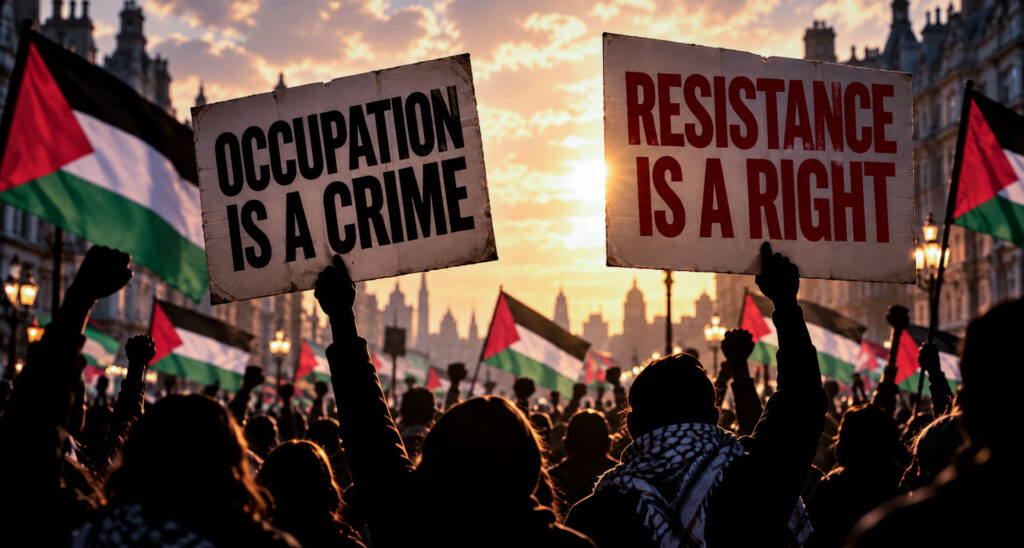
Across the major cities of the western world there have been protests, starting on October 7th itself, with signs like “resistance is not a crime” and “long live the resistance ” coupled with chants like “when people are occupied, resistance is justified.” The notion being, of course, that the actions taken by the Palestinians constitute a legitimate form of resistance to oppression and occupation.
This is an interesting notion, and makes perfect sense in a vacuum. If a sovereign state is militarily occupied by another nation, the citizens of the occupied state generally have the right to try and throw off the hostile control of their neighbor.
However, here in the real world, rather than a sterile hypothetical, there is no occupation in this instance. Even if there was, the actions the Palestinians take to “resist” would not be legitimate or just under any circumstances, no matter how grim.
A people under an occupation could plausibly attack the military forces occupying their territory. However, under no reading of international law is invading another country to murder, rape, and kidnap civilians considered “resistance.” Under no code of armed struggle was burning families alive in their homes in Nir Oz or Be’eri legitimate. Under no laws of basic morality was it justified to blow up the Sbarro pizzeria or a public bus. And no decent person can defend massacring Olympians in Munich.
Those who defend Palestinian “resistance” as a legal right usually point to two sources: The first is UN General Assembly Resolution 37/43 and the second is Additional Protocol I to the Geneva Conventions. Neither says what anti-Israel activists claim it does.
General Assembly resolutions are recommendations, not binding law. Nothing in 37/43, or anywhere else, permits targeting civilians, so doesn’t really apply to the Palestinian brand of resistance. While named in the resolution as having inalienable rights, how can the Palestinians be resisting a “foreign occupation” by Jews in Judea?
Additional Protocol I is even more damning to those who claim the Palestinians’ propensity for attacking civilians is justified under international law. The same treaty that recognizes fighting against occupation states in Article 51 that “the civilian population as such, as well as individual civilians, shall not be the object of attack,” and prohibits “acts or threats of violence the primary purpose of which is to spread terror among the civilian population.” This quite literally prohibits exactly what the Palestinians and their supporters are claiming it allows and nearly defines verbatim the entirety of Palestinian resistance going back to before the founding of the PLO.
It is astonishing that the very documents cited to justify this “resistance” are the ones that most clearly condemn it.
The history of Palestinian “resistance” goes back before 1967, and the “resistance” of Arabs before they called themselves Palestinians goes back to before the state of Israel even existed. Who were the occupiers then? Why were they attacking, raping and murdering Jews when Jews hadn’t had a state army to occupy anything in nearly 2,000 years?
Conclusion
The signs on the streets of Western cities declare that “resistance is not a crime.” They are half right. Resistance to a genuine occupation, directed at soldiers, can be lawful. But there is no “occupied Palestine,” and there is no law, no code of war, and no standard of decency under which burning families in their homes, bombing a pizzeria, or murdering Olympians can be considered legitimate acts of resistance. These are acts of terrorism, and they are crimes against humanity. No slogan will ever change those simple facts.
Liked this article? Follow HonestReporting on Twitter, Facebook, Instagram and TikTok to see even more posts and videos debunking news bias and smears, as well as other content explaining what’s really going on in Israel and the region. Get updates direct to your phone. Join our WhatsApp and Telegram channels!
© Divuach Ne’eman R”A, 2025