Key Takeaways
- In 2005, Popular Mechanics took truthers’ claims seriously enough to test them. Theories related to thermite and Building 7 were debunked. Twenty years later, conspiracists’ claims have mutated into theories that can’t be tested at all.
- There are mechanics that go into building and spreading conspiracy theories that can be spotted and called out: proportionality bias, the Gish Gallop, moving the goalposts.
- Neither debunker believes committed believers can be argued out of it; both say the real audience is the persuadable middle, and that the most effective response is transparency from institutions rather than ridicule of the people asking.
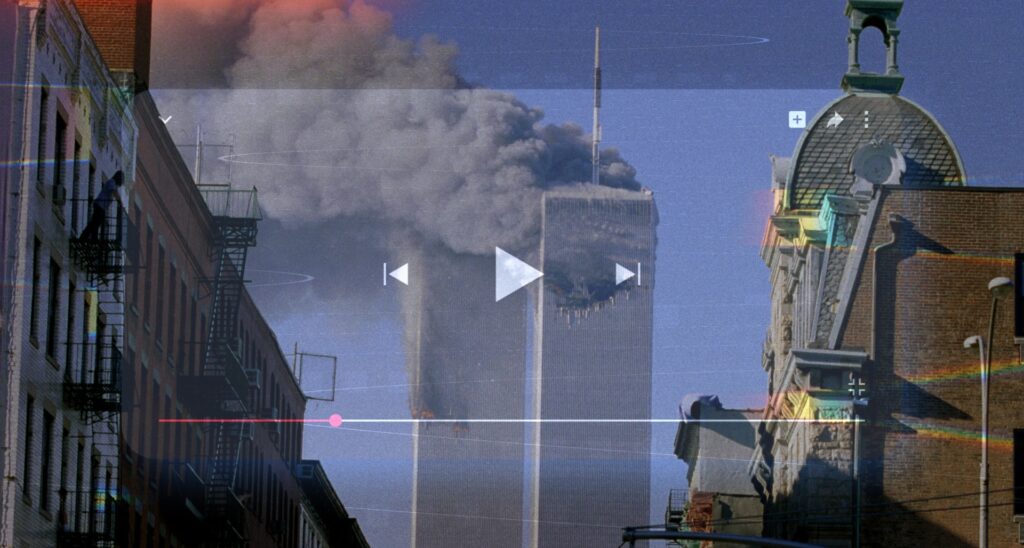
The 9/11 conspiracy theories were investigated, tested, published, and buried two decades ago. They are back, with one substitution. In 2005, the story was that the government did it. Today, increasingly, the story is that Israel did it. Same claims, same non-evidence, new target.
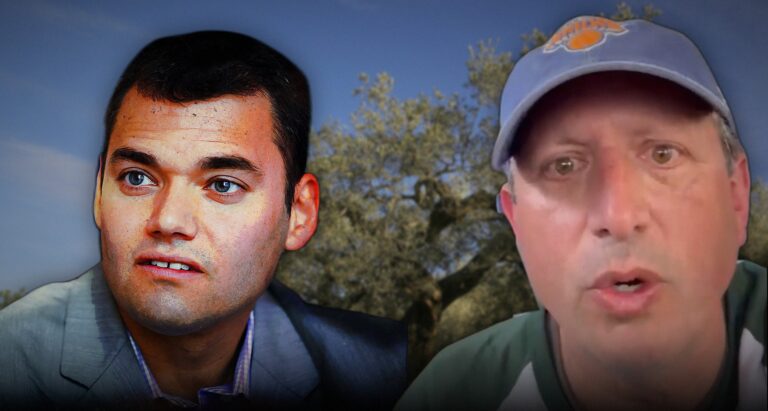
James B. Meigs was editor-in-chief of Popular Mechanics in 2005, when the magazine did what almost nobody in journalism was willing to do: take the truther claims seriously enough to actually test them. He put his staff on it; they went to hundreds of engineers, demolition experts, accident investigators and aviation specialists, and they took the most persistent myths apart one at a time. That became the March 2005 cover story and then the book Debunking 9/11 Myths.
Michael Shermer is the founder and publisher of Skeptic magazine and executive director of the Skeptic Society. When Popular Mechanics published its report in 2005, it cited Shermer’s writing on arguing from anomaly. The two men have been in the same document for twenty-one years. They had never been in the same room until this conversation.
The New Version Wins by Refusing to Be Specific
In 2012, Tucker Carlson called 9/11 truthers parasites. To imply a conspiracy, he said on camera, you ought to have some evidence, and you have none. In November 2025, he released a five-part documentary arguing that the official story is a lie and intimating, not quietly, that Israel did it. Meigs wrote the takedown in City Journal.
What happened to Carlson is, Meigs says, “way over my head.” Whether it was the audience that pays him or something internal, “it’s hard to say, but I like the old Tucker Carlson a lot better.”
What interests Meigs more is the structure of the argument. The 2005 investigation worked because it confined itself to physical claims about physical reality that were either provable or disproven. It stayed out of geopolitics entirely. “At the bottom,” Meigs says, “every theory has to have some contact with reality.”
Carlson’s new documentary is built to avoid exactly that contact. Carlson minimizes the places where he makes specific claims he would have to defend, and fills the space with former government officials making broad, unfalsifiable ones: that allies must have known, that they failed to warn, that maybe they were in on it. “He leaves it all pretty amorphous,” Meigs says, “so that by the end he can weave this idea that of course there was a big conspiracy” without ever specifying how it functioned, what the conspirators conspired to do, or who they were.
Where it does get specific, it collapses. A BBC reporter said on air that World Trade Center 7 had fallen before it had — an understandable error on a day when the building had been burning ferociously for hours, and everyone expected it to come down. But in the conspiracy world there are no mistakes. Carlson concludes the BBC was tipped off in advance, and that they clearly weren’t the only ones. The absurdity of it struck Meigs immediately: you are running a vast top-secret operation to bring down or prop up the American empire, “and you make sure to include the BBC.”
They Don’t Want You to Look at the River
Meigs describes the technique as a hiker crossing a stream, hopping from rock to rock, never acknowledging the water. The rocks are the anomalies, the river is the evidence.
Shermer calls it anomaly hunting, and it is not specific to 9/11. Any event with enough media coverage generates weird details, because every event does. The JFK assassination has a running list of roughly a hundred of them. Those are the rocks that conspiracy theorists stand on. JFK cannot have been killed by a lone nut; it has to be the CIA and the FBI and the KGB and the Mafia and LBJ.
That mismatch has a name. “We call this the proportionality bias,” Shermer says. “The size of the event should be matched by a cause that’s equally big.” Princess Diana died of drunk driving, speeding, and no seatbelt- three causes that kill tens of thousands of Americans a year, but she was a princess.
And 9/11 cannot have been nineteen men with box cutters.
The delivery mechanism is volume. Shermer knows it from the creationism debates of the 1980s, where Duane Gish would open with a slide deck of fifty objections — this fossil, this find, “here’s the left elbow of the frog” — and the biologist across from him would be handed the microphone with twenty minutes to answer what takes a semester. “You put them all together, it sounds devastating,” Shermer says. “But in fact it isn’t.” That strategy was named Gish Gallop in his honor, and is a favorite of Tucker Carlson and Candace Owens today.
Meigs got the same treatment when the Popular Mechanics report came out, and a radio producer put Alex Jones on the line. He recalls being bombarded by a dizzying array of pseudofacts about William Randolph Hearst, yellow journalism, the Spanish-American War, one thing after another. A lot of claims, stated confidently and at speed, and you understand why a listener thinks some of that has to be true, Meigs reflects. He also admits to nights spent inside conspiracy websites where his own head started to spin. “It’s a very seductive way of thinking.”
Shermer adds the piece that makes it airtight: the believer never has to defend a positive account of what happened. Pressed, the answer is that they’re not saying they know who did it or how; they’re “just asking questions.” Shermer says he calls it “JAQing off.”
The Claims Got Vaguer Because the Specific Ones Failed
Watch the theories over twenty years, and you can see them retreat.
The early ones were concrete. A missile hit the Pentagon, a claim that sold books and filled lecture halls worldwide until the wreckage, the landing gear, and the human DNA recovered inside the building made it indefensible. The towers were wired with thousands of pounds of explosives and hundreds of miles of cable, somehow installed by crews breaking through sheetrock in occupied office buildings with people coming and going all day. There were no planes; they were tankers, or holograms, or the jets were diverted to an airport and the passengers gassed.
Those were claims that demanded physical proof, and they were dismantled. So the smarter theorists moved. In truther shorthand, the shift runs from MIHOP — made it happen on purpose — to LIHOP, let it happen on purpose. “The beauty of the let-it-happen-on-purpose is you don’t need facts anymore,” Meigs says. You assert means, motive, and opportunity in borrowed legal and intelligence jargon, and once that is accepted, nothing further has to be proven.
Shermer’s version is blunter and includes a third option nobody wants. Roosevelt did not make Pearl Harbor happen and did not let it happen; he needed a way into the war and used the one he was handed. Bush wanted to finish his father’s business in Iraq, and 9/11 gave him the opening. “I call that capitalize on what happened on purpose,” Shermer says. There is plenty to criticize in what followed — Afghanistan, Iraq, the whole record. Substituting a secret plot for that argument lets the actual decision-makers off the hook.
The evidence retreated with the claims. The focus moved from the Twin Towers, which are documented in overwhelming detail, to World Trade Center 7, which for a long time was genuinely less well understood; no building had been built like that and burned like that before.
And then it retreated further, to dust. The thermite papers rest on iron oxide and aluminum flecks collected from windowsills half a mile from the site, after a collapse that buried lower Manhattan in a cloud of pulverized buildings. “What are the odds it would have a little bit of ordinary rust and a little bit of shredded aluminum in it?” Meigs asks. Nobody has ever brought a building down with thermite; nobody knows how you would, and that vagueness serves the argument rather than damaging it.
The Sources Were Antisemitic Before Anyone Noticed
The Popular Mechanics investigation was inspired by a full-page ad in The New York Times.
It advertised a book called Painful Questions, and the ad itself was a list of questions that read as reasonable: jet fuel doesn’t burn hot enough to melt steel, so how did the buildings fall? Why weren’t the planes intercepted? Why was the hole in the Pentagon too small for the aircraft that made it? Meigs saw it and thought his magazine had been answering exactly this kind of question for a century. The method required no special expertise, only diligence. So he hired reporters to run down every claim, call people, read documents, ask experts.
That last step is the one the theories almost never take. The seismic-spike claim held that explosions at the World Trade Center registered on a seismograph at the Lamont-Doherty Earth Observatory, across the river from where Meigs still works. Nobody had ever called. When Popular Mechanics did, the scientists’ reaction was relief: oh my gosh, I’m so glad you called. The trace showed the collapse — a gradual, escalating cascade of vibration entirely consistent with a building coming down — and they had been unable to get that in front of anyone.
Painful Questions was written by Eric Hufschmid, who also trafficked in Holocaust denial. The seismic-spike claim came from Christopher Bollyn, writing in the American Free Press, the paper founded by Willis Carto.
While Meigs says he didn’t see any of it coming, Shermer recognized the shape of it immediately. He had just finished a book on Holocaust denial. It referenced a man named Bradley Smith who, in the 1980s, bought ads in college newspapers offering money to any campus that would host a debate on the Holocaust. This was the same move, a generation later: launder the claim by dressing it as an invitation to inquiry.
Shermer also supplies the test that separates error from fraud. Everyone makes mistakes; historians make them constantly. In the libel trial David Irving brought against Deborah Lipstadt, the defense went through every footnote Irving had ever written and found errors everywhere — as they would in any historian’s work. What convicted him was direction. “His all moved in one direction, and that’s how they proved it.” The same test applies to the truthers: every error they identify moves their way. That tells you the belief is driving the evidence, not the other way around.
What struck Meigs hardest was who was repeating it. In 2005, the 9/11 theories lived on the progressive left, in alternative weeklies in Seattle and elsewhere. The people originating the underlying material were long-standing racists and antisemites. Self-described liberal, open-minded, tolerant readers were recycling professional bigots without a flicker of skepticism, “because they liked the conclusion.”
A Conspiracy Theory Is a Mind Virus, and It Routes Back to the Protocols
“Conspiracy theories are a little bit like a mind virus,” Meigs says. Once one has taken hold, the next exotic claim is easier to absorb.
And the destination is not random. Almost all of these theories converge on a single vast entity secretly controlling events, which is to say they replicate The Protocols of the Elders of Zion, a forgery, a point Meigs now finds he has to say out loud. Someone can be raised with no antisemitism at all, he says, and still be drawn in: “It’s like a black hole whose gravity pulls them in once they’re in the world of conspiracies, because so many of them come back to that.”
Twenty years on, the pull is visible on both ends of the horseshoe: Hasan Piker and Candace Owens arriving at the same conclusions but from opposite directions, because both run on the same underlying animus.
Shermer has watched the Mossad become the universal solvent. It is a formidable intelligence service that has done real things, “but that doesn’t mean everything you think is weird that happened is due to Mossad.” They did not kill Charlie Kirk. The Epstein case did not run through them. When the Iran war started, the whole thing was reorganized around Israel overnight.
He has a name for the mechanism: proxy conspiracies. Very few people literally believed a pedophile ring was operating out of a Washington pizzeria, but one man did show up with a gun and demanded to be shown where the basement was. There was no basement.
The retreat position is maybe not that one, but they’d do something like that. Shermer traces the same logic through the O.J. Simpson verdict: the LAPD really had planted evidence and abused Black Angelenos for decades, so a jury in the 1990s could conclude that whether or not this particular detective planted this particular glove, it was the kind of thing they did and would do again.
Underneath that sits something more ordinary than malice. It’s simply not knowing, and not taking the time to learn for themselves. Ask people to draw a bicycle, and the pedals go missing. Ask whether they support NAFTA and most can’t say what is in it. Ask a college class to explain natural selection, and you get giraffes stretching their necks. What they’re really signaling, Shermer says, is groupthink: my team believes this, the scientists usually get it right, I’ll offload the work I don’t have time to do. The whole system runs on trust in institutions.
You Cannot Argue Someone Out of a Conclusion They Reached Morally
The insertion of ethics into the argument is why the fight has become so hard to win.
Meigs keeps returning to a comment left on the Popular Mechanics website after the first report: some people find the facts and then draw a moral conclusion, and other people start with the moral conclusion and assemble the facts that justify it. “That’s really it in a nutshell.”
He sees the same structure in the campus argument over Israel. The desire to protect the oppressed is a good instinct, but it is not a developed idea; it is closer to an impulse, and it can be hijacked. Add decades of relativism in which everything is a social construct enforced by power, and the conclusion arrives before the evidence: power is bad, Israel has power, ipso facto. Only after do the facts get compiled.
That is the daily problem at HonestReporting. When The New York Times ran a photograph of an emaciated child from Gaza, and it emerged that the child had a congenital disorder (and that other frames from the same shoot showed people who were plainly not emaciated), saying so out loud makes the speaker sound like a monster. Meigs suspects somebody at that paper wondered whether the photo showed what they were saying it showed, and didn’t want to ask, because it was too useful.
Meigs raises the issue of feasibility when conspiracists allege a large-scale coordinated effort to hide the truth. Imagine, he says, that he arrives as editor of a magazine, hires people he has never met, gathers them in a room and says: we are all going to cover up the greatest crime in American history, and keep the secret for the rest of our lives. “Is that how you think the world works? This isn’t a Dan Brown novel.” The larger versions of the conspiracies would require thousands of people to never talk. But someone always does. Though Harvey Weinstein’s accusers signed NDAs, they talked anyway. When President Trump declassified decades of files related to UFO sightings, the very people who had been demanding disclosure claimed it wasn’t real. “You don’t really want the answers,” Shermer says. “You really like the pursuit.”
The Only Real Antidote Is Institutions That Don’t Hide Things
Neither man thinks the diehards are reachable. Both think the middle is.
That means not shouting people down, and not treating a question as an offense. Meigs points to the Wuhan lab leak as the cautionary case: Alina Chan waded into it as a young postdoc, going against the consensus of her entire field and at real risk to her career, and she was right about the strength of the possibility. What made the subsequent damage permanent was not the uncertainty. It was the effort to freeze out the scientists asking, to lean on platforms to suppress it, to shut down a legitimate question by calling it a conspiracy theory.
“Science isn’t about trust,” Meigs says. “That’s not a word you use in science. Science is about evidence.” And then the operative line for anyone in charge of anything: “If you’re in a position of authority, don’t ever make it look like you’re hiding something.”
Asked what they understand now that they didn’t when they started, Meigs reaches for Richard Hofstadter, who described the conspiracy-minded believer as someone who always lives at a hinge point in history: the wised-up one who sees through the illusion that has fooled everyone else. It is thrilling. It is personally compelling. It is very hard to reach them with an argument about how thermite works.
Shermer’s answer is shorter, and it rests on basic instinct. The fear underneath it all, he says, is not that lizard aliens or the Illuminati are running the world.
It’s that nobody is.
James B. Meigs is a senior fellow at the Manhattan Institute, a columnist for the Wall Street Journal’s Free Expression newsletter, and the former editor-in-chief of Popular Mechanics, where he directed the magazine’s 2005 investigation of 9/11 conspiracy claims. Michael Shermer is the founder and publisher of Skeptic magazine and executive director of the Skeptic Society. He is the author of Conspiracy: Why the Rational Believe the Irrational and Denying History.
This interview was conducted by Ben Chertoff for The Honest Take. Listen and subscribe to the show on your favorite podcast streaming platform: https://podcast.honestreporting.com
Liked this article? Follow HonestReporting on Twitter, Facebook, Instagram and TikTok to see even more posts and videos debunking news bias and smears, as well as other content explaining what’s really going on in Israel and the region. Get updates direct to your phone. Join our WhatsApp and Telegram channels!
© Divuach Ne’eman R”A, 2025