Key Takeaways:
- Satellite imagery of the Gaza Strip shared online is being used to claim Israel committed genocide.
- The imagery alone does not have the ability to show Israel’s military purpose for targeting certain locations, nor can it show Hamas’ underground tunnel network.
- Media coverage that presents destruction without military context leads to a misleading picture of the war.
Throughout the Israel-Hamas war, the internet has repeatedly leveled false accusations of genocide against Israel by distorting the meaning of the term and applying it to circumstances that do not meet its definition. The term has become so misrepresented when used to describe Israel’s military actions that even legitimate collateral damage assessments have been twisted into evidence of genocide.
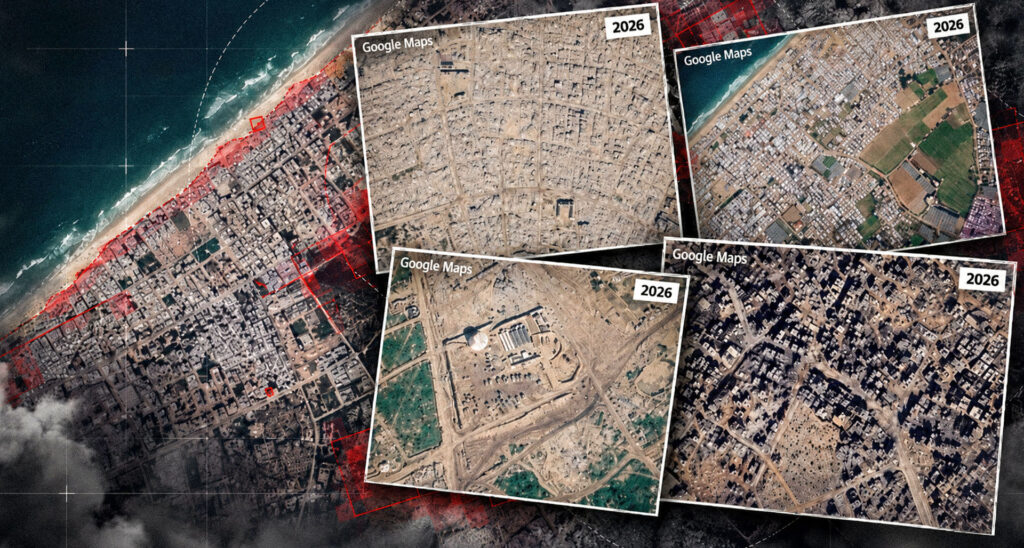
Now, satellite imagery of the Gaza Strip is being used to reach the same conclusion.
Despite the images originally being updated by Google in June, HonestReporting.ai Labs found that the imagery was first published and spread online on September 26, when the director of Electronic Intifada posted satellite imagery from Gaza on X, garnering more than 4 million views. From there, the images began to circulate online in activist circles, eventually reaching newsrooms on September 28 with articles published by Anadolu, The Independent and Newsweek, then appearing two days later on the front page of The National.
Each outlet portrayed the images as being conclusive evidence of genocide, when compared against a satellite image taken from the same location before the war.
Yet not one outlet mentioned the most important information: satellite imagery does not show what is underground. For instance, the satellite imagery of Tel al-Sultan shows significant destruction. But what the image does not show is the vast tunnel network hidden underground in the same neighborhood.
It was in this very location that Hamas murdered six Israeli hostages in a tunnel 20 meters underground, and where former Hamas leader Yahya Sinwar hid from the IDF.
Nor can satellite imagery explain the military purpose of targeting a specific location. Tall buildings have been used by Hamas to track Israeli troop movements. Meanwhile, hospitals were turned into terror hubs, acting as command-and-control centers, weapons storage facilities, and hideouts. Tunnels have consistently been found beneath or adjacent to hospitals. Ordinary residential buildings have similarly been turned into places to launch attacks from or have been booby-trapped with explosives.
Satellite imagery from Rafah presents the neighborhood as destroyed. What the images cannot explain is how Hamas had transformed the area into a major center of its military infrastructure. As Rafah is positioned along the Egyptian border, Hamas held the region as a tactic to control aid and movement while smuggling weapons, specifically using tunnels that crossed into Egypt. Meanwhile, buildings, many of which were booby-trapped, were also used to hold hostages. The city ultimately was a critical aspect of Hamas’ very survival until the IDF began its military operations there.
Just as importantly, the satellite imagery being highlighted is not a comprehensive picture of Gaza. Locations showing less destruction are conspicuously absent from both news coverage and posts online. By selecting images of the most heavily damaged areas while omitting those that present a different picture, destruction is presented without the military context needed to explain why it occurred. What this does display is that the IDF’s intention was never to inflict arbitrary destruction or to commit genocide.
When the images alone are presented as evidence, the necessary context disappears. That is to be expected when images are shared online by anti-Israel activists to demonize Israel. However, the international media has a different moral obligation and responsibility, one that should require it to explain what cannot be seen from looking at a picture alone. Letting the imagery speak for itself ultimately leads to a dark conclusion that misrepresents the challenging war Israel has been fighting.
The destruction is undeniable. But destruction is not evidence of genocide; rather, it is a feature of urban warfare that must be understood in its military context.
Liked this article? Follow HonestReporting on Twitter, Facebook, Instagram and TikTok to see even more posts and videos debunking news bias and smears, as well as other content explaining what’s really going on in Israel and the region. Get updates direct to your phone. Join our WhatsApp and Telegram channels!
© Divuach Ne’eman R”A, 2025