Key Takeaways:
• Iran’s repression is not absent from global awareness because evidence is lacking, but because it is consistently deprived of sustained visual presence in international media.
• The same media ecosystem that amplifies Gaza imagery daily applies radically different standards to Iran, sidelining mass violence through omission rather than denial.
• This imbalance is not accidental. It reflects editorial choices about which conflicts are rendered visually urgent and which are allowed to remain abstract.
Iran is experiencing one of the most severe internal crackdowns of the modern era. Protests have spread across cities and provinces. Security forces have responded with lethal force. Arrests, disappearances, and executions have followed. Internet access has been repeatedly restricted. Journalists have been detained. Cameras have been confiscated.
And yet, the visual record reaching global audiences tells a strangely muted story.
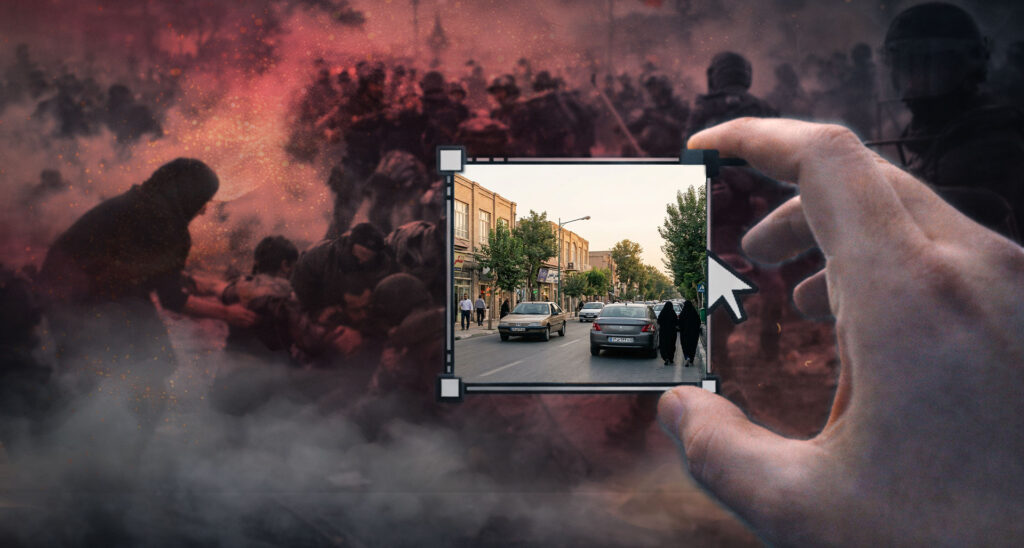
Unlike other conflicts that dominate front pages and broadcasts through relentless imagery, Iran appears largely through statements, diplomatic reactions, and carefully managed official visuals. The scale of repression is acknowledged in text, but rarely embodied in images. The violence is known, but not seen.
This absence is not a coincidence of access or a temporary gap in coverage. It is the product of a media system that decides, repeatedly, which crises are rendered visually urgent and which are allowed to recede into abstraction.
Human Cost Measured Through Absence
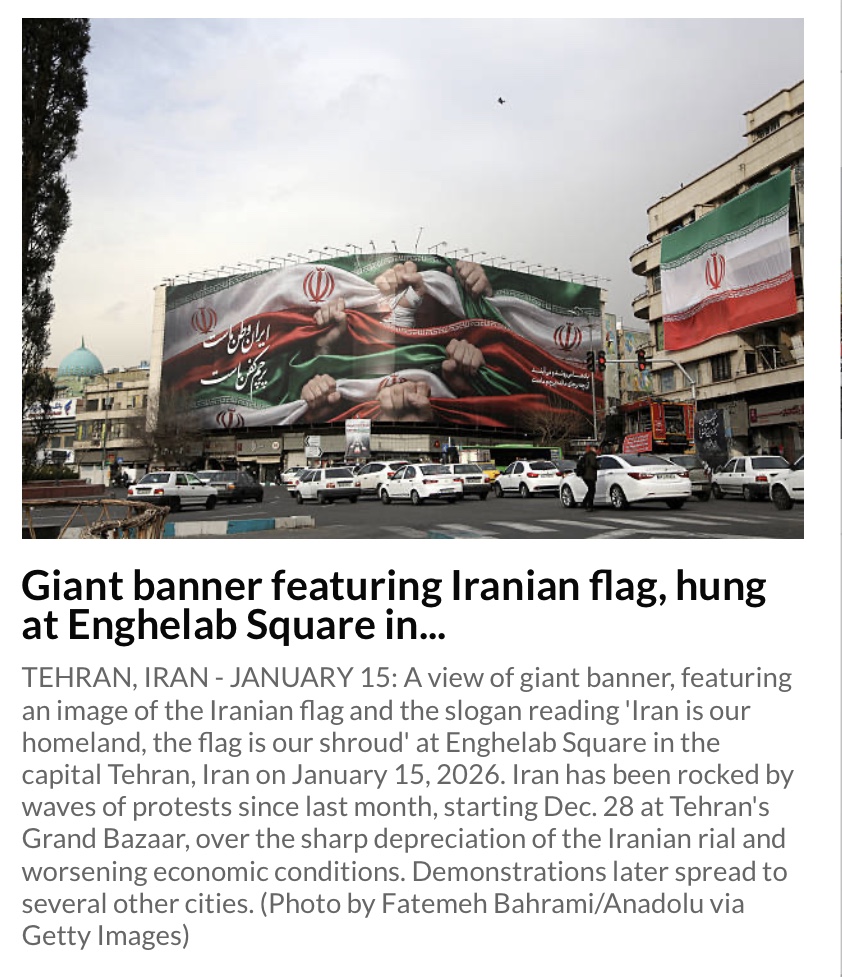
What makes Iran’s repression uniquely invisible is not the lack of information, but the lack of accumulated visual witness. There is no sustained visual record of fear moving through neighborhoods, of emergency rooms overwhelmed by the wounded, of families searching for the disappeared. The absence itself carries evidentiary weight. In conflicts of this scale, visual silence is not neutral. It is diagnostic. When an entire category of imagery fails to materialize over time, it signals not safety or calm, but structural suppression of visibility.
Screenshot
A Pattern, Not an Oversight
Modern news audiences understand that images shape moral attention. What is seen repeatedly becomes emotionally legible. What is not seen, even when reported, remains distant.
In recent years, Gaza has been rendered omnipresent through a constant flow of imagery: destruction, suffering, rescue, grief. These images arrive daily, framed urgently, circulated widely, and reinforced across platforms. They are treated as essential to understanding the conflict.
Iran has not been afforded the same visual insistence.
This disparity is often explained away through familiar arguments: access restrictions, safety concerns, verification challenges. But those explanations collapse under comparison. Other conflicts with comparable risks still generate sustained visual documentation. What differs is not danger alone, but editorial persistence.
The Stringer Myth and the Caption Double Standard
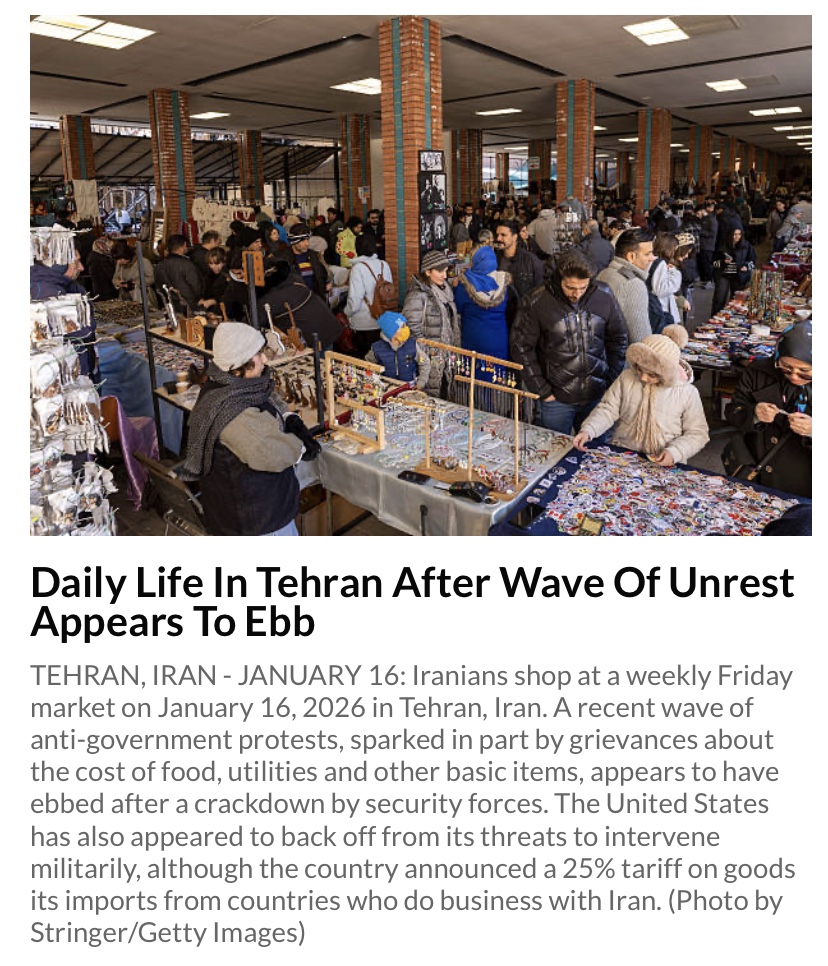
In Gaza, images supplied by local photographers operating under Hamas control are routinely elevated through emotionally assertive captions and contextual framing. Restrictions are foregrounded as proof of concealment, while the imagery itself is treated as evidentiary. In Iran, images distributed under the neutral byline of “Stringer” are stripped of context about state oversight, accreditation pressure, or censorship. The same word functions in opposite ways: in Gaza, it signals danger and urgency; in Iran, it signals neutrality. This asymmetry is not incidental. It is editorially constructed.
Screenshot
When Violence is Reduced to Text
Iran’s repression is extensively documented by human rights organizations, diaspora networks, and independent observers. Accounts of shootings, torture, mass arrests, and executions are widely reported.
What is missing is visual continuity.
There are no sustained sequences showing the aftermath of crackdowns. No repeated imagery of overwhelmed hospitals. No visual accumulation that forces audiences to confront the scale of what is happening. Instead, repression appears episodic, fragmented, and abstract.
This absence has consequences. Without images, violence remains conceptual. Without visual repetition, outrage dissipates. The story becomes something to be acknowledged, not reckoned with.
January 2026 and the Problem of Contemporaneous Erasure
During January 2026, this absence became especially pronounced. Reports of nighttime hospital raids, forced removals of the wounded, and coordinated security operations circulated through human rights channels and diaspora networks, yet none of these dynamics entered the mainstream visual record. The temporal proximity between reported violence and visual quiet is critical. This was not historical distance. It was contemporaneous erasure.
The Double Standard Made Visible
The contrast with coverage elsewhere is stark.
In Gaza, restrictions on journalists are framed as evidence of concealment. Imagery supplied under controlled conditions is still treated as urgent and authoritative. Visual access is demanded, and its absence is loudly criticized.
In Iran, where restrictions are more severe and more dangerous, there is no comparable outcry. The lack of images is accepted as an unfortunate reality rather than challenged as a journalistic failure.
This is not a neutral difference. It is a methodological one.
The same media system that insists on images to validate suffering in one context accepts their absence in another. The standard is not principle. It is editorial choice.
Visual Substitution as Media Strategy
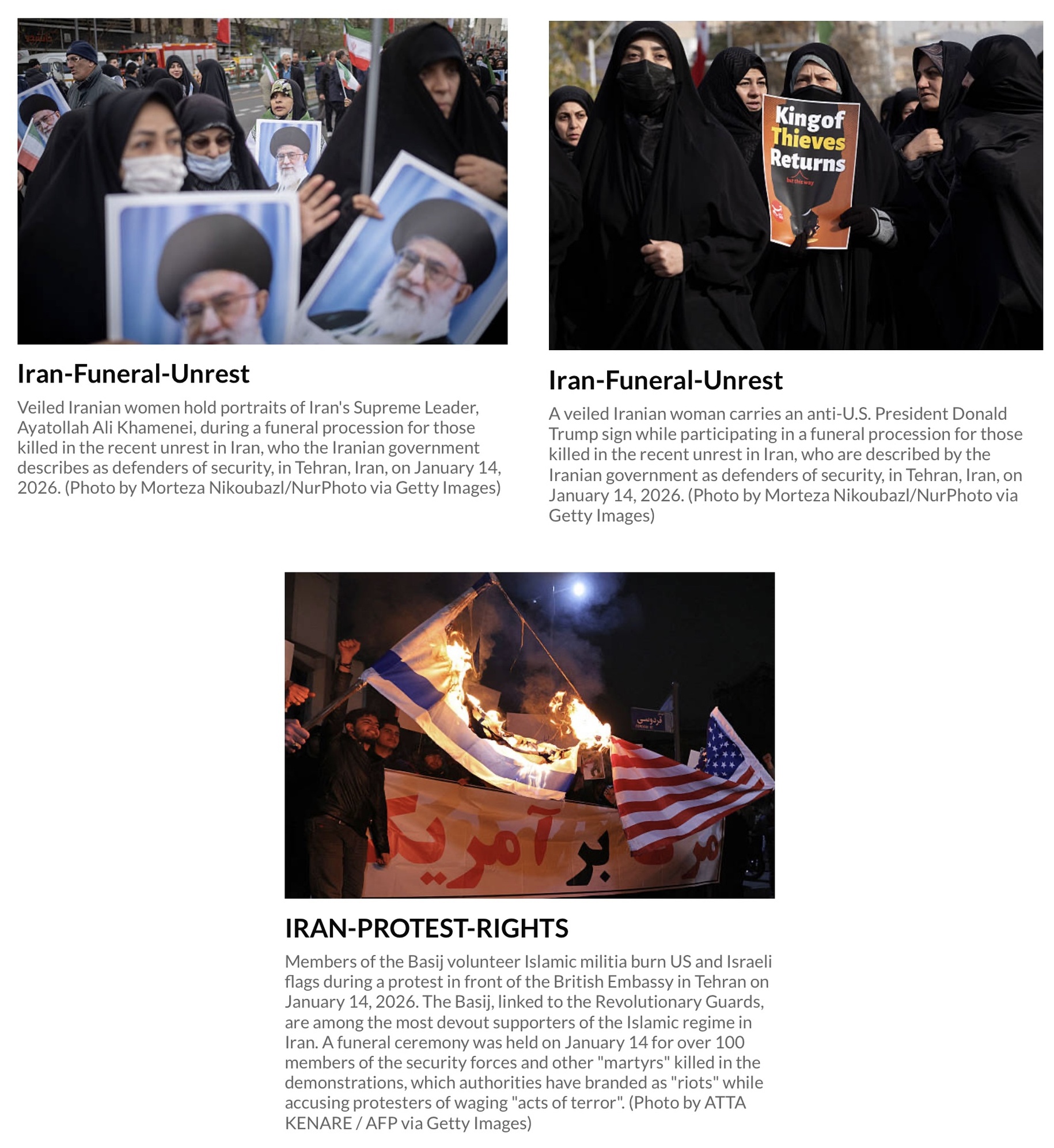
What emerges is not random omission but a coherent pattern of visual substitution. When uncontrolled imagery cannot circulate, controlled imagery expands to fill the gap. Official rallies, symbolic displays, and choreographed public scenes do not merely coexist with repression; they visually displace it. The result is not denial of violence, but its visual replacement with order, ceremony, and stability.
How Selective Vision Functions
This imbalance does not require conspiracy. It requires inertia.
Visual news ecosystems reward volume, familiarity, and immediacy. Conflicts that already generate imagery continue to receive it. Conflicts that are visually constrained drift toward the margins, regardless of severity.
Over time, this creates a feedback loop. Editors expect fewer images from Iran, so they assign fewer resources. Audiences see less, so urgency fades. The absence becomes normalized.
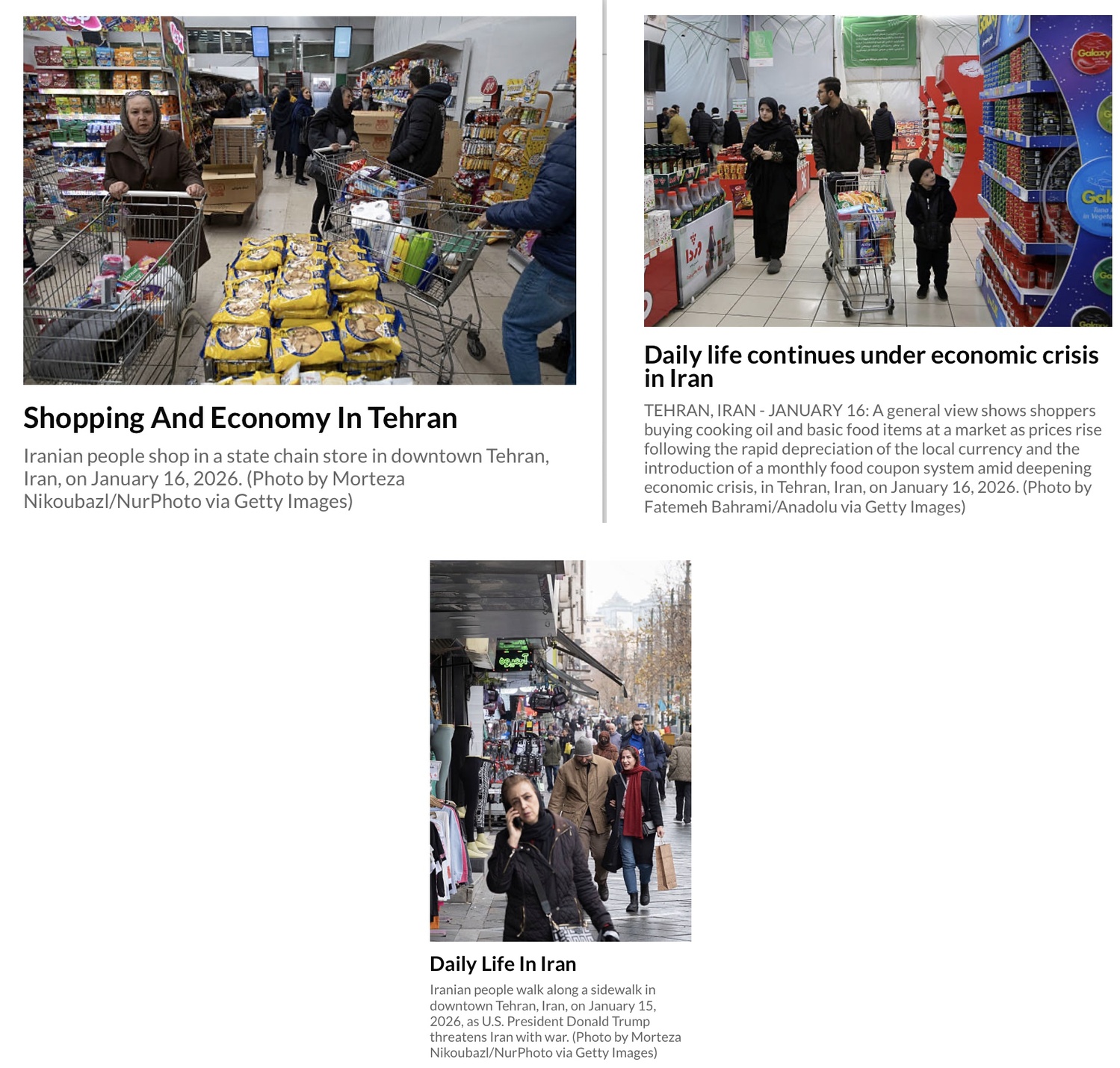
What results is not silence, but substitution. Carefully managed official visuals fill the space left by what cannot be shown. Order replaces chaos. Stability replaces violence. The frame narrows, and with it, public understanding.
A single editorial truth: The world does not lack eyes on Iran; it lacks the editorial will to look.
Conclusion
What is happening in Iran is not invisible. It is being displaced.
The global media system has not failed because it lacks images, witnesses, or warnings. It has failed because it consistently chooses which violence deserves saturation coverage and which is permitted to remain abstract, distant, and visually muted.
Gaza is rendered omnipresent through imagery that arrives daily, framed urgently, and circulated without hesitation. Iran, by contrast, is reduced to statements, denials, and carefully managed official visuals, even as repression unfolds at scale. This disparity cannot be explained by access, safety, or verification alone. It reflects a deeper editorial pattern about what kinds of suffering are considered legible, mobilizing, and worth sustained attention.
When violence is visually sidelined, accountability is delayed. When imagery is selectively amplified, moral urgency is distorted. The result is not neutrality, but narrative imbalance with real-world consequences.
If journalism cannot adapt to document repression where visibility is intentionally denied, what role does it retain in an age of authoritarian control? If editors accept visual absence as inevitable rather than interrogating its cause, whose violence will be next to disappear? And if moral urgency is determined by image availability rather than human cost, what does that say about the future credibility of the profession itself?
Liked this article? Follow HonestReporting on Twitter, Facebook, Instagram and TikTok to see even more posts and videos debunking news bias and smears, as well as other content explaining what’s really going on in Israel and the region. Get updates direct to your phone. Join our WhatsApp and Telegram channels!
© Divuach Ne’eman R”A, 2025