Key Takeaways
- Jew-hate survives by disguising itself as virtue. Today, ancient hatred of Jews is repackaged in the vocabulary of human rights, anti-colonialism, “genocide,” and “apartheid” — allowing prejudice to present itself not as hatred, but as moral conscience.
- Appropriating Jewish suffering both erases and weaponizes it. Equating the Holocaust with the Nakba or Israeli hostages with Palestinian prisoners strips Jewish experiences of their meaning while borrowing their moral weight to indict Jews and Israel.
- Jewish trauma and symbols are not available for inversion. The Holocaust, the language born from Jewish catastrophe, and symbols like the yellow hostage ribbon have histories and meanings that cannot simply be reassigned to those responsible for Jewish suffering.
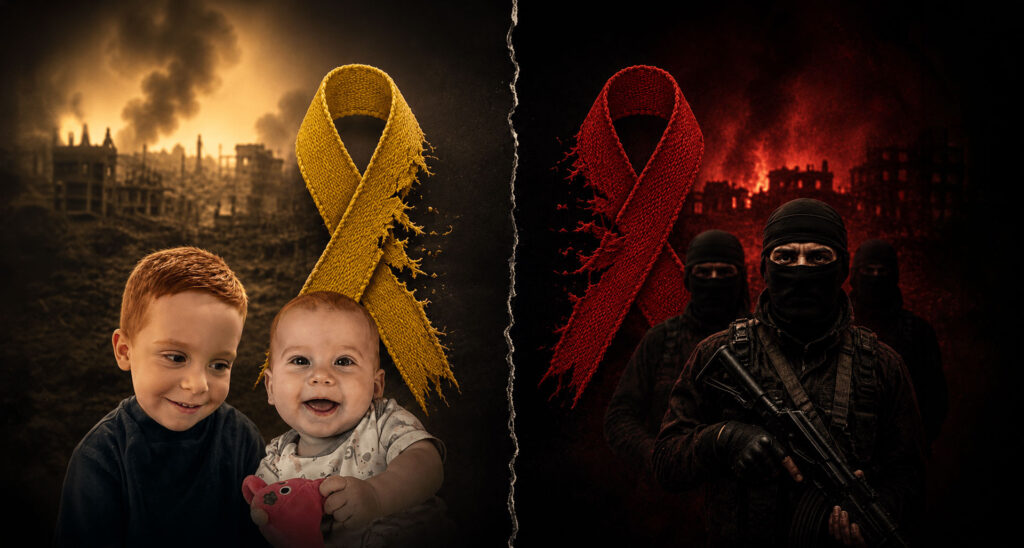
Since October 7th, a small yellow ribbon has traveled the world. It is pinned to coats in London and tied around trees in Tel Aviv. It is folded into the lapels of men reading Kaddish and printed on the posters that went up on every lamppost in every city where Jews live. It carries one meaning: Bring them home. It is worn for the people taken into Gaza on a single morning: infants, mothers, grandmothers, Holocaust survivors, a young woman pulled bleeding from the back of a jeep, teenagers seized from a music festival in the desert.
Before long, a second ribbon began to circulate. This one was red. It was worn, its promoters said, to demand the freedom of Palestinian “hostages.” It also appeared alongside signs bearing the slogan “Bring them home”: the exact words that defined the campaign for the return of the actual hostages taken on October 7.
The move was simple. A symbol of Jewish grief, grief for those stolen from us, was copied in a different color and pinned to the chests of people demanding the release of terrorists, many of them convicted in courts of law for murder. This was not a case of two peoples reaching independently for the same idea. It was a taking. And it is a taking I have watched unfold since the morning the bodies were still being counted.
This is not about the war, and not about the borders. It is about a particular habit that has gained popularity in the past two years: the confiscation of Jewish suffering, and its transfer onto others. Very often onto the very people, or the champions of the very people, who inflicted that suffering in the first place.
A Stolen Ribbon
The ribbon shows how the method works. The yellow ribbon did not appear from nowhere. It is an old American sign of a family waiting for someone who has not come home, worn through wars and absences long before this one. When Israelis and Jews reached for it after October 7th, they reached for something plain and human. A hostage is a person who has been snatched from their life and held against their will.
The red ribbon answered a claim, not a fact. The people it referred to were, overwhelmingly, security prisoners: individuals charged and sentenced through a legal process, a great many of them for planning or carrying out the killing of civilians. To wear a red ribbon for their release, in deliberate mirror of the yellow one, is to say that these two groups are the same. A baby carried into a tunnel and a man serving multiple life sentences for murder become interchangeable captives.
The Word “Hostage”
The same thing happened to the word itself. During the exchanges that returned some of the captives, the pattern that had lived on activist placards climbed into the language of the mainstream. Palestinian prisoners released from Israeli jails were described, in headlines and broadcasts and the mouths of commentators, as “hostages.” The word was applied to convicted men as though it were a neutral synonym for anyone behind bars. And once the two uses sat side by side in the same sentence, the distinction they exist to protect quietly dissolved.
A hostage is not a prisoner. This is not a subtle point of vocabulary. A hostage has committed no crime and faced no court; a hostage is seized precisely because they are innocent and therefore useful as leverage. A convicted prisoner is in custody as a consequence of an act. To fuse the two is to erase the innocence of the one and the guilt of the other, in a single stroke, using a single stolen word.
The exchanges themselves made the sleight of hand impossible to miss. The living captives were returned in their dozens, and then in their handfuls, only in return for Palestinian prisoners released in far greater numbers. The arithmetic itself was an old and grim confession of how differently the two sides price a human life. A young hostage would come home, gaunt and hollowed, and the coverage beside her would grieve the “hostages” now walking free the other way, men who had been tried for the murder of Jews. The screen split down the middle and asked the viewer to feel the same thing on both sides of it. That was the design. Grief for the innocent and grief for their killers, framed as one continuous human tragedy, until the audience could no longer say which was which. Having lost the distinction, they could no longer say who had done what to whom.
The Words For It
The ribbon and the “hostage” are recent. The deeper pattern reaches back much further, into the vocabulary the modern world uses for its worst crimes: a vocabulary that, again and again, was built out of Jewish catastrophe and is now aimed at the Jewish state.
The gravest word we possess is not an ancient one. “Genocide” was invented in 1944 by Raphael Lemkin, a Polish Jewish lawyer, who fused the Greek genos with the Latin -cide to give a name to something the law had no name for. Lemkin was not theorizing from a distance. He fled the Nazi advance across Europe, and dozens of his relatives, his parents among them, were murdered in the Shoah. He spent the rest of his life, poor and largely alone, campaigning until the United Nations adopted the Genocide Convention in 1948. He built the word out of the ash of his own family. Today it is the favored charge against the one state the Jewish people built for their survival, and it is chanted by people who could not say where the word came from or who paid for it.
“Pogrom” is a Russian word, carried into every European language to describe a very particular horror: the organized mob descending on the Jewish quarter, the burned homes and the murdered families, the authorities who stood back and let it run. The word exists because the thing happened to Jews, over and over, from Kishinev to Kristallnacht. On October 7th the Jewish people experienced the largest single-day massacre of Jews since the Shoah, a pogrom in the oldest and most literal sense, complete with the celebration of the killers. And within days the word, and the accusation of mass murder it carries, was being turned to describe Israel’s response. The term coined by the persecutors of Jews to name what they did to Jews now travels the other way.
The turn is not impressionistic; it can be counted. In our tracking of how the language of antisemitism moves online, we gathered every post in our collection that reached for the word “pogrom.” Of the 289 it found, at least 180, nearly two-thirds, used the word not for something done to Jews but to accuse Israel and its soldiers of committing a pogrom themselves. By reach the tilt is starker still: those posts drew more than 286,000 of the roughly 406,000 engagements the word earned in total, about seven in ten. And these are the conservative figures, since the count leaves out the many posts that simply declared “this is the real pogrom” without naming anyone, which would only push the share higher. The pattern lay dormant for years and then erupted in a single month, July 2026, and most of that month’s posts were the inverted kind. A word that entered our language for one reason, because of what was done to Jews in Kishinev and a hundred towns like it, is now, more often than not, aimed at the Jews who survived to build a state.
“Apartheid” is not a word of Jewish origin, but is hijacked under the same method of theft. It names a specific system of racial law in South Africa and it is among the heaviest moral words the twentieth century produced. That is exactly why it was chosen. It is attached, with a consistency that no honest observer could mistake for coincidence, to the single Jewish state, and to almost no other place on earth, however brutal. The point is never analysis. The point is to reach for the most damning word available and fasten it to the Jew, so that the moral weight built up around real atrocities can be spent against us.
No Holocaust in Gaza
I have seen the phrase “Holocaust in Gaza” on placards and in the captions of people with very large audiences. I have seen it invoked, explicitly, as the template for what Israel is said to be doing, the Star of David drawn as a swastika, the survivors told that they have become the thing that tried to annihilate them.
The Holocaust was the industrialized murder of six million Jews, carried out by a state that built factories for the sole purpose of turning Jewish human beings into smoke, whose aim was the removal of every Jew from the face of the earth. Gaza is a terrible war, with horrific civilian suffering, fought against an enemy that started it by butchering civilians and hiding behind its own. To lay the word Holocaust over it is not a comparison. It is a desecration, and it is designed as one. The purpose is not to describe Gaza. The purpose is to take the defining catastrophe of Jewish history, the event that sits at the center of recent Jewish memory, and hand it to the Palestinians as their own, while turning its perpetrators’ role over to the Jews.
It accomplishes something precise for the person who does it. In one move, the Jew is stripped of the Holocaust, which is no longer ours but a general-purpose metaphor available to our accusers, and the Jew is recast as the Nazi. Our grief is confiscated and our guilt is invented, using the same word, in the same breath. There is a horrible economy to it.
Why it Works
None of this is random, and none of it is new. Jew-hate has always survived by borrowing the language a society holds most sacred and bending it against the Jew. When Europe was Christian, the Jew was the killer of God. When Europe worshipped race and nation, the Jew was the racial pollutant and the rootless cosmopolitan. Our own age holds nothing more sacred than the vocabulary of human rights and anti-colonial justice: genocide and apartheid, the oppressor and his victim. So that is the language the hatred now speaks. It does not announce itself as hatred. It arrives dressed as conscience, which is why so many decent people march behind it without ever suspecting what they are carrying.
The confiscation of our suffering is the sharpest form this takes, because it does two jobs at once. It denies that Jewish pain is real or singular: if the Nakba is the Holocaust and every prisoner is a hostage, then nothing that happened to the Jews was distinct, and our memory is just one grievance in a crowded field. And at the same time it arms our accusers with the moral authority that our pain earned, so that the words we bled to define can be fired back at us. We are robbed of the past and convicted with the proceeds.
I have spent years arguing that only Jews can define Jewish experience, and I hold to it here. Our symbols are ours. Our dead are ours. The words we forged in our own catastrophes were not minted to be handed to whoever finds them useful against us. Genocide came out of Lemkin’s murdered family. The Holocaust came out of our six million.
The yellow ribbon means what the people who first tied it meant. It means a family standing at the window, waiting for a loved one who was stolen from them. No one gets to repaint that and pin it to the ones who did the taking. And if the world cannot see the difference between the stolen and the thief, that failure is not ours to carry. It is the world’s.
Liked this article? Follow HonestReporting on Twitter, Facebook, Instagram and TikTok to see even more posts and videos debunking news bias and smears, as well as other content explaining what’s really going on in Israel and the region. Get updates direct to your phone. Join our WhatsApp and Telegram channels!
© Divuach Ne’eman R”A, 2025