Key Takeaways
- Dog whistles rely on ambiguity. They communicate different messages to different audiences while maintaining plausible deniability.
- Coded language has a long history. Many modern political terms evolved from older antisemitic narratives after explicit expressions became socially unacceptable.
- Language shapes behavior over time. Repeated exposure to coded rhetoric can normalize extremist ideas and contribute to a greater risk of real-world violence.
Last week, Vice President JD Vance spent three hours on Joe Rogan’s podcast covering everything from the Epstein files to his theory that aliens could be demons. Buried in the conversation were two lines that a narrower, more attentive slice of the audience recognized instantly. The first: Epstein “clearly had connections to the highest levels of Israeli intelligence.” The second, offered almost in passing about Israeli politicians “wanting endless war.” Taken at face value, both sound like ordinary political commentary, the kind of thing said about any intelligence service, any country’s leaders and their wars. But each echoes a claim that has circulated in conspiracy communities for years, and each of those claims descends from a much older idea: that Jews, or the Jewish state, secretly steer world events from behind the curtain, and profit from the chaos, the wars, the destabilization they orchestrate. The “puppeteer” language traces a direct line back through decades of conspiracist rhetoric. The “endless war” line does the same work in miniature, gesturing at the old Protocols-era claim that Jewish power thrives on manufactured conflict, without ever having to name it outright. Whether Vance meant to invoke any of that is beside the point of this piece. What matters is that the vocabulary exists, has existed for well over a century, and shows no sign of going away. Understanding subtextual rhetoric about Jews requires knowing where the ideas came from and how they spread, a worthwhile endeavor in its own terms, independent of any one guest or host.
What is a Dog Whistle?
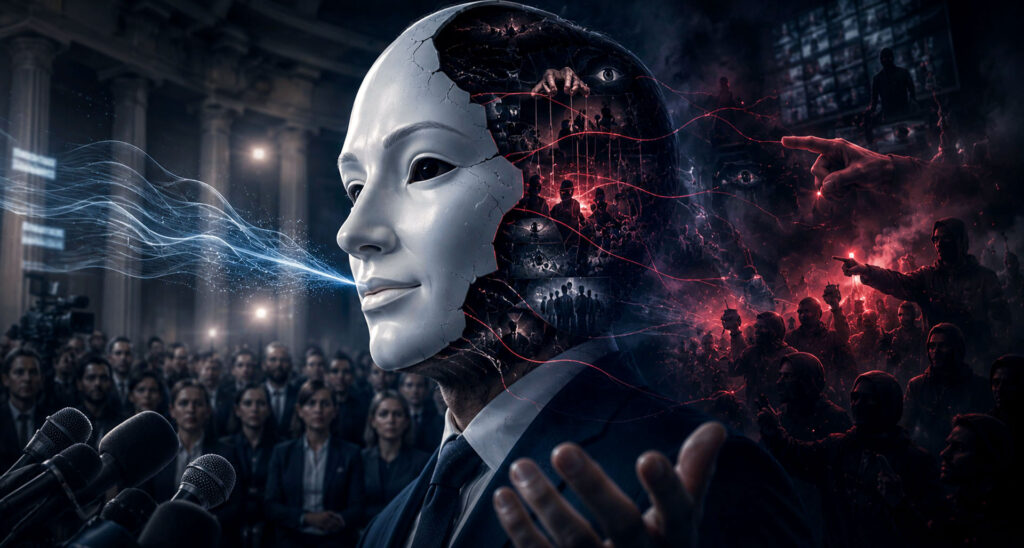
A dog whistle is language designed to carry two messages at once: an innocuous one for the general audience and a second, sharper one for listeners already primed to receive it. Its power lies almost entirely in deniability. Because the surface statement is defensible, anyone who flags the coded meaning underneath can be accused of imagining things. That deniability isn’t a side effect of the technique. It is the technique. A speaker gets to activate a prejudice in listeners who already hold it while never having to own the prejudice publicly, and critics who name what’s happening can be dismissed as oversensitive or paranoid.
The linguistic mechanism behind this is sometimes called semantic bleaching: a word or phrase gradually loses its specific, loaded meaning through repeated casual use, until it functions as ordinary vocabulary even though its origin was anything but ordinary. This is exactly what allows the same term to be used with complete innocence by one speaker and with real intent by another. The ambiguity is not a flaw in the system. That’s the point of it.
The term “dog whistle” itself is younger than the practice it describes. “Dog whistle politics” entered political science usage in Australia in the 1990s to describe coded campaign messaging, crossed into American commentary over the following two decades, and was popularized in its current form by legal scholar Ian Haney Lopez’s 2014 book of the same name. But the specific vocabulary of anti-Jewish coding, the words that function as a wink toward the “Jews secretly run things” premise without explaining so explicitly, has a documented history that stretches back years before anyone had a name for the pattern.
A Short History, Longer Than It Looks
For most of history, Jew-hate was overt, with the perpetrators feeling no shame in their prejudice. That is the hinge the rest of this history turns on. Once the full scale of the Holocaust became public knowledge, outright antisemitism became radioactive in mainstream Western politics in a way it had never been before. The underlying belief did not disappear. It went underground, and it needed new words.
Founded in 1958, the John Birch Society spent decades warning its members about a secret, coordinated international conspiracy, run through hidden financiers and shadowy councils, working to subvert American government and culture. The society’s official position was that it welcomed “people of all faiths and races,” and it rarely named Jews in its literature. A later ADL undercover investigation into the group found what one historian described as conspiracy theories that “often became conflated with Jews,” with the antisemitism “bubbling up from the grassroots” even as the leadership kept the public rhetoric ostensibly neutral. The architecture of the claim, a small hidden group secretly directing world events through finance and media, was lifted wholesale from the Protocols. Only the label had been removed. That is close to the purest form a dog whistle can take: identical content, minus the one word that would have made it impossible to say out loud.
The same shift happened on a different continent, for different political reasons, inside the Soviet Union. Stalin’s late-1940s and early-1950s purges targeted so-called “rootless cosmopolitans,” a phrase everyone involved understood as a euphemism for Jews accused of insufficient loyalty to the Soviet state. Bureaucrats didn’t write “Jewish” on a purge order. They wrote “cosmopolitan,” and everyone reading it knew exactly who was meant. The technique isn’t fixed to one side of politics; it migrates to wherever the underlying idea needs cover. The Soviet regime’s substitution of “Zionist” for “Jew” ran on the same logic, a term precise enough to be understood by everyone and deniable enough to be defended by no one. That substitution is the template for modern antizionism: the word “Zionist” doing the work “Jew” cannot, and the deniability that it was ever about Jews at all.
“Cultural Marxism” is the clearest case study in how a coded term gets manufactured on purpose. The Frankfurt School was a real group of twentieth century academics who wrote about mass media and critical theory, and whose members happened to be disproportionately Jewish. Starting with Lyndon LaRouche in the 1970s, developed into its modern form by a 1992 essay from Michael Minnicino, and popularized among paleoconservatives by William Lind and Paul Weyrich through the 1990s and 2000s, a conspiracy theory took shape claiming the Frankfurt School had deliberately engineered the decline of Western culture. Scholars who study the theory describe it plainly as an update of the old “Jewish Bolshevism” myth, and note that explicitly neo-Nazi forums use “Frankfurt School” as a direct stand-in for “Jewish” in spaces where saying the word itself would get a post removed. By the 2010s, stripped of its most explicit framing, “cultural Marxism” had migrated into mainstream conservative commentary from figures including Andrew Breitbart and Jordan Peterson, who used it, for the most part, with no antisemitic intent at all. Both things are true at once: the term has real, non-bigoted usage today, and it was built, function and all, as a euphemism for “the Jews did this.”
Foreign policy produced its own version. On August 26, 1990, Pat Buchanan, then a nationally syndicated commentator and future presidential candidate, said on television that only two groups were “beating the drums for war” in the Middle East: “the Israeli Defense Ministry and its amen corner in the United States.” Buchanan didn’t need to detail who the “Amen corner” were, because the phrase did the work of suggesting a coordinated, quasi-religious chorus of American voices taking orders from a foreign government. This is the dual loyalty trope in miniature, wearing a coat of plausible-sounding foreign policy criticism.
The last decade added two more entries to the same list, this time built for the internet rather than the radio. “Globalist” surged as a term of art in American political rhetoric starting around 2016, championed by Steve Bannon and others, functioning for some users as ordinary policy vocabulary and for others as a direct descendant of “international banker” and “rootless cosmopolitan.” The terms had been repackaged for a social media audience. And in the spring of 2016, antisemitic communities online began systematically deploying the “echo,” triple parentheses placed around a name, as in (((Cohen))), to mark someone as Jewish for targeted harassment. It had originated two years earlier as an audio effect on an obscure podcast and was weaponized at scale against Jewish journalists once the format found an eager online audience. This prompted a mass counter-adoption of the symbol by non-Jewish allies in solidarity. The echo is arguably the cleanest example of the whole phenomenon available: three punctuation marks that mean nothing to almost everyone who sees them, and exactly one thing to the people they were built for.
Two later moments show the same idea running in both its unmasked and its coded forms side-by-side. In 2017, Charlottesville’s “Unite the Right” rally produced the chant “Jews will not replace us,” about as explicit as language gets. That chant drew on Great Replacement theory, French writer Renaud Camus’s 2011 claim that native Europeans were being demographically replaced by non-white immigrants, which American white nationalist circles had already adopted with an added layer blaming Jews for orchestrating the replacement. But the version of that theory that reached the largest American audience arrived stripped of the Jewish layer entirely, delivered instead as a claim about immigration and electoral politics on mainstream cable news, a distinction that matters a great deal for where this history goes next.
The Danger: How Dog Whistles Develop, and Where They Lead
The risk isn’t any single word. It’s the process a word or phrase enables, and that process runs through several reinforcing stages.
Because a dog whistle’s surface meaning is always defensible, it can be repeated in respectable venues, cable news, congressional floor speeches, three-hour podcast interviews, without triggering the backlash that an explicit version would draw. Every repetition does two things at once. It reinforces the coded meaning for the audience already tuned to it, and it further normalizes the phrase for everyone else, who absorb it as ordinary vocabulary. This is why the same term can be used completely innocently by one speaker and with real intent by another.
Political scientists describe the range of ideas treated as acceptable in mainstream discourse as the Overton window, and coded language is one of the most efficient tools for shifting the window over time. A claim too radioactive to state directly gets introduced in euphemism, absorbed as normal, and then, because it no longer shocks, becomes available for a more overt statement by the next speaker. Researchers tracking this pattern have pointed to figures like Tucker Carlson, who took replacement theory language from its fringe, explicitly anti-Jewish origins and delivered a version of it, describing an effort to “replace the current electorate… with new people… from the Third World,” to a mainstream cable audience. Carlson stripped most overt of the anti-Jewish framing but left its basic structure intact. Once that version is broadcast and normalized, the fuller, more explicit version becomes an easier next step for anyone already primed toward it.
The platforms that carry this language today reward exactly the dynamic that makes it dangerous. Long form, low pushback interview formats, hours of unchallenged conversation, are especially efficient vehicles, because ambiguous claims can be floated, sit unexamined by the host, and reach enormous audiences before anyone fact-checks them. Researchers who study platform radicalization describe a pipeline effect: audiences move from ambiguous, “just asking questions” content toward progressively more explicit material, because engagement driven recommendation systems reward escalation over caution. The mechanism doesn’t require any deliberate strategy on the part of a host or platform. It emerges naturally from incentives that favor the more provocative claim over the more careful one.
This is the sharpest edge of the danger, and it has a name. Stochastic terrorism describes how hostile rhetoric, repeated and amplified across media, statistically raises the likelihood that some unknown individual, somewhere, commits ideologically motivated violence, without any direct coordination or explicit instruction from the person whose rhetoric inspired it. The concept traces to a 2002 risk modeling paper by analyst Gordon Woo and was popularized in its current form around 2011. Researchers who study it describe a three part chain. An originator deploys hostile, coded rhetoric while maintaining plausible deniability. Amplifiers (media outlets, platforms, algorithms) repeat and spread the rhetoric. Receivers, individuals already primed by exposure to the underlying conspiracy, act on the rhetoric without ever having been in direct contact with the originator.
This isn’t an abstract model. Robert Bowers, who killed eleven people at Pittsburgh’s Tree of Life synagogue in 2018, spent the weeks before the attack posting on the platform Gab that the refugee resettlement group HIAS “likes to bring invaders in that kill our people.” Bowers blended replacement theory anti-immigrant rhetoric with older conspiracy theories about George Soros and Jewish organizations secretly directing immigration policy with coded language he had absorbed, restated, and ultimately acted on. Months later, John Earnest opened fire at a synagogue in Poway, California, citing the same replacement theory framework and explicitly blaming Jews for orchestrating demographic change. Brenton Tarrant‘s 2019 Christchurch mosque attack manifesto was titled, without irony, “The Great Replacement.” Patrick Crusius, who killed twenty-three people in El Paso that same year, referenced a “Hispanic invasion” of Texas in language that drew on the same replacement framework, minus the explicitly anti-Jewish layer but built on the identical structure. None of these men were following direct orders from anyone. All of them were downstream of language that had been circulating in increasingly mainstream form for years before they picked up a weapon.
The scale of what that produces is measurable. The ADL’s 2024 audit recorded 9,354 anti-Jewish incidents in the United States, the highest total in the organization’s 46 year tracking history. This was a 5 percent rise over 2023, an increase of 344 percent over five years, and 893 percent increase over the past decade. Assaults rose 21 percent year over year, vandalism rose 20 percent, and incidents on college campuses rose 84 percent, now accounting for the highest share of total incidents on record. None of that traces to a single podcast episode or a single politician’s word choice. It traces to a decades long accumulation of coded and semi-coded language that made the underlying ideas feel, to enough people, like something other than what they actually are.
None of this means every use of a loaded word is evidence of bigotry, and it’s worth saying plainly that overcorrecting carries its own cost. “Globalist” is sometimes just a policy label. Skepticism about a specific intelligence agency’s conduct is not automatically an anti-Jewish accusation. Treating every instance of contested vocabulary as proof of hidden intent empties the term “dog whistle” of its actual meaning and makes it easier for bad faith critics to dismiss real instances as overreach. The useful distinction isn’t between words that are always innocent and words that are always coded. It’s between an isolated, ambiguous phrase and a documented pattern, repeated across time, drawing recognizably on a specific and traceable lineage, delivered to an audience where at least some listeners will receive the second meaning whether or not the speaker intended to send it.
That distinction is the actual danger of a dog whistle: not the phrase itself, but what repeated, deniable exposure to the phrase does over time. It reaches the people who already believe the conspiracy underneath it and gives them confirmation. It slowly acclimates a much larger audience that never consciously signs on to anything. And in the worst and rarest cases, it reaches the handful of listeners who decide the coded version was never coded enough and act on the plain meaning they hear underneath. Recognizing the vocabulary, knowing that “globalist” has a lineage running through Bannon back to Stalin’s purges, that “secret banker” runs through the Rothschild pamphlets to the Protocols, that “replacement” runs through Camus to Charlottesville to a string of synagogue and mosque shootings, isn’t about assuming bad faith in every speaker who reaches for a loaded word. It’s about being able to tell, over time and in aggregate, when a pattern with a documented, century-long track record is being repeated in front of an audience of millions, regardless of who happens to be holding the microphone that day.
Liked this article? Follow HonestReporting on Twitter, Facebook, Instagram and TikTok to see even more posts and videos debunking news bias and smears, as well as other content explaining what’s really going on in Israel and the region. Get updates direct to your phone. Join our WhatsApp and Telegram channels!
© Divuach Ne’eman R”A, 2025