



Key Takeaways:
- Narrative over reality: An ordinary bakery opening is reframed as a politically charged symbol, replacing description with interpretation.
- Familiar framing: The contrast between “powerful” and “vulnerable” draws on long-standing narratives about Jews, updated through contemporary political language.
- Normalization through implication: By embedding these ideas in everyday contexts, the piece encourages readers to see Jewish presence as inherently political and suspect.
A popular bakery chain opens a new branch in London. That should be the end of it.
Gail’s is a well-known, upmarket British bakery brand, often associated with gentrification and middle-class consumer culture. Its expansion has attracted criticism from campaign groups who see it as a symbol of “bourgeois” encroachment. More recently, however, opposition has taken on a different character. Activists have begun targeting Gail’s because of perceived associations with Israel, pointing to the fact that the company was founded in the 1990s by Israeli baker Gail Mejia, who no longer owns it. From this, they attempt to situate an ordinary British business within the politics of the Israeli-Palestinian conflict. Boycott calls, protests, and online campaigns have framed the bakery as politically implicated. That is the context in which the story unfolds.
A bakery opens in North London. That should be the end of it. Instead, in a column by Jonathan Liew in The Guardian, the opening of a Gail’s branch in Archway in North London is turned into something far more loaded. It is not presented as a routine feature of urban life, but as a symbolic event onto which a broader political and moral narrative is projected. What we are given is not a description of reality, but an interpretation guiding the reader toward one very particular conclusion.
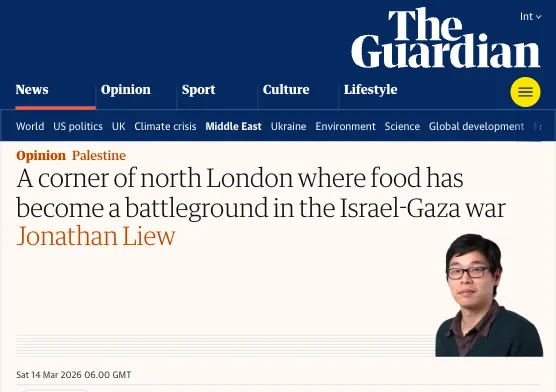
The reaction has been immediate and intense. Campaign groups, commentators, and politicians, such as the opposition Conservative Party leader Kemi Badenoch, have all pointed out that what is being framed as social commentary reads instead like something much older. Critics suggested the column draws on familiar ideas about Jews, power, and influence, repackaged in contemporary form. The speed and breadth of this response is telling. People recognized the pattern because they have seen it before.
Turning the Ordinary into Allegory
The column constructs a contrast and assigns meaning to it. Gail’s is framed not simply as a bakery, but as something symbolically charged. Its presence is described as “an act of heavy-handed high-street aggression,” a phrase that transforms a business opening into something coercive and intrusive. The article suggests that Gail’s “very presence” near a Palestinian café is “quietly symbolic.” Symbolic of what is left unstated, but the implication is clear. The bakery is made to stand for something political and morally charged.
By contrast, the Palestinian café is framed as vulnerable and rooted. We are told it exists in a world where “their very existence is threatened.” The café becomes a symbol of endurance and legitimacy. This is how an ordinary situation becomes allegory. A bakery becomes power. A café becomes victimhood. The reader is invited to interpret the relationship accordingly. This is not analysis. It is projection.
The Structure Beneath the Story
What makes this framing troubling is not just its inaccuracy. It draws on a deep and familiar set of ideas. For centuries, Jews have been depicted as powerful, wealthy, and intrusive. As outsiders who reshape and dominate. As agents of displacement. These ideas did not disappear. They adapted. Today, they are often expressed through language focusing on Israel. Instead of “the Jew,” we are given “the Israeli,” “the Zionist,” or, in this case, a Jewish-founded business made to carry those associations. What appears as geopolitical commentary can function as a vehicle for older assumptions.
This helps explain why so many readers recognized the tone. Critics pointed to how Gail’s was implicitly linked to power and expansion, while the Palestinian café was framed as vulnerable. Others noted how vandalism against the bakery was described as “small acts of petty symbolism,” a phrasing that reframes rather than condemns the act, placing it within a broader moral narrative.
These patterns are not new. They are among the oldest.
From Distortion to Normalization
The issue is not that the Israel-Palestinian conflict is mentioned. It is that it is imposed where it does not belong. A bakery in North London is not an extension of that conflict. A café across the street is not its victim. Collapsing these contexts distorts both.
More than that, this framing encourages readers to see Jewish presence, even in ordinary settings, as inherently political and suspect. It trains perception, creating patterns of power and displacement where none exist. Over time, this shapes not only views of Israel, but perceptions of Jews more broadly.
This is how narratives become normalized. Not through explicit claims, but through repetition and implication. The reader may not consciously register it, but the association is made. Gradually, it begins to feel natural.
The Backlash and the Guardian’s Response
As stated, the backlash was swift. Journalists, advocacy groups, and politicians argued the column crossed a line from commentary into something more troubling. Reports also suggested discomfort within The Guardian. In response, the paper issued an amendment, stating that a phrase had been “repositioned to clarify” and another had been removed “to avoid misunderstanding.” This was presented as a correction.
As the Guardian marks its own homework, this may be the closest we get to an apology for calling the opening of a bakery – Gail’s – with a tenuous Israel link, ‘an act of heavy-handed high street aggression’. pic.twitter.com/u5MdIAZQe8
— Nicole Lampert (@nicolelampert) March 17, 2026
But this response sidestepped the issue. The problem was not wording, but framing. It was the narrative structure that cast a bakery as aggressor and a café as victim, drawing on recognizable historical ideas. By reducing the issue to phrasing, the response treated the reaction as a misunderstanding rather than acknowledging that the interpretation was built into the piece.
This is a familiar pattern. The apology addresses offense, not cause. It adjusts language, not structure. It closes the conversation without addressing the underlying issue.
A Familiar Pattern
This is not an isolated misjudgment. It reflects a broader pattern in which Jews, or anything linked to them, are placed into pre-existing narratives about power and displacement. The details change. The structure remains.
A bakery opens. It is described as “aggression.” Vandalism follows. It is framed as “symbolism.” A narrative is imposed. When challenged, the response is partial. This is not just about one article. It is about a way of seeing. A framework in which Jewish presence is rarely neutral or ordinary. It must always signify something more.
A bakery opens in North London. That should be the end of the story. But here, it wasn’t. And that tells us far more than the column ever intended.
Liked this article? Follow HonestReporting on Twitter, Facebook, Instagram and TikTok to see even more posts and videos debunking news bias and smears, as well as other content explaining what’s really going on in Israel and the region. Get updates direct to your phone. Join our WhatsApp and Telegram channels!