Key Takeaways:
- Mission drift: WikiLeaks has shifted from publishing classified material to amplifying anti-Israel narratives using recycled or non-classified documents.
- Narrative over transparency: Selective framing and lack of context turn old material into misleading talking points.
- Echo chamber effect: High-profile activists and millions of followers help amplify and legitimize unverified claims with little scrutiny.
Founded in 2006 as a platform for leaked documents exposing war, espionage, and corruption, WikiLeaks built its reputation on radical transparency. Despite the controversy surrounding its publication of classified material, the organization gained global recognition, winning numerous awards and becoming best known for releasing documents related to the U.S. wars in Afghanistan and Iraq.
Today, its X account tells a very different story.
With more than 5.6 million followers, WikiLeaks has increasingly become a hub for anti-Israel conspiracy theories — content that bears little resemblance to its original mission of publishing classified material.
Rather than exposing new information, the account now appears to construct narratives about Israel and the Jewish people using documents that are neither classified nor newly revealed, amplified through carefully timed posts.
The pattern is clear. Two months into Israel’s war with Hamas, WikiLeaks resurfaced a document it first published in 2010 claiming that an “Israeli intelligence chief encouraged Hamas’ takeover of the Gaza Strip” — a framing that shifts blame for the conflict onto Israel.
Since the start of 2026, the account has posted 15 times (excluding replies). Of those, 11 focused entirely on Israel or the Jewish people.
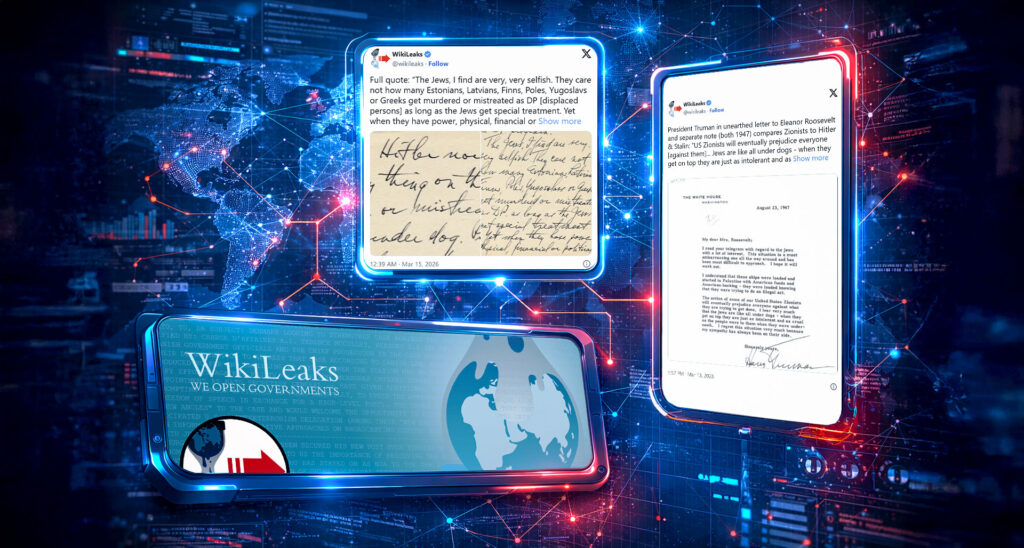
Its most recent example is particularly telling. WikiLeaks “leaked” a document dated July 21, 1947, written by U.S. President Harry S. Truman, which includes derogatory remarks about Jews.
Full quote: “The Jews, I find are very, very selfish. They care not how many Estonians, Latvians, Finns, Poles, Yugoslavs or Greeks get murdered or mistreated as DP [displaced persons] as long as the Jews get special treatment. Yet when they have power, physical, financial or… pic.twitter.com/IA32IjvHBd
— WikiLeaks (@wikileaks) March 14, 2026
What the account failed to mention is that the document was made public in 2003 and is therefore not a leak. Nor did it provide the broader historical context, including Truman’s decision to recognize the State of Israel immediately after its founding.
Instead, the post highlights a willingness to promote inflammatory material to an audience primed to accept it. In doing so, WikiLeaks helps sustain an online echo chamber where misleading anti-Israel narratives circulate with little scrutiny. This dynamic is amplified by high-profile activists such as Shaun King and Susan Abulhawa, who readily repeat and disseminate such claims to large audiences, transforming misleading posts into widely shared talking points.
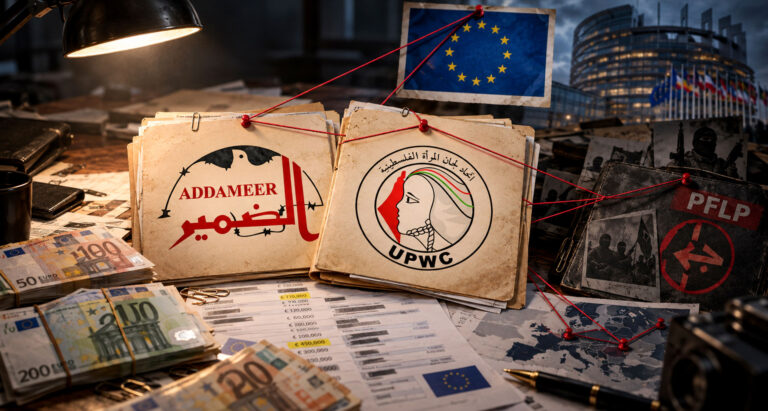
The trend is not new. In October 2025, WikiLeaks helped spread the false claim that pro-Israel influencers were being paid $7,000 per post to “increase global influence.” Yet the documents cited provided no evidence for such payments or any breakdown of how funds were allocated.
View this post on Instagram
WikiLeaks’ fixation on Israel is not limited to its social media output. Its founder, Julian Assange, has his own record of anti-Israel activism, raising further questions about the organization’s impartiality.
In 2012, Assange launched The Julian Assange Show, produced by the Russian state-controlled network RT. His first guest was Hezbollah leader Hassan Nasrallah, whom Assange allowed to portray Israel as an “illegal state” while framing media coverage as a “war” against Hezbollah.
Assange’s activism has also been taken to the streets. More recently, in August 2025, Assange was seen leading a pro-Palestinian protest in Sydney that featured flags of terrorist organizations and imagery of their leaders.
Julian Assange showed up at a pro-Palestinian protest in Sydney, alongside images of Iran’s Khamenei and flags of Hezbollah, Al-Qaeda, and the Taliban. That says everything. pic.twitter.com/TOCJOw5l9Q
— Open Source Intel (@Osint613) August 3, 2025
If WikiLeaks was founded to expose censored information in the public interest, its current trajectory raises serious questions about its purpose. Rather than prioritizing transparency, the organization now appears increasingly focused on amplifying anti-Israel narratives detached from its original mission.
With a platform reaching millions – and bolstered by influential amplifiers – misleading claims are circulated and legitimized with little scrutiny. What emerges is not a commitment to truth, but an ecosystem in which information is selectively curated to reinforce an anti-Israel worldview.
Liked this article? Follow HonestReporting on Twitter, Facebook, Instagram and TikTok to see even more posts and videos debunking news bias and smears, as well as other content explaining what’s really going on in Israel and the region. Get updates direct to your phone. Join our WhatsApp and Telegram channels!
© Divuach Ne’eman R”A, 2025