Key Takeaways:
-
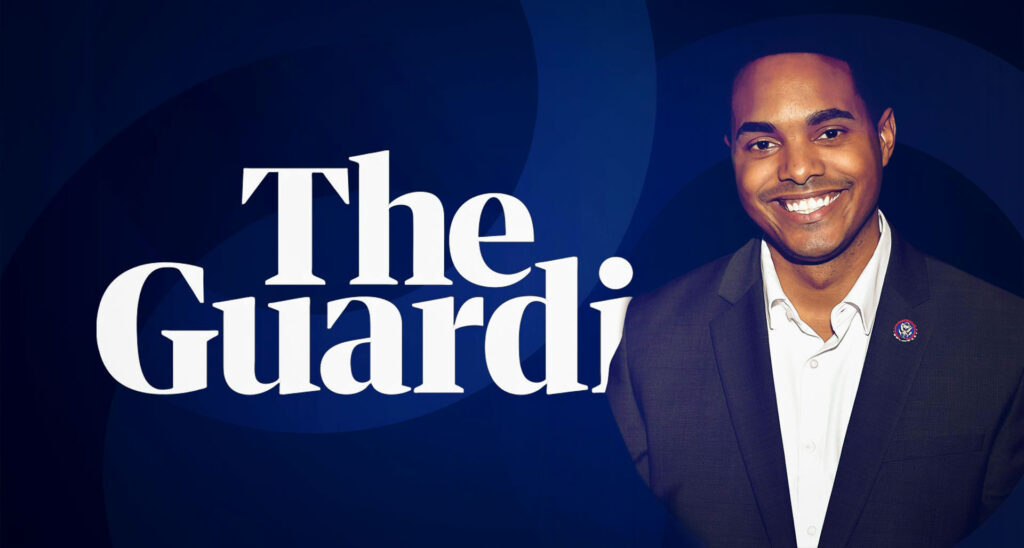
The Guardian’s hit piece on Rep. Ritchie Torres uses manipulative framing to portray pro-Israel advocacy as politically suspect, masking a broader anti-Zionist campaign as ordinary “grassroots” criticism.
-
Jewish safety and support for Israel are subtly recast as indulgent or out of touch, with The Guardian blurring unrelated economic issues to delegitimize concerns about antisemitism and terrorism.
-
Through selective sourcing, rhetoric, and editorial sleight of hand, The Guardian manufactures narratives that normalize anti-Zionist hostility, granting extremist positions a veneer of mainstream legitimacy.
While much attention is focused on the missteps of The New York Times and the BBC, the real yeoman’s work of advancing the anti-Zionist narrative is being done elsewhere: quietly, steadily, and with devastating effectiveness by The Guardian.
Its recent hit piece on Congressman Ritchie Torres exemplifies this approach.
What masquerades as political reporting is, in reality, narrative engineering – aesthetic journalism that substitutes analysis for framing and fact for insinuation. The unsettling part is how persuasive it feels to readers unfamiliar with the mechanics of media manipulation.
Let’s examine how it works.
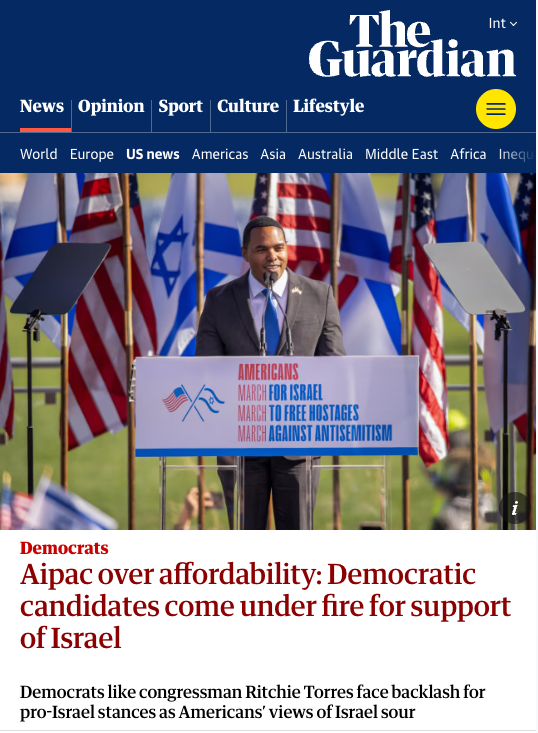
The article’s headline performs a classic sleight of hand. It suggests Torres “came under fire for his support of Israel,” yet reframes the controversy as a debate over affordability – subtly implying that Jewish safety concerns (and those who prioritize them) are somehow incompatible with caring about the American working class.
In effect, the framing poses a false choice:
Care about Jews, or care about people.
This is provocation masquerading as reporting.
The truth—that Torres is facing backlash from an ideologically driven anti-Zionist movement—isn’t stated plainly because it would expose the narrative. Instead, the article recasts a targeted political campaign as an organic populist awakening.
And so, rather than confronting the uncomfortable reality of escalating antisemitism in progressive politics, The Guardian repackages the story into a faux-populist scolding:
- “Americans struggling financially…”
- “Grassroots activists challenging establishment Democrats…”
- “Questions of moral leadership…”
- “Shifts in public sentiment…”
This is not a neutral analysis.
It is a smoke machine.
A small, ideologically aligned network of Democratic Socialists of America activists is presented as a sweeping “grassroots” groundswell – while Torres, a Democrat representing a heavily Jewish, Black, and Latino district, is cast as out of step with the people he serves.
Woven throughout is a familiar historic maneuver: portraying Jewish concerns as privileged distractions from “real problems.” Support for Israel, the world’s only Jewish state and refuge for an endangered people, is depicted as a luxury issue—indulgent at best, selfish at worst—in the midst of economic hardship.
Let’s be clear:
Jews are not causing the affordability crisis. Israel has nothing to do with rising rents or interest rates.
These are entirely separate realities.
The Guardian blurs them anyway.
More disturbing still is how easily the article normalizes the rhetorical excesses of anti-Zionist activism – deploying words like “genocide,” “colonialism,” and “occupation” as routine political vocabulary while stripping them of legal or moral seriousness.
In this framework, extreme accusations become everyday slogans—weapons, not arguments—aimed at Jews who dare to assert the right to survival and self-defense.
The result is a carefully constructed worldview in which:
- Support for Jewish safety becomes suspicious.
- Moral clarity becomes controversial.
- Political safety requires silence.
This is how antisemitism spreads today – not only through chants and mob violence, but through polished prose and editorial aesthetics. Through the sanding down of hostility until it looks like “debate.” Through institutional language that pretends to be neutral while laundering hatred into legitimacy.
The Guardian isn’t merely covering a political race.
It is shaping the terrain on which Jewish safety is politically contested.
And when Jewish survival becomes the battlefield, euphemism transforms into weaponry.
If Torres were facing attacks for defending any other vulnerable minority, the moral stakes would be obvious, and the framing would be fair. But when the target is Jewish safety, context suddenly appears. Excuses emerge. Extremism is rebranded as activism.
What is handed to the global anti-Zionist movement is invaluable: a veneer of legitimacy, a mainstream platform, and implied permission to escalate.
This is the most dangerous function of media failure:
These stories do not merely misreport antisemitism.
They manufacture the conditions for it to thrive.
And the world is reading.
Liked this article? Follow HonestReporting on Twitter, Facebook, Instagram and TikTok to see even more posts and videos debunking news bias and smears, as well as other content explaining what’s really going on in Israel and the region. Get updates direct to your phone. Join our WhatsApp and Telegram channels!
© Divuach Ne’eman R”A, 2025