Key Takeaways:
- Motaz Azaiza’s recent podcast interview revealed some enlightening facts about the media landscape in the Hamas-run Gaza Strip both before and after October 7, including the censoring of anti-Hamas voices and journalists acting as pro-Hamas activists.
- Motaz Azaiza’s exposure of Gaza’s media environment raises questions about the reliability of those who are the sole sources of news reports for mainstream media organizations.
- Motaz Azaiza exposed a Hamas-affiliated journalist group where participants led campaigns against those who were deemed to be not supportive enough of Hamas and its activities.
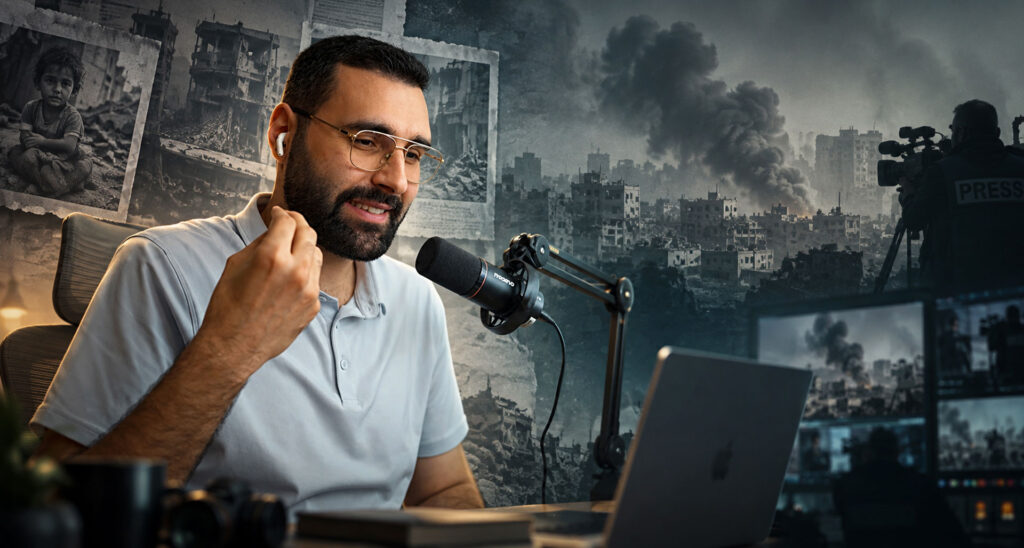
Motaz Azaiza, the Gazan journalist who has become the darling of such anti-Israel personalities as Ms. Rachel and New York City Mayor Zohran Mamdani, is back in the spotlight as an Arabic-language podcast interview he gave earlier this month has spread on social media.
While most are focusing on his activities during October 7 and his revelations about how Hamas ran Gaza prior to the war, Motaz also exposed some interesting facts about the media climate within Hamas-run Gaza, as well as the structural impediments that journalists faced within the coastal enclave.
Here are just some of the media-related revelations that were exposed by Motaz in his recent interview:
Journalists Avoid Airing Anti-Hamas Sentiments
During the podcast, Motaz said that, unlike other journalists who reported from Gaza, he refused to turn off his camera when someone would publicly curse Hamas for starting the war. In his words, “I’ve never seen a journalist from Gaza publish something like this.”
He then went on to explain that the norm among Gaza-based journalists is that when someone starts maligning Hamas, journalists put their cameras down.
The podcast host agreed with Motaz’s description and added that when a journalist is doing a live recording from a site in Gaza and someone walks by and disparages Hamas, “you sense a kind of defensive, security-related behavior. People quickly grasp the situation and cover it up.”
The fact that journalists avoid airing or publishing anti-Hamas sentiment by Gazans means that global news consumers are left unaware of this anti-Hamas feeling and are led to draw the conclusion that the terror group has the unanimous (or near-unanimous) loyalty of the people under its control. Not only are these journalists not telling their audiences the whole story, they are aiding in the spread of a false narrative about Hamas’ support within the Gaza Strip.
Journalists in Gaza Are Heavily Influenced By Hamas
At another point in the podcast, Motaz discusses a WhatsApp group known as “SMART,” and explains that “all the journalists in Gaza are there.” This group is run by someone affiliated with Hamas, where certain news items are published for the journalists’ knowledge and use.
While it is not unusual for a state or governing body to run groups that keep journalists abreast of the latest events, what is unusual is how Motaz describes the actions of the journalists within the group. Instead of acting as neutral observers receiving news updates from Hamas, the journalists within the group acted as partisans for Hamas, attacking those who were not seen as supportive enough of the terror group (including Motaz, himself). This assault on certain people did not remain within the group but was expanded into campaigns on social media directed against them. He even claims that when there was a split within the Hamas leadership and terror leader Khaled Meshaal fell out of favor, he was also attacked by the journalists in this group.
As the podcast’s host aptly observes, the members of this group seemed to have acted more like activists than like journalists.
The fact that, seemingly, the vast majority of Gazan journalists belonged to a Hamas-affiliated WhatsApp group, where they actively took part in campaigns directed against other journalists or public personalities who were viewed as not sufficiently pro-Hamas, should raise red flags about the reliability and objectivity of those journalists who are the sole source of information on the Gaza Strip for many mainstream media organizations.
The Stories That Emerge From Gaza Are Curated
Motaz also described the media environment in Gaza prior to 2023, claiming that they only published stories that would trend or would garner many likes. As an example, he mentions how every Christmas, journalists would photograph Santa Claus in different locales (such as among the destruction or in refugee camps) since that would “attract attention.”
Later on, the podcast host describes how Motaz and other journalists, after October 7, eventually began acting like “activists,” creating and controlling the narratives and trends that were coming out of Gaza.
While the popularity or longevity of a story is a factor that any journalist will take into account, it is clear from Motaz’s words that Gazan journalists amplify some stories while ignoring others, while also staging images for them so as to have the greatest impact. While this practice predates October 7, it has surely intensified with the war between Israel and Hamas in Gaza.
This leads to the question of whether the stories and images that came out of Gaza during the war represent the full picture of what was happening in the coastal enclave, or whether they were chosen and framed to represent a certain narrative about the conflict.
There Are Restrictions on What Is Published By Journalists
In discussing his activities on October 7, Motaz states that he had videos of Israeli hostages being beaten by local Gazans but didn’t publish them out of fear that Israel would use the videos to target those who had taken part in these assaults.
The host then expands on this, explaining that in Gaza, there are restrictions on filming in certain locations and you have to be careful about who you film, lest you film someone who is wanted by Israel.
This restriction on reporting is another example of how Hamas heavily controls journalism within the Gaza Strip and also shows how global news audiences are not being presented with the full picture when consuming news that emerges from the Gaza Strip.
While some of the above revelations may be seen as self-evident by those who have been following the news that has emerged from Gaza over the past few years, there are still plenty of people (including those who work in the media and for foreign NGOs) who treat any news emerging from the Hamas-run territory as independent and not influenced by the terror organization that controls the coastal enclave with an iron fist.
Hopefully, what Motaiz Aziza has (perhaps inadvertently) revealed in this podcast will grant those who consume news from the Middle East greater media literacy skills. Readers and views should be inspired to ingest a healthy dose of skepticism about any information that is provided by Gaza-based journalists and is then filtered to the wider world through mainstream news organizations.
Liked this article? Follow HonestReporting on Twitter, Facebook, Instagram and TikTok to see even more posts and videos debunking news bias and smears, as well as other content explaining what’s really going on in Israel and the region. Get updates direct to your phone. Join our WhatsApp and Telegram channels!
© Divuach Ne’eman R”A, 2025