Key Takeaways:
- HonestReporting reviewed 431 articles from six major international outlets across three windows, beginning on October 7, 2023, and the following two anniversaries.
- Phrasing that minimized the attacks of October 7, by obscuring who attacked whom, blurring the attack into symmetric language, or removing it from its own story, was found across the outlets and years.
- When the media removes October 7 and its victims from the center of the story, it distorts the understanding of the war that followed.
On October 7, 2023, the world woke up to the news of a terrorist attack in Israel beyond the scale of imagination. The images and videos were shared widely online. Material from victims of the attack and by footage from Hamas’ GoPro cameras displayed the horrifying story for the world to see.
Despite the initial worldwide shock, international reporting was quick to editorialize the events, and narratives downplaying the attack soon emerged. This became particularly evident in international coverage of the anniversary of the massacre, where, rather than returning to the event itself, the terrorist attack and Israeli victims got pushed away from the center of the story.
HonestReporting reviewed 431 articles from six outlets: the BBC, Reuters, Associated Press (AP), The New York Times, CNN, and The Guardian. In examining the immediate aftermath (October 7-9, 2023), the first anniversary (October 4-10, 2024), and the second (October 4-10, 2025), the pattern of minimization was all too apparent.
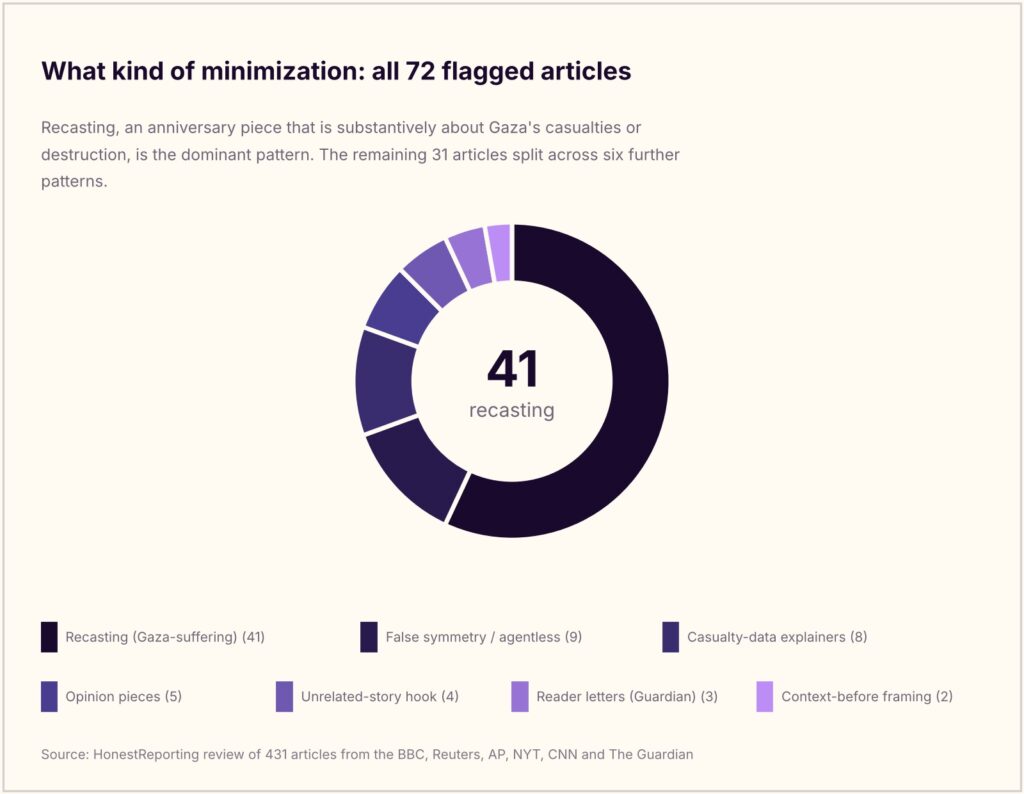
In the dataset, minimization refers to articles about October 7 that downplayed the attack by obscuring who attacked whom, either by omitting the attack, describing it in passive or symmetric terms with no named perpetrator, or steering an anniversary story so far toward Gaza’s casualties or destruction that the attack itself gets a single sentence or nothing at all.
2023: Outliers Set the Stage
In the immediate aftermath of the attack on October 7, the event was impossible to ignore. While initial reporting focused on casualty counts, military response, and international reaction, outliers from major outlets paved the way for more problematic coverage in the months and years following the initial attack.
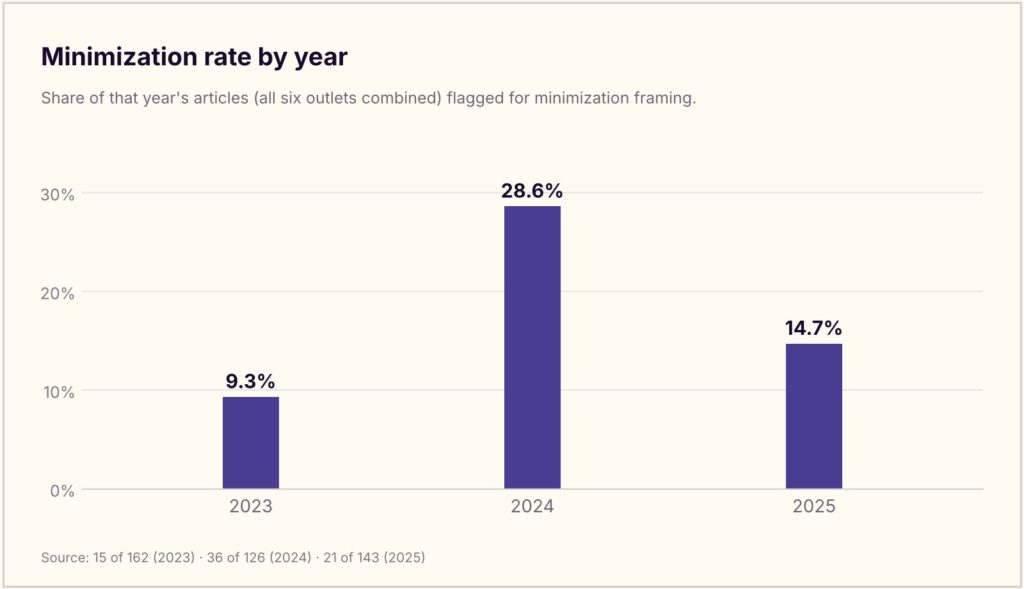
For instance, on October 7, The New York Times published “‘The Children Were Terrified.’ Fear Grips Israel and Gaza,” placing Israeli and Gazan fear on the same plane as the terrorist attack was unfolding. This was despite Hamas attacking anyone in sight, while Israel conducted targeted airstrikes against terrorist sites. The same day, the Times also ran “Gaza Has Suffered Under 16-Year Blockade,” moving attention away from the massacre unfolding that day and, as such, providing justification for the pogrom. Also on October 7, AP’s headline described “Hamas surprise attack out of Gaza stuns Israel and leaves hundreds dead in fighting, retaliation,” blurring the distinction between the initial attack and Israel’s response. While the 15 flagged articles represent only 9.3 percent of the 162 articles in the 2023 sample, they nonetheless provide insight into how the attack could be minimized in the years to follow.
2024: October 7 Becomes a Story About Gaza
By the first anniversary, the framing had changed dramatically. Rather than returning to the events of October 7 and the Israelis who were murdered, wounded, and abducted, coverage increasingly used the anniversary as a starting point for stories about Gaza.
The pattern of minimization appeared in 28.6 percent (36 of 126) of the 2024 anniversary-period articles – more than three times the 2023 rate. Each of the six outlets recorded its highest minimization rate in 2024, making the first anniversary the worst-performing period in the dataset.
Particularly, the 2024 articles fall into the recasting pattern, in which the piece is nominally about October 7 or its anniversary, but its actual content concerns Gaza’s casualties, displacement, or destruction, with the attack itself reduced to a sentence or omitted entirely.
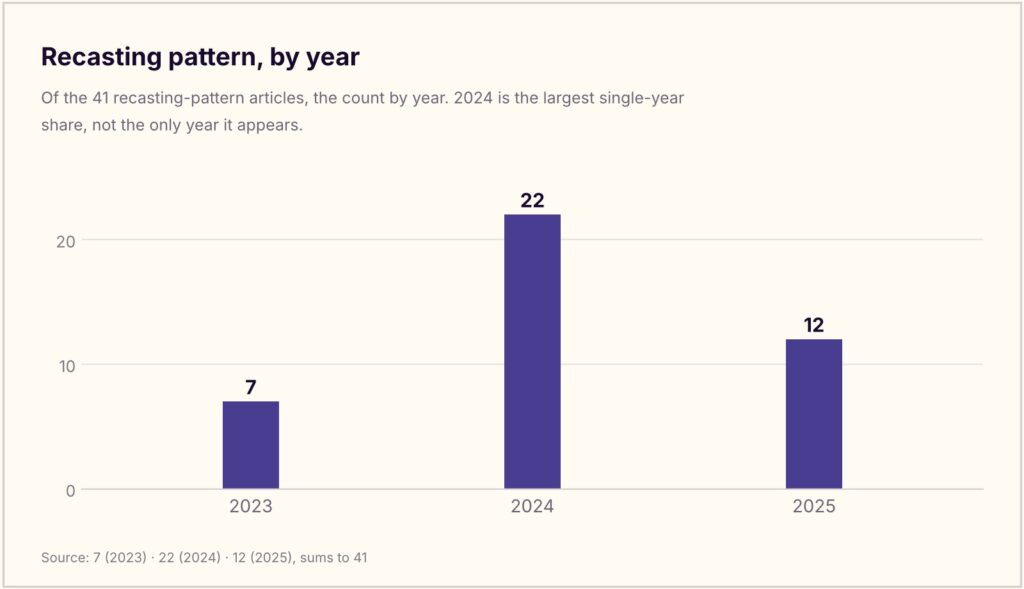
Across all three years in the dataset, 72 articles were identified as containing minimization framing, and 41 (56.9 percent) followed the recasting pattern. 22 of these 41 articles were published in 2024 alone (22 of the 36 flagged that year), compared to seven in 2023 and 12 in 2025.
This shift to recasting Gaza is illustrated in AP’s “A Year of fleeing across Gaza,” CNN’s “Flattened in a year: How Israeli bombardment reduced most of Gaza to rubble,” Reuters “Israel steps up Gaza bombing on war’s first anniversary” and the New York Times’ “Nowhere to Go: How Gaza Became a Mass Death Trap.”
The AP piece, published under an October 7 anniversary banner, follows one family’s displacement inside Gaza and never mentions the Hamas attack, its victims, or the hostages taken that day. In each case, the anniversary window became an opportunity to foreground Gaza while the October 7 attack itself receded from view, despite the attack being what prompted the anniversary in the first place.
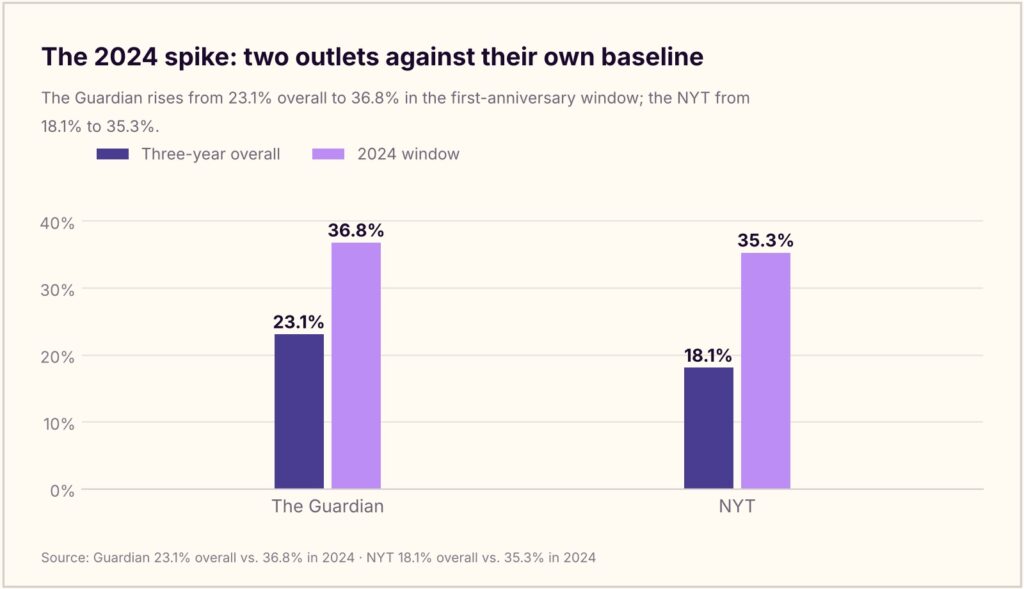
The Guardian stands out most in this framing, with The New York Times second. Across the three years, roughly 23 percent (25 of 108) of the Guardian’s articles displayed the minimization pattern, roughly double the rates at the BBC (12.9 percent) and Reuters (11.0 percent). During the 2024 anniversary window alone, that figure rose to 36.8 percent (14 of 38). The New York Times recorded an overall rate of 18.1 percent (13 of 72), just ahead of CNN (17.1 percent, 7 of 41) and AP (15.8 percent, 9 of 57), rising to 35.3 percent (6 of 17) during the first anniversary, the second-highest single-outlet, single-year rate in the dataset and trailing only the Guardian.
Yet the issue in reporting on the first anniversary was not limited to minimization stories. In some cases, the anniversary itself was treated as merely a convenient hook for unrelated coverage. For instance, in The Guardian’s “‘I’m not interested in someone passive about Gaza’: how views on the war have changed dating in America,” October 7 was no longer necessarily being treated as an event worthy of its own examination, but as an entry point into a dating story.
2025: The Numbers Improve, The Pattern Remains
By the second anniversary, the rate of minimization fell to 14.7 percent (21 of 143), likely reflecting increased coverage of the ceasefire negotiations between Israel and Hamas, which went into effect on October 10, 2025.
But the underlying pattern had not disappeared. Recasting remained evident, with 12 articles falling into that category in 2025, including the BBC’s “Inside one battle-scarred Gaza building, displaced families tell the story of the war,” which makes no effort to mention what prompted the war.
The change from 2024 to 2025 therefore should not be mistaken for a complete reversal. The anniversary window still produced coverage in which the consequences of the war in Gaza displaced the event that began it. The difference was one of degree, not the disappearance of the framing problem.
Three Years Later
Three years have passed since the terrorist attacks in 2023. As Israel has continued to fight against terrorism and threats from multiple fronts, the media landscape has continued to provide yet another battlefield. Even today, outlets beyond the six reviewed here, such as the Irish Times, are focused on shifting the focus away from the horrific attacks.
While the massacres of October 7, 2023 rightfully remain the center of attention for Israel and the Jewish people globally, that attention should not be limited to these groups alone. The reframing of the events by removing the victims from the center and treating the attack as a footnote to its own anniversary obscures not only what happened on October 7, but why the war that followed began in the first place.
Liked this article? Follow HonestReporting on Twitter, Facebook, Instagram and TikTok to see even more posts and videos debunking news bias and smears, as well as other content explaining what’s really going on in Israel and the region. Get updates direct to your phone. Join our WhatsApp and Telegram channels!
© Divuach Ne’eman R”A, 2025