Key Takeaways:
- Not humanitarian, but ideological: The Nuestra América Convoy is framed as aid, but is driven by a coordinated activist network with a consistent anti-Western and anti-Israel agenda.
- Blame the West, ignore the regime: Cuba’s crisis is reduced to American responsibility, while the failures and repression of the Cuban regime are minimized or ignored.
- Performance over substance: Luxury accommodations, staged events, and limited aid expose a gap between claims of solidarity and the reality on the ground.
A Political Project Disguised as Humanitarian Aid
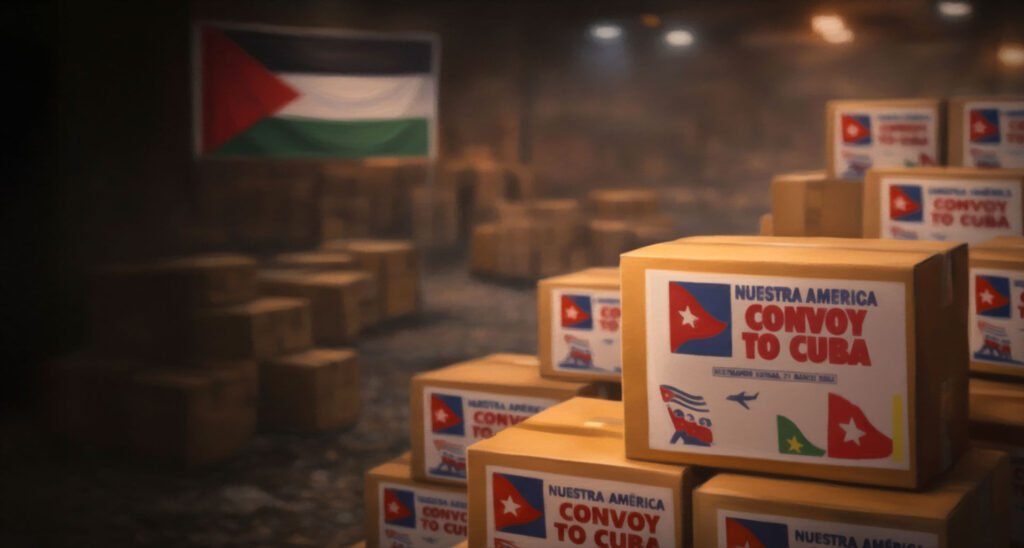
The Nuestra América Convoy presents itself as a humanitarian mission to Cuba. Hundreds of activists from the United States and Europe have traveled to the island, claiming to deliver aid while challenging what they describe as the U.S. “blockade.” That is the branding. The reality is something else entirely.
Look at who is actually there.
Jeremy Corbyn. Kneecap. Code Pink activists. Hasan Piker. Owen Jones. Figures tied to Progressive International. This is not a random collection of humanitarians responding to a crisis. It is a familiar activist circuit, one that reappears across causes, particularly in anti-Israel campaigning. The same names, the same networks, the same rhetoric. Many of these figures have spent years defending or platforming groups hostile to Israel, minimizing or justifying violence, and advancing narratives that blur into anti-Jewish hostility under the banner of anti-Zionism. Corbyn’s record of engagement with extremist actors, Code Pink’s long-standing alignment with anti-Israel campaigns, and the broader media ecosystem around figures like Jones and Piker all point in the same direction. Since the October 7 attacks, that pattern has only become more explicit, with elements of this same network openly rationalizing or excusing Hamas. This is not new behavior. It is a consistent ideological pattern carried from one cause to the next.
These are people who have spent years positioning themselves as moral authorities on global injustice. And yet, when confronted with a regime that has overseen decades of repression, economic collapse, and the systematic impoverishment of its own population, they arrive not to challenge it, but to protect it. That contradiction is not accidental. It is the defining feature of this kind of activism. The outrage is always directed outward, never inward. Responsibility is always assigned to an external enemy, never to the regime actually in power.
BLACKOUT BACKLASH: Far-left activists are facing criticism after traveling to Cuba, where they stayed in expensive hotels and met with the nation’s communist leadership while residents suffer in total darkness without electricity.
The trip, organized by the activist group… pic.twitter.com/Jtcn0TOy90
— Fox News (@FoxNews) March 22, 2026
Blame the West, Ignore the Regime
Cuba is in crisis. There are severe shortages of food, medicine, and electricity. Blackouts are routine. People are struggling to meet basic needs. This is not contested. What is contested is why. The activists have already decided the answer before they even set foot on the island. It is America. It is always America, and more broadly the West itself, which they view as the primary source of global injustice. That framing allows them to tell a simple, emotionally satisfying story, one in which there is a clear villain and a clear moral position to adopt, without the inconvenience of engaging with the full complexity of the situation or confronting the failures of the regime in front of them.
What is striking is not just the simplicity of that explanation, but the deliberate refusal to engage with anything that might complicate it. The Cuban regime’s role in creating and sustaining this crisis is minimized or ignored entirely. Repression, corruption, and economic mismanagement are treated as secondary, if they are acknowledged at all. The point is not to understand the situation. The point is to preserve the narrative.
And then there is the reality of how they experience Cuba while claiming to speak on its behalf.
While ordinary Cubans deal with blackouts and shortages, convoy participants stay in five-star hotels in Havana, with constant electricity, air conditioning, and reliable internet. They move through the country in air-conditioned buses, attend curated events, paint murals, hold concerts, and produce content designed for audiences back home. They are not navigating the constraints that define everyday life for the people they claim to support. They are insulated from them, both physically and psychologically.
They are not living the crisis. They are visiting it.
The contrast is not incidental. It reveals the underlying dynamic of the entire exercise. A group of Western activists arrives in a country facing real hardship, remains comfortably removed from that hardship, and then presents itself as an authoritative voice on its causes and its solutions. The performance of solidarity becomes more important than any meaningful engagement with reality.
Hasan Piker and his VIP entourage were caught throwing food at Cuban children to make them dance, while filming videos for their social media.
Well, here’s a message to Hasan & Co:
Cuban kids are not zoo animals.
YOU are the animals. pic.twitter.com/l9pHOB8UNu— Samantha Smith (@SamanthaTaghoy) March 23, 2026
The Same Playbook, From Cuba to Gaza
This pattern should feel familiar, because it is.
The same ecosystem has spent years mobilizing around Israel in almost identical ways. Flotillas, delegations, boycott campaigns, and international “solidarity” visits all follow the same structure. A complex conflict is reduced to a simple moral narrative. One side is cast as entirely responsible, the other as entirely passive. Internal dynamics are ignored. Context is stripped away. The activist’s role is not to understand, but to perform certainty.
The flotilla is back, now calling itself the Nuestra América Convoy. This time, it’s going to Cuba, alongside a group of influencers claiming it’s a humanitarian mission to “break the blockade.”
Participants include Hasan Piker, @owenjonesjourno, and other activists and… pic.twitter.com/2Kf7bzvTx2
— HonestReporting (@HonestReporting) March 25, 2026
What links these movements is not the specific cause, but the mindset. The same individuals who are willing to overlook or excuse authoritarianism in Cuba are often the same ones who downplay or justify the actions of Hamas, or who ignore corruption and repression within Palestinian leadership. The pattern is consistent. If a regime or movement can be positioned against a Western or Western-aligned adversary, it is granted a level of moral indulgence that would never be extended elsewhere.
That is why the convoy matters. Not because of the limited aid it delivers, but because of what it reveals about the people involved.
What we are seeing is a form of activism that is less about helping those in crisis and more about reinforcing a worldview. It allows participants to signal their values, align themselves with a global ideological movement, and produce content that affirms their identity as moral actors. The setting may change, but the function remains the same. Cuba today. Gaza yesterday. Somewhere else tomorrow.
The Nuestra América Convoy is not an anomaly. It is part of a pattern in which crises are not engaged with on their own terms, but repurposed to fit a pre-existing narrative. The same actors appear, the same explanations are offered, and the same blind spots remain.
And that is ultimately what this convoy reveals. Not how to respond to a humanitarian crisis, but how easily one can be used.
Liked this article? Follow HonestReporting on Twitter, Facebook, Instagram and TikTok to see even more posts and videos debunking news bias and smears, as well as other content explaining what’s really going on in Israel and the region. Get updates direct to your phone. Join our WhatsApp and Telegram channels!
© Divuach Ne’eman R”A, 2025