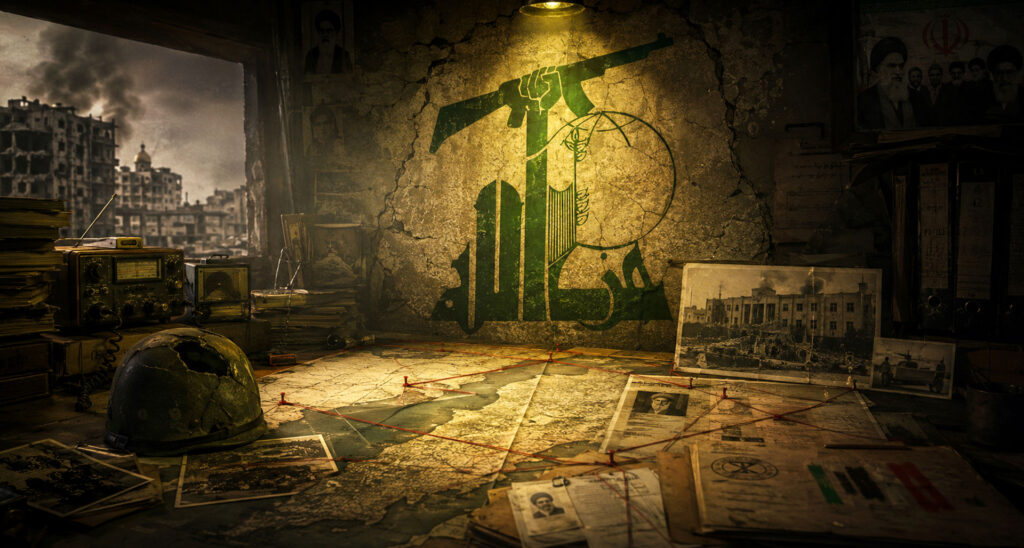
Since 1983, Hezbollah has grown from a small guerrilla army to one of the largest state-backed terrorist organizations in the world, expanding its reach from a local problem to a global threat.
Although Israeli military action is often blamed for the creation Hezbollah, the historical record tells a different story. Long before Israel entered Lebanon, terrorism and Iranian influence had already begun to root itself in the country’s south.
Palestinian Terrorism in Lebanon
While Israel’s northern border was not granted with peace after the state’s founding, it enjoyed relative quiet until 1969, when the Yasser Arafat-led Palestine Liberation Organization (PLO) and Lebanese government signed the Cairo Agreement, effectively granting the PLO autonomy within Palestinian refugee camps in Lebanon.
By removing Lebanese Armed Forces control of the camps, Palestinian terrorist organizations were able to act with more freedom. The proximity to northern Israel provided a launching ground for terrorist attacks, including infiltrations of Israeli territory.
Following the September 1970 events in Jordan known as Black September, in which fighting between the Jordanian military and Palestinian terrorist organizations resulted in the expulsion of the Palestinian groups, the PLO’s presence in Lebanon grew exponentially.
Out of the PLO’s increasing control of the unstable Lebanese-Israel border region came a series of deadly terrorist attacks in the 1970s. Some of the worst attacks included the 1974 Ma’alot Massacre, where Popular Front for the Liberation of Palestine (PFLP) terrorists infiltrated Israel, killing 25 hostages and injuring 68 others. The following year, PLO terrorists infiltrated by sea and made their way to Tel Aviv, where they took Israelis hostage at the Savoy Hotel, ultimately killing five of them.
From 1970 through 1974, Israel conducted numerous counter-terrorism operations in Lebanon, hoping to root out the problem.
When the Lebanese civil war erupted in April 1975, Palestinian terrorists were still embedded deep within southern Lebanon, exacerbating fractures amongst Lebanon’s diverse population.
At the same time, Palestinian terrorism continued. In 1978, PLO terrorists again infiltrated Israel by sea and hijacked two buses on the Coastal Road. After a long engagement with Israeli security forces, the terrorists blew up the bus, killing 38 Israeli civilians and wounding 71.
Days after the massacre, the United Nations adopted Security Council Resolution 425, establishing a United Nations Interim Force in Lebanon (UNIFIL) and calling on Israel to withdraw from the areas it had entered in southern Lebanon.
After another few years of terrorist attacks, a U.S.-mediated ceasefire in July of 1981 attempted to bring an end to the PLO’s terrorist attacks and create security for Israel’s northern border.
Iran Enters the Picture
The ceasefire had hardly been in place for one month when the Iranian regime saw an opportunity to export its revolution and, as a result, further destabilize the region.
In August 1981, the Iranian regime sent Ali Akhbar Mohtashami, a close ally of Supreme Leader Ayatollah Ruhollah Khomeini, to Syria. There, he served as the regime’s ambassador and was put in charge of founding a new Lebanon-based Shi’ite movement that would serve as an alternative to Amal, which the Iranian regime regarded as a secular movement that did not serve to further the Islamic revolution.
At the same time, Israel sought to build its relationship with the Christian-Maronite population in Lebanon, which was broadly opposed to Palestinian terrorism.
Less than one year later, in June 1982, the U.S.-led ceasefire broke down when PLO terrorists shot and critically wounded Israel’s ambassador to the United Kingdom, Shlomo Argov, ultimately setting the stage for the IDF to enter Lebanon through Operation Peace for the Galilee.
The military operation, now known as the First Lebanon War, sought to remove the presence of more than 23,000 terrorists — including the PLO terrorists that had established themselves in Lebanon years before.
One month after the war began, an agreement was signed, resulting in the transfer of 14,000 PLO terrorists to Tunisia, where they established a new headquarters.
But the PLO’s expulsion created an opportunity for new guerrilla fighters to emerge in Lebanon. These men were the result of Mohtashami’s program to export the Iranian revolution by training, arming, and funding militants.
The dangerously powerful terrorist organization known as Hezbollah – the Party of God – was officially founded.
The First Years of Hezbollah
In the formative years of Hezbollah, the terrorist organization was determined to become a functioning force within Lebanese society whilst exporting the Iranian revolution.
Although a U.S.-brokered agreement declared the end of the war in May 1983 – one month after a Hezbollah-affiliated attack on the U.S. Embassy in Beirut killed 63 people – Hezbollah continued to expand and make clear that Israel was not its only enemy. In October, the terrorist organization carried out a bombing attack against a U.S. Marine compound in Beirut, killing 241 U.S. service personnel.
Hezbollah’s Open Letter in 1985 further outlined the intention to export the Iranian revolution by establishing an Islamic regime in Lebanon, combat US-rooted “abomination,’ and fight Israel “until the hated ones get what they deserve.”
The Taif Agreement in 1989, which put a formal end to the nearly 15-year-long civil war, further provided Hezbollah with the opportunity to expand its reach. Despite the agreement calling for an end to both Lebanese and non-Lebanese militias, Hezbollah vehemently objected and has since continued to refuse disbandment.
The agreement further allowed Hezbollah to entrench itself in Lebanese society through philanthropic activities, providing civil services to the war-torn Shi’ite population. The Lebanese government’s failure to enforce the militia-disbanding provision of the Taif Agreement meant Hezbollah faced no meaningful check on its growth.
The notion that Israel’s 1982 invasion created Hezbollah inverts the actual sequence of events. Iran had dispatched its envoy to Damascus a full year before Operation Peace for the Galilee began. And for more than a decade before the first IDF soldier crossed the border, Palestinian terrorist organizations worked tirelessly to destabilize the region and terrorize Israeli society.
Israel did not build Hezbollah. It worked to root out terrorism from a country that the Iranian regime had infiltrated first. The result of Iranian machinations: Hezbollah.
Liked this article? Follow HonestReporting on Twitter, Facebook, Instagram and TikTok to see even more posts and videos debunking news bias and smears, as well as other content explaining what’s really going on in Israel and the region. Get updates direct to your phone. Join our WhatsApp and Telegram channels!
© Divuach Ne’eman R”A, 2025