Key Takeaways:
- Explosive allegations, glaring evidence gaps. From ICC cases to civilian deaths, “NAZA” leaves its most serious accusations unsubstantiated.
- Selective editing, leading questions, distorted conclusions. The filmmakers omit crucial context and push interpretations beyond what their witnesses establish.
- Awards are no substitute for evidence. Despite The Guardian’s claims of rigorous verification, “NAZA” leaves fundamental questions unanswered.
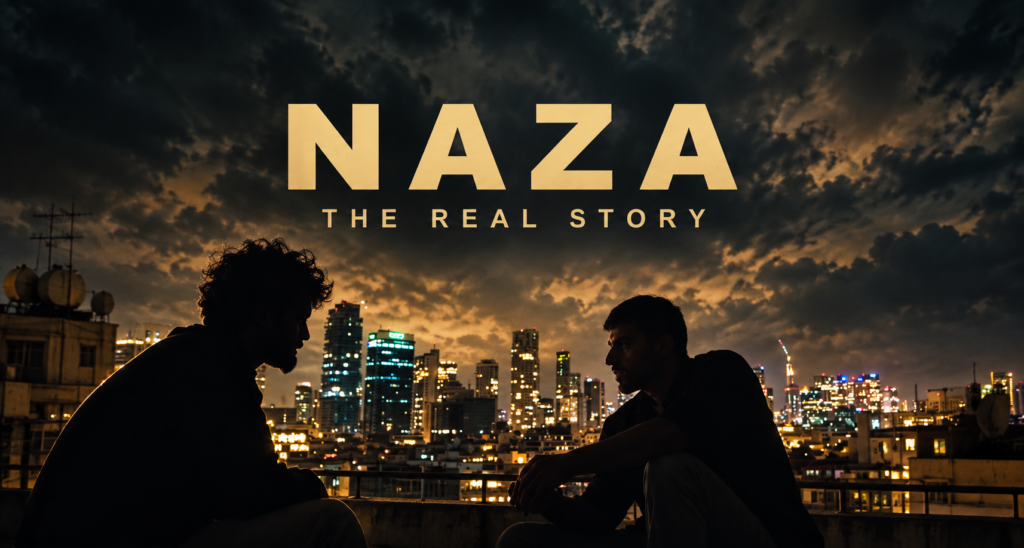
Why did the filmmakers behind “NAZA,” a documentary effectively accusing Israel’s military of genocide, fail to submit their allegations to the IDF for a response before its release?
Why is its producer, The Guardian, waiting until late November to stream the documentary free on its website, after its theatrical run?
And why, despite boasting of more than 100 sources, classified documents and extensive corroboration, has the news organization provided so little publicly verifiable evidence for some of the film’s most incendiary allegations?
These are serious questions for a documentary that has already enjoyed a record-breaking standing ovation at Venice, collected the festival’s Special Jury Prize and been celebrated internationally as an extraordinary exposé of Israeli wrongdoing during the war in Gaza.
1/6 The most revealing clip from “NAZA”… isn’t even in the film. Venice director Alberto Barbera checks his watch until the ovation breaks the festival record. Then he’s done. PR stunt? Maybe. But the story being sold is far bigger: genocide. And it ends at The Hague. 🧵 https://t.co/WeenbnMW7m
— HonestReporting (@HonestReporting) September 16, 2026
But strip away the acclaim, the anonymity and the emotionally charged presentation, and a far more troubling picture emerges.
HonestReporting has examined the documentary in detail. What we found goes considerably beyond the flaws already identified by the IDF and other critics: sweeping allegations unsupported by identifiable incidents, selective quotations, leading questions, questionable calculations and conclusions that go well beyond what the film’s own witnesses establish.
This is not simply a documentary presenting one side of a controversial war. It is a film asking audiences to accept some of the gravest accusations imaginable while withholding essential information needed to scrutinize them.
HonestReporting has put “NAZA”’s most explosive allegations under the microscope. What follows is a forensic examination of the claims, contradictions and omissions that strike at the very heart of the documentary’s credibility and serve to unravel its entire narrative.
Did Israel Secretly Make ICC Cases Disappear?
One of NAZA’s most extraordinary allegations comes just over an hour into the documentary, when filmmaker Yuval Abraham suggests that Israeli intelligence operations successfully forced cases against Israel to be withdrawn from the International Criminal Court (ICC).
An anonymous intelligence operative claims that his unit worked to thwart Palestinians’ petitions to the court in The Hague, principally by finding compromising information about those making the allegations.
Abraham then asks whether he knows of cases that were withdrawn because of operations in which he personally participated.
“Definitely,” the interviewee replies.
It is an astonishing allegation: that Israeli intelligence did not merely monitor Palestinians seeking international accountability, but successfully prevented cases from proceeding through the world’s permanent international criminal court.
Yet the film identifies not a single case supposedly withdrawn, nor any complainant, date, court record or documented connection to an intelligence operation.
What makes this especially noteworthy is that Abraham himself co-authored a May 2024 investigation for +972 Magazine, published in partnership with The Guardian and Local Call, alleging a years-long Israeli intelligence campaign targeting the ICC.
That investigation, said to be based on interviews with more than two dozen sources, alleged surveillance of prosecutors, Palestinian human rights organizations and individuals supplying evidence to the court. It also described attempts to discredit Palestinian allegations and obtain compromising information about former ICC prosecutor Fatou Bensouda.
But there is a crucial difference between those allegations and the claim made in NAZA: Abraham’s earlier investigation did not identify a single ICC case that had been withdrawn as a result of Israeli intelligence operations.
Indeed, the earlier report described Israel’s efforts to prevent the court from opening a formal investigation, an effort that ultimately failed. The ICC opened its Palestine investigation on March 3, 2021, and subsequently issued arrest warrants for Benjamin Netanyahu and Yoav Gallant on November 21, 2024.
Neither development rules out interference with particular witnesses or submissions. But they certainly do not demonstrate that Israel made cases disappear.
There is also a fundamental legal problem with the documentary’s terminology.
According to the ICC’s own procedures, individuals and organizations can submit information about alleged crimes through Article 15 communications. These are assessed by the Office of the Prosecutor. They are not necessarily individual court cases that complainants can simply withdraw or terminate.
The court also distinguishes between evidence submissions, applications by victims to participate in proceedings, investigations into situations and formal prosecutions against specific defendants.
These are not interchangeable.
And the ICC explicitly states that documents submitted to its prosecutor are retained by the office. A witness withdrawing cooperation does not automatically erase evidence already provided or close a criminal investigation.
So what precisely was supposedly withdrawn? Was an individual persuaded not to testify? Was an evidence submission abandoned before it reached the court? Or did an actual ICC proceeding come to an end?
Abraham’s earlier investigation described Israel gathering intelligence about allegations presented to the ICC so its lawyers could challenge them, including through arguments about the court’s jurisdiction and the principle of complementarity, under which genuine national investigations can affect whether an ICC case is admissible.
There is a fundamental difference between allegations that Israeli intelligence gathered information to challenge accusations at the ICC and the far more serious claim that Israel intimidated witnesses, obstructed justice and caused cases to disappear. Yet Abraham blurs those distinctions, without identifying a single withdrawn case to substantiate his most explosive allegation.
The filmmakers have said publicly that they conducted extensive corroboration using additional sources and confidential documents. But they have not publicly identified which, if any, of those materials independently establish the alleged withdrawal of ICC cases.
Abraham spent years investigating Israel’s alleged efforts to undermine the ICC. He now presents a witness claiming those efforts successfully derailed cases, without showing viewers which cases they were.
For an allegation this serious, that is an extraordinary evidentiary gap.
Did Israeli President Isaac Herzog Say All Gazans Legitimate Targets?
Just ten minutes into “NAZA,” Israeli President Isaac Herzog appears on screen declaring: “It’s an entire nation out there that is responsible. It’s not true, this rhetoric about civilians were not aware, not involved, it’s absolutely not true.”
The clip immediately follows an anonymous interviewee claiming that the belief there were no innocent Palestinians in Gaza had spread throughout the Israeli military.
The message is unmistakable: even Israel’s president supposedly endorsed the indiscriminate treatment of Gazan civilians that the documentary goes on to portray as Israeli military policy.
But the filmmakers left out something rather important: Herzog explicitly rejected that very interpretation during the same press conference.
The remarks were made on October 12, 2023, just five days after Hamas’s October 7 massacre, as Israel was conducting airstrikes ahead of its ground offensive.
The original press conference tells a very different story from the carefully selected excerpt shown in “NAZA.”
Herzog expressly stated that Israel was operating according to international law. He defended Israel’s right to strike Hamas military infrastructure and acknowledged that innocent Palestinians lived in Gaza.
More importantly, a journalist from British television outlet Channel 4 directly challenged Herzog on the precise interpretation “NAZA” now encourages.
Did holding Gaza’s population responsible for failing to remove Hamas mean Palestinian civilians were legitimate military targets?
Herzog’s answer was clear: “No, I didn’t say that. I did not say that and I want to make it clear.”
He explained that Israel was defending itself against Hamas rockets launched from civilian areas, and later expressly acknowledged the existence of innocent Palestinians who opposed Hamas.
This was not a clarification issued months or years later in response to mounting criticism. It was part of the original press conference, openly available to journalists and filmmakers.
Indeed, when CNN’s Wolf Blitzer questioned Herzog about the remarks three days later, the president again rejected the suggestion that he had held all 2.3 million Gazans responsible for Hamas’s atrocities.
So why does “NAZA” present the accusation while excluding Herzog’s direct rebuttal?
The filmmakers omit the very words that challenge the interpretation they are constructing. It is selective editing with a profoundly misleading effect.
When the Interviewer Supplies the Accusations
One of the most revealing aspects of “NAZA” is not simply what its anonymous interviewees say, but what filmmaker Yuval Abraham attempts to get them to say.
In one particularly striking exchange, Abraham asks an intelligence officer whether he thought about the people inside buildings being bombed.
The witness replies that he did not.
“Because you don’t see them as humans?” Abraham presses.
“No, because we just wouldn’t talk about those things,” the witness responds.
The distinction could not be clearer. The interviewee describes emotional detachment from his work. Abraham introduces the far more damning accusation that he regarded Palestinians as less than human, only for the witness to explicitly reject it.
Yet this is far from the only instance in which Abraham’s questioning goes beyond what his interviewees have actually established.
When one witness claims an AI system used to identify suspected Hamas operatives was 85 percent accurate, Abraham immediately concludes that at least 15 percent of those flagged were not Hamas members. But without knowing how that accuracy figure was calculated, there is no basis for converting it into a verified false-positive rate among flagged individuals. The distinction between accuracy and precision is fundamental to evaluating machine-learning systems.
Elsewhere, Abraham takes an alleged allowance of 20 anticipated civilian casualties per Hamas operative, multiplies it by tens of thousands of potential targets and suggests the resulting figure could encompass Gaza’s entire population.
The calculation assumes every possible target was attacked, every strike resulted in the maximum anticipated civilian toll and no individuals were counted more than once.
And then there is Abraham’s question to another witness: “Are you saying that you participated in a genocide?”
The witness agrees, adopting the legal characterization introduced by the interviewer.
A witness’s agreement with Abraham’s terminology is not evidence that the legal requirements for genocide have been established. Yet the documentary repeatedly encourages viewers to move from descriptions of military operations to sweeping conclusions about intent and criminal responsibility.
The pattern is difficult to ignore. Abraham repeatedly supplies the most incendiary interpretations himself, encouraging interviewees to validate conclusions that their underlying testimony has not independently established.
How Much of “NAZA’s” Narrative Is Constructed Through Editing?
The documentary’s questionable editorial choices extend beyond its interviews.
In one sequence, “NAZA” presents a news report discussing Israeli proposals to encourage Palestinians to emigrate from Gaza. Almost immediately afterward, the film cuts to Prime Minister Benjamin Netanyahu announcing that Israel is stopping the entry of goods into the territory.
Placed together, the clips invite viewers to see the suspension of supplies as part of a deliberate policy to drive Palestinians out of Gaza.
But where is the evidence connecting the two?
Netanyahu’s announcement was made on March 2, 2025, immediately after the first phase of the ceasefire and hostage-release agreement expired. Israel explained that it was suspending the entry of goods to pressure Hamas into agreeing to a proposed extension of the ceasefire involving further hostage releases.
The brief suspension did occur. But the documentary’s juxtaposition supplies no government directive, operational instruction or other evidence establishing that the decision was intended to implement a Palestinian emigration policy.
Nor can the film simply treat proposals discussed in Israeli political circles as established government policy.
Consider the so-called Generals’ Plan, put forward by retired Israeli major general Giora Eiland. Presented to a Knesset committee in September 2024, it proposed evacuating civilians from northern Gaza before imposing a siege intended to force Hamas fighters to surrender.
But according to CNN’s reporting the following month, sources said Israel’s cabinet had declined to adopt the proposal. The IDF also denied implementing it.
Crucially, even a debate about such a proposal does not establish that the March 2025 suspension of supplies was intended to bring about permanent Palestinian emigration.
And this is the problem with the sequence in “NAZA.” Two independently significant developments are placed beside one another in a way that encourages viewers to draw a conclusion the documentary does not substantiate.
An Incomplete History of Palestinian Telecommunications
Early in the documentary, Abraham explains that after Israel occupied Gaza and the West Bank in 1967, Palestinians were not permitted to establish their own communications infrastructure.
But the filmmakers conveniently dispense with the history of 1967 itself.
Israel gained control of those territories during the Six-Day War, following Egypt’s expulsion of UN peacekeepers, blockade of the Straits of Tiran and military buildup in Sinai. Israel launched a preemptive strike against Egypt, while Jordan entered the fighting by shelling Israeli positions. Israel subsequently captured Gaza from Egyptian control and the West Bank from Jordan.
Under Article 36 of the 1995 Israeli-Palestinian Interim Agreement, Israel explicitly recognized the Palestinian right to establish and operate separate, independent telecommunications networks, including telephone, television and radio infrastructure.
And by 2008, a World Bank assessment documented a functioning Palestinian telecommunications industry, including PalTel and its mobile subsidiary Jawwal.
The report also identified Israeli restrictions on frequencies and infrastructure, alongside Palestinian regulatory weaknesses and PalTel’s market dominance. But restrictions on a functioning telecommunications sector are hardly the same as Palestinians being prohibited from establishing infrastructure of their own.
The film compounds its sweeping account with an equally sweeping allegation about Israeli surveillance.
One anonymous witness recalls being taught that Israel monitored every Palestinian telephone conversation, text message and phone location.
Yet what independent evidence establishes surveillance of this magnitude?
But where is the evidence that Israel intercepted every Palestinian telephone call, text message and phone location?
Even Microsoft’s September 2025 investigation, which identified surveillance by the Israeli military and resulted in certain services being disabled, did not establish anything approaching such universal interception.
Indeed, Microsoft expressly acknowledged that it had never accessed the underlying customer communications, relying instead on internal business records. This means it could not independently verify whose communications had been intercepted, much less establish that Israel was monitoring every Palestinian phone call and text message, as “NAZA” suggests.
Does the Footage Actually Corroborate the Testimony?
One of the documentary’s most harrowing sequences comes near its conclusion, when an anonymous intelligence operative describes monitoring a Palestinian family’s communications before an Israeli airstrike.
The witness claims that approximately five families were inside the targeted home. He recounts listening to intercepted conversations afterward, including relatives apparently discussing the deaths of their mother and children.
The testimony is accompanied by distressing footage of rescue operations in Gaza, lending the account a powerful sense of immediacy and apparent corroboration.
But does the footage actually show the incident being described?
The documentary identifies neither the family nor the date or location of the alleged strike. More importantly, it does not establish that the accompanying rescue footage depicts the same incident.
No independently verifiable connection is demonstrated between the witness’s account and the images presented alongside it.
If the footage depicts the strike described by the witness, why not provide the details needed to establish that connection? And if it does not, why present it in a sequence that could encourage audiences to assume otherwise?
More Than 100 Sources. So Where Is the Evidence?
Following the IDF’s rejection of “NAZA,” The Guardian issued an emphatic defense of its documentary.
In an October 1 statement, the news organization claimed its investigation involved more than 100 sources familiar with Israeli military systems, including senior commanders directly involved in authorizing strikes.
It also maintained that the documentary’s allegations had undergone rigorous corroboration, including the examination of leaked classified documents and detailed verification of specific attacks.
These are substantial claims about the depth of the filmmakers’ investigation.
But if the evidence is so extensive, why does “NAZA” leave viewers unable to independently examine so many of its most sensational allegations?
Protecting confidential sources is a legitimate journalistic consideration. But protecting an interviewee’s identity is not the same as withholding virtually every independently checkable detail about the events being alleged.
The Guardian’s assurance that it examined classified documents is not a substitute for showing audiences what those documents establish, even in appropriately redacted or summarized form.
Nor does interviewing more than 100 people automatically corroborate every accusation made by the 24 anonymous participants appearing in the documentary.
The fundamental question remains: which of “NAZA’s” most serious allegations have been independently verified, and what evidence can the public actually examine?
Further Discrepancies That Cannot Be Ignored
Even beyond the examples examined here, “NAZA” contains striking instances where estimates and assumptions are presented in ways that suggest far more certainty than the underlying evidence warrants.
For example, in one exchange, an interviewee calculates that eight residential buildings, each containing eight apartments with approximately five occupants, would accommodate 320 people.
Assuming 25 percent remained after evacuation, he arrives at 80 people.
And suddenly those 80 estimated residents become “80 dead.”
No casualty records establish that those individuals were present during an attack, much less that all of them were killed.
Moreover, Israeli reserve intelligence officer Yair Miron, who has publicly challenged the film’s portrayal of military targeting, says the green designation on the evacuation maps referred to areas with anywhere between zero and 25 percent of residents remaining. That range would include completely evacuated buildings.
Even accepting the witness’s assumptions, the calculation establishes neither an actual occupancy figure nor a single confirmed death.
Elsewhere, the film moves between numbers of telephone records, suspected operatives, potential targets, anticipated civilian casualties and actual deaths without consistently establishing the relationship between them.
Throughout “NAZA,” the same questions repeatedly arise: Where are the identifiable incidents? Where are the operational records? Where is the evidence connecting the witnesses’ allegations to the sweeping conclusions the filmmakers encourage audiences to reach?
For a documentary celebrated as a groundbreaking investigation, “NAZA” leaves far too many of its most consequential claims beyond meaningful public scrutiny.
A standing ovation at Venice cannot answer those questions. Neither can a prestigious award or The Guardian’s assurances that the journalism was rigorous.
The filmmakers have made their accusations. The burden remains on them to substantiate them.
Liked this article? Follow HonestReporting on Twitter, Facebook, Instagram and TikTok to see even more posts and videos debunking news bias and smears, as well as other content explaining what’s really going on in Israel and the region. Get updates direct to your phone. Join our WhatsApp and Telegram channels!
© Divuach Ne’eman R”A, 2025