Key Takeaways:
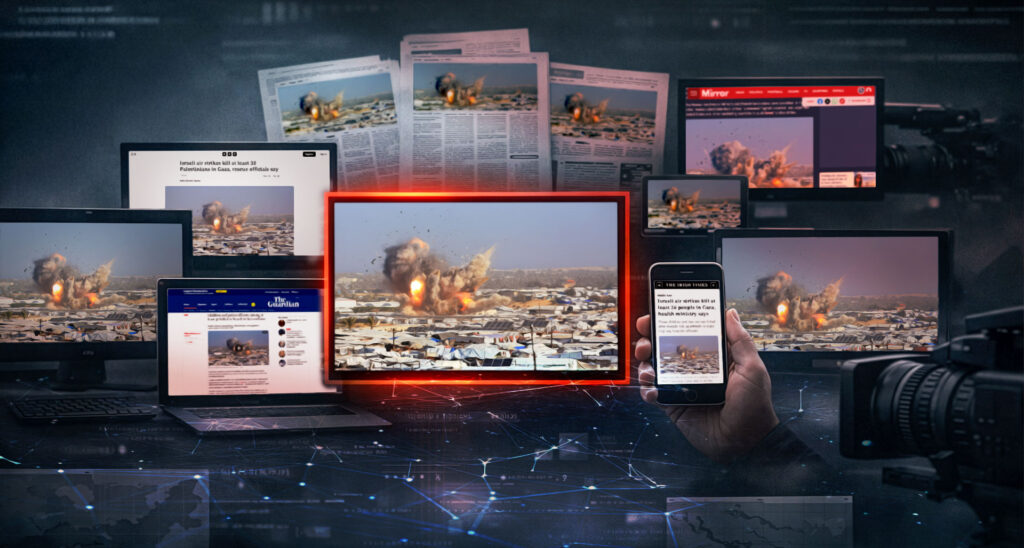
- Within hours of Israel’s January 31 strikes in Gaza, the same or near-identical image appeared across multiple international outlets, shaping the global narrative before context could catch up.
- The photographers credited for these images have appeared repeatedly at pivotal moments throughout the war, raising legitimate questions about access, positioning, and the visual supply chain in Gaza.
- The issue is not foreknowledge or conspiracy, but how a closed visual environment consistently produces images that dominate headlines while critical context is relegated to secondary placement.
On January 31, 2026, Israel carried out a series of targeted strikes in Gaza following what it said was a violation of the existing ceasefire agreement by Hamas and Islamic Jihad. According to the IDF, gunmen were identified exiting underground infrastructure, and commanders and weapons facilities were struck in response.
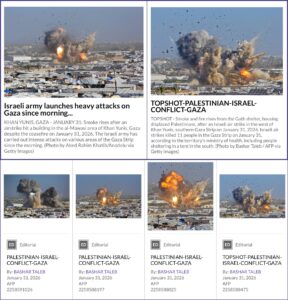
Within hours, a powerful image of the strike circulated globally. It appeared on television screens, newspaper websites, and social media feeds across Europe and beyond, quickly becoming the visual shorthand for the event.
As with many moments in this war, the image arrived before most readers had absorbed the surrounding facts. It shaped perception instantly, and then repeated.
The Same Image, the Same Moment, Everywhere
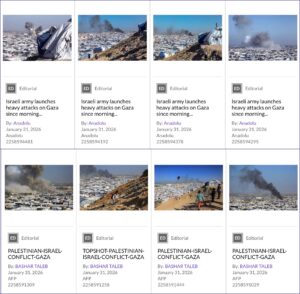
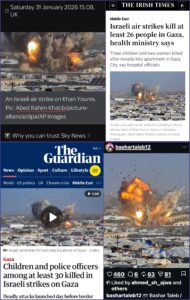
Within a short window on January 31, the same or near-identical frame of the Gaza strike appeared across multiple major outlets, including CNN, Sky News, The Guardian, and The Irish Times. The photographs were credited to the same small group of Gaza-based photographers and distributed through major wire services. The vantage point, framing, and timing were effectively identical: a distant, elevated perspective capturing the moment of impact, visually dramatic and immediately legible. This was not a case of similar images taken independently across a wide area. It was one visual moment, replicated across platforms, and elevated almost simultaneously into a global headline image.
The photographers credited for these images were Abid Rahim Khatib and Bashar Taleb. Khatib works for Anadolu, Turkey’s state-run news agency, and has previously been documented entering Israel alongside Hamas on October 7, 2023. Taleb works for Agence France-Presse, one of the world’s largest international wire services. These affiliations do not constitute an allegation, but they are material context. When the same individuals, operating within a closed territory, repeatedly supply the images that define global coverage, identifying who they are and which organizations distribute their work is essential to understanding how visual narratives are formed.
Here’s what actually matters.
In conflict reporting, repetition is power.
When the same image appears across multiple outlets in rapid succession, it does more than illustrate a story. It defines it. For many audiences, this image becomes the event. Everything else, including explanations, statements, or contextual reporting, follows in its shadow.
That is precisely what happened here.
Headlines focused on casualty figures. Captions emphasized death tolls. The image, spectacular, violent, and emotionally arresting, dominated screens. The IDF’s explanation for the strike, including the claim that it was a response to a ceasefire violation and the targeting of specific terrorist commanders and infrastructure, was present, but rarely foregrounded with equal visual weight.
This is not unusual. But repetition makes it consequential.
The Question of Positioning
The technical improbability matters. Capturing an image of this nature requires far more than proximity. A long lens must already be mounted and oriented. Reaction time is measured in seconds, not minutes. The photographer must have an unobstructed line of sight, sufficient elevation, and a safety distance that allows visibility without exposure, a narrow and unstable window in an active combat zone. These constraints make opportunistic capture unlikely. When the same photographers repeatedly secure such vantage points at decisive moments, the explanation cannot be reduced to chance. This is not about how the image was taken, but about how consistently the conditions required to take it are already in place.
Images like this are not easy to capture.
They require elevated access, a clear line of sight, precise timing, and proximity to areas that are often dangerous, restricted, or tightly controlled. That the same photographers repeatedly occupy these positions at decisive moments is not, in itself, an accusation. But it is a fact that deserves scrutiny.
No public warning, evacuation notice, or pre-strike advisory was issued that would normally allow civilian photographers to stage themselves at this vantage point.
Gaza is not an open reporting environment. Movement is constrained. Access is mediated. Photographers do not simply wander freely across vantage points as events unfold.
So the question is not how did they know a strike would happen, but rather how does the visual ecosystem of Gaza consistently place the same photographers in optimal positions when globally defining moments occur?
That is a structural question about access, permissions, relationships, and the mechanics of image production in a closed territory.
This article does not allege coordination. It documents repetition.
Captions, Context, and the Speed of Narrative
Once the image enters circulation, its framing accelerates.
Editors need speed. Broadcasters need visuals. Social platforms reward immediacy. In that environment, the image does the work, and text struggles to keep up.
Here, the image told a story of devastation before readers encountered explanations of why the strike occurred, what preceded it, or who was being targeted. Even when such context appeared, it was often secondary, placed lower in articles or framed as an Israeli claim rather than an operational explanation.
The result is not necessarily false reporting. It is imbalanced reporting, driven by visual dominance.
A Pattern, Not an Isolated Moment
This was not the first time a Gaza image surged across global media within hours, nor will it be the last. What makes this moment notable is how cleanly it illustrates the system at work: a small pool of photographers, a single defining image, rapid wire distribution, and near-simultaneous adoption by multiple outlets.
When this pattern repeats often enough, it stops being incidental. It becomes the default way the war is visually understood.
The January 31 Gaza image did not mislead because it was fabricated or staged. It misled because it dominated the story before the story could fully form. By the time context arrived, the image had already done its work.
This is the power, and the danger, of visual convergence in a closed conflict zone. When access is limited and images are scarce, the few that emerge carry disproportionate influence. They shape headlines, emotions, and assumptions long before readers are equipped to evaluate them.
The question this raises is not about intent, but about responsibility.
Who decides which images define a war, and why do the same photographers, the same angles, and the same moments so often end up speaking for millions?
Liked this article? Follow HonestReporting on Twitter, Facebook, Instagram and TikTok to see even more posts and videos debunking news bias and smears, as well as other content explaining what’s really going on in Israel and the region. Get updates direct to your phone. Join our WhatsApp and Telegram channels!
© Divuach Ne’eman R”A, 2025