Key Takeaways:
-
Images from Gaza are not independent journalism — every photo leaving the Strip is taken and transmitted under Hamas control, meaning global media are publishing visuals shaped by a terrorist organization’s censorship, staging, and narrative priorities.
-
Emotional framing is being used to distort reality and portray Israel falsely — tightly cropped, theatrical images are selected to manufacture impressions of “genocide,” “famine,” and chaos, while wider contextual shots reveal far more ordinary scenes that contradict those narratives.
-
Visual propaganda has become a strategic weapon against Israel — by prioritizing emotion over verification, news outlets amplify manipulated imagery that redirects blame, erases context, and fuels misinformation. The public must scrutinize who takes these photos, what is omitted, and why.
Words and language are only part of the tsunami of coverage coming out of Gaza. For many people, it’s not the descriptive text that is making a mark but the accompanying imagery. But like the journalist who chooses their words carefully to create a narrative, so the photographer capturing the image or the photo editor deciding which of the images to use is also making conscious choices to frame the narrative.
The emotional force of these pictures is deliberate. The aim is to bypass logic and provoke outrage; to portray Israel as the perpetrator of genocide and famine when no such realities exist. The images are used to shape global perception, transforming a defensive war against terror into a moral indictment of the Jewish state. The facts, food deliveries, aid coordination, and open crossings are rendered invisible by the flood of emotional imagery. Every viewer must understand that no image leaves Gaza without Hamas approval or oversight. This lack of independent access is a structural bias, and it must frame the way these photographs are received, interpreted, and judged.
Imagery is the frontline weapon in the campaign to delegitimize Israel. Gaza-based photographers operate entirely under Hamas control, and global media distribute those images uncritically, amplifying emotion instead of truth. Emotional manipulation has replaced journalistic verification, shaping the false narratives of “genocide” and “famine.”
For more than forty years, I have witnessed the power of images to move people, sometimes to compassion, sometimes to anger, and often to conclusions ungrounded in fact. In today’s information war against Israel, emotion has become the weapon of choice and imagery its delivery system.
Since the attacks of October 7, 2023, millions of photographs and videos have poured out of Gaza. They dominate global feeds, headlines, and hashtags. They are designed not to inform but to feel — a crying child, a blood-stained toy, a parent’s outstretched hand amid rubble. Each frame appeals to the heart before the mind ever asks what happened, when, or why.
These images do not emerge from a free press environment. Every visual that leaves Gaza does so under Hamas permission and censorship. Photographers there work under constant oversight by a terrorist organization that decides what may be shown and what must be hidden.
Yet these visuals, born of coercion and fear, are treated by the world’s media as spontaneous truth.
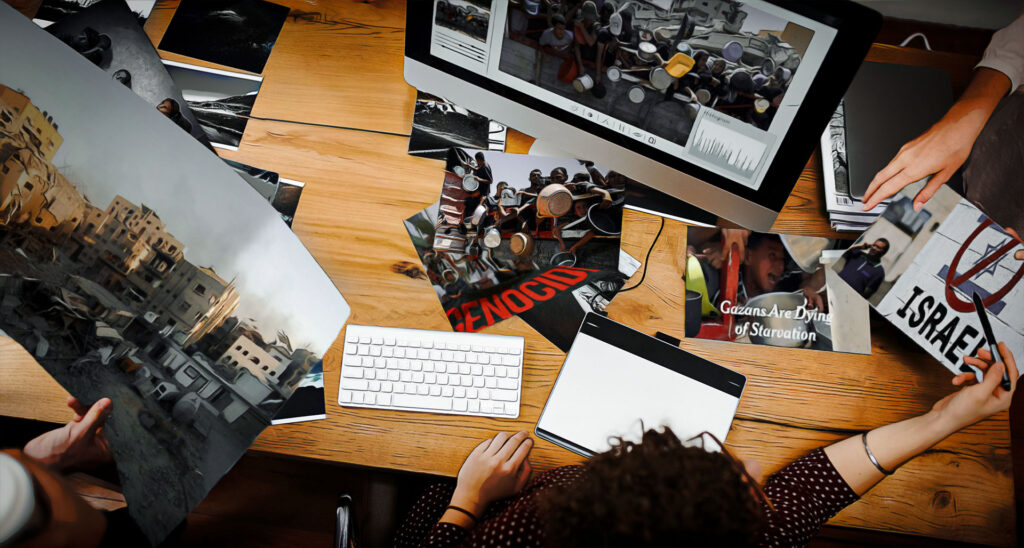
One widely circulated New York Times image shows a tightly packed cluster of boys pressed against a metal railing, pots raised above their heads, faces strained in mid-cry. The photographer is positioned extremely close, using a wide-angle lens that exaggerates the foreground and compresses multiple limbs and containers into a single intense mass. Harsh overhead sunlight intensifies the sweat and strain, magnifying the emotional load. No wider context is visible. Only a constructed impression of panic and starvation. The frame communicates desperation rather than documenting the reality beyond the edges.
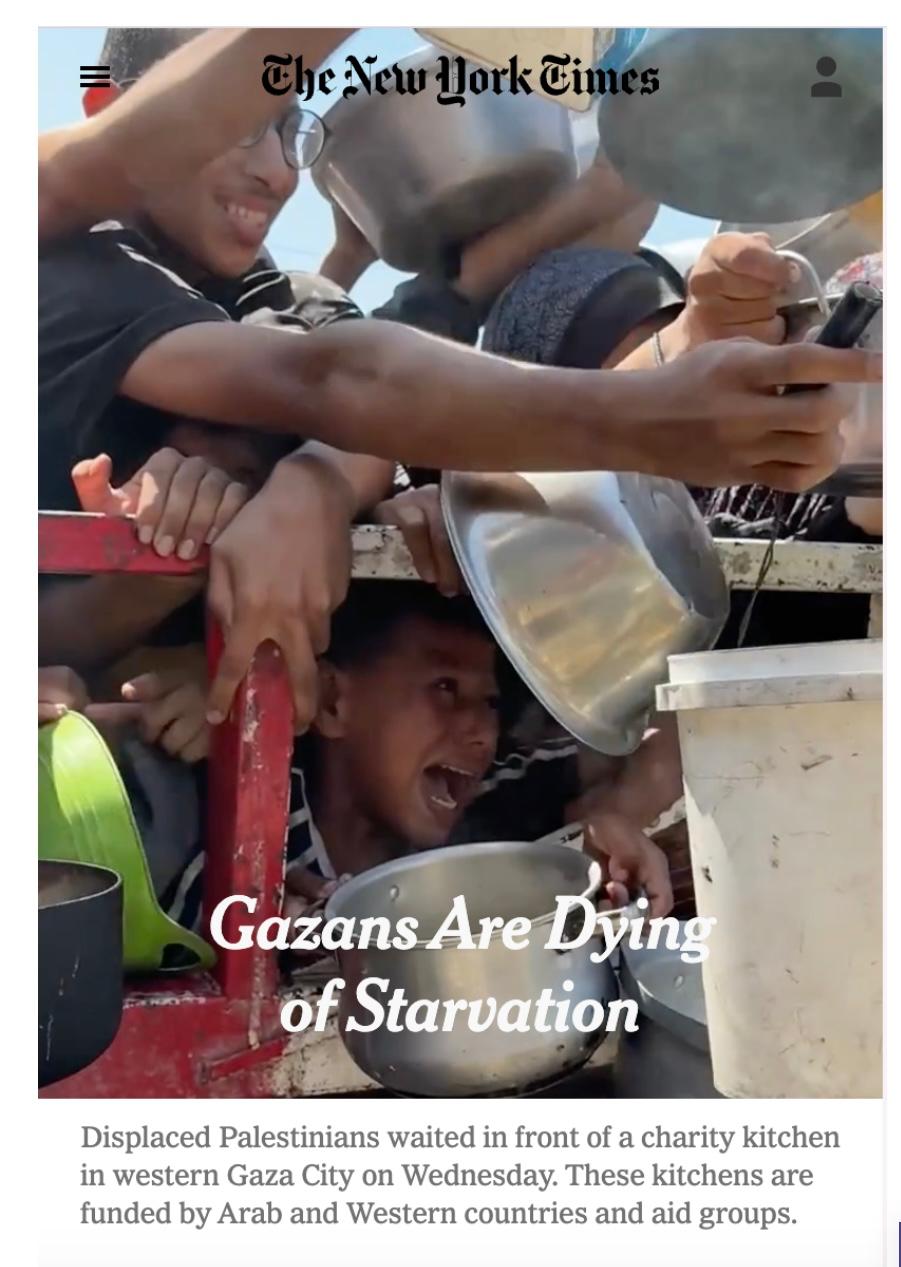
A second photograph, taken from several meters further back with a standard lens, shows the same individuals standing upright, calm, and orderly behind the same railing, each holding a pot or container while waiting. The ground is clear, the space open, and no one appears to be crushed or in danger. The apparent chaos of the first image exists only inside the tight frame.
View this post on Instagram
Nothing in the wider photograph supports the claim of imminent starvation or breakdown. The difference between the two images, one close and theatrical, the other ordinary and uneventful, reveals how emotional imagery is constructed through framing, proximity, and selective omission rather than through the facts of the scene.
Fifteen years ago, in my Shattered Lens investigation, I documented how international wire services relied on Gaza-based freelancers working under the same constraints, resulting in patterned, emotionally charged imagery that shaped global headlines without context. The mechanics have not changed. They have simply become more sophisticated.
And we saw it again on October 7. Freelancers working for AP and Reuters were present inside Israel, photographing Hamas atrocities at the moment they occurred. Global media elevated their subsequent images without transparency over the access, timing, or the degree of coordination that may have been involved. The framing, sequencing, and selective omission mirrored the same emotional logic, maximizing shock, erasing context, and redirecting blame.
As someone who has spent a lifetime in photography and imagery analysis, I know how easily a picture can be manipulated without altering a single pixel. Change the angle, delay the frame, omit the armed men standing just outside it, and an image becomes a weapon. Emotion takes over and truth is the casualty.
Audiences must learn to question what they see. Who took the picture? Under whose authority? What was outside the frame? Compassion without context is precisely what propagandists rely on.
Today, the campaign to delegitimize Israel is fought not only in words but in pictures engineered to make the world feel before it thinks. The only defense is discernment. Once emotion replaces evidence, the photograph ceases to inform; it deceives. And when deception takes root, history itself is rewritten.
Liked this article? Follow HonestReporting on Twitter, Facebook, Instagram and TikTok to see even more posts and videos debunking news bias and smears, as well as other content explaining what’s really going on in Israel and the region. Get updates direct to your phone. Join our WhatsApp and Telegram channels!
© Divuach Ne’eman R”A, 2025