Key Takeaways:
- The Guardian’s Iran photo essays rely on a photographer linked to a state affiliated outlet, without disclosing that connection to readers.
- Images presented as intimate civilian documentation may be shaped by editorial choices and institutional constraints that go unexplained.
- In a tightly controlled media environment, failing to provide sourcing context gives audiences only part of the story.
The Guardian’s recent visual coverage of Iran presents itself as an intimate window into civilian life under bombardment. The images are powerful. The framing is human. The tone is empathetic.
But a closer look at the sourcing raises a different question. Who is behind the lens, and what is not being disclosed to readers?
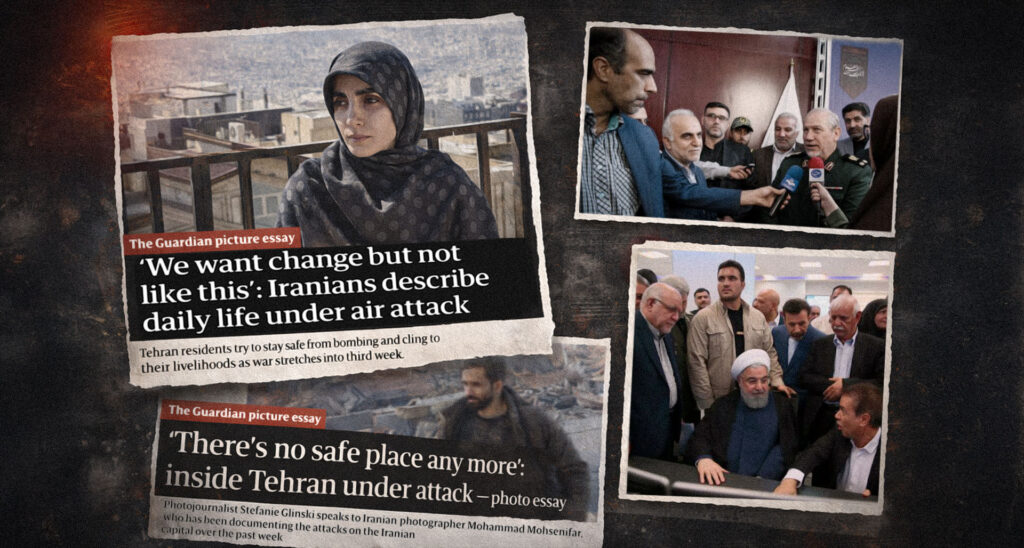
In two recent pieces, ‘We want change but not like this’: Iranians describe daily life under air attack” and “‘There’s no safe place any more’: inside Tehran under attack,” The Guardian relies on photographs by Iranian photographer Mohammad Mohsenifar to document life inside the country during the current conflict.
The presentation suggests independent, ground-level documentation — a rare and valuable perspective.
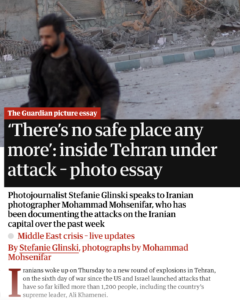
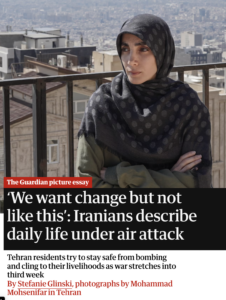
What is missing is context: The same photographer has also worked for Mehr News Agency, a state-affiliated Iranian outlet owned by “The Islamic Development Foundation.” A publicly available photo credit on Mehr identifies Mohsenifar as the photographer for official coverage of President Hassan Rouhani’s inauguration of major petrochemical projects. Another photo credit lists him as the photographer for Iran’s “Sacred Defense Week.”
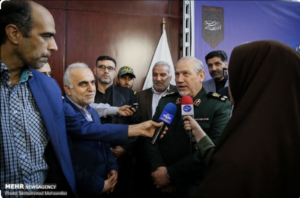
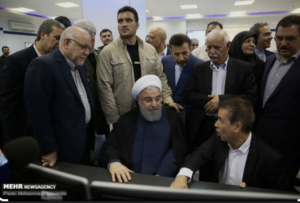
Mehr is not an independent agency operating outside the system. It is part of Iran’s state-aligned media ecosystem. When a photographer contributes to such outlets, that affiliation becomes relevant to any claim of independence.
Yet The Guardian does not disclose this background in either of the photo essays. Instead, readers are presented with images that appear to stand on their own, authentic and detached from any institutional or political context.
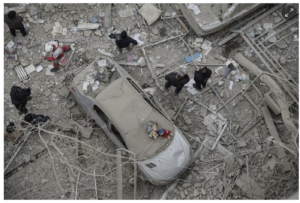
Mohsenifar’s visual choices themselves also raise questions. In one image set, scenes of destruction are juxtaposed with objects such as teddy bears at the site of an airstrike, a composition that emphasizes emotional impact.
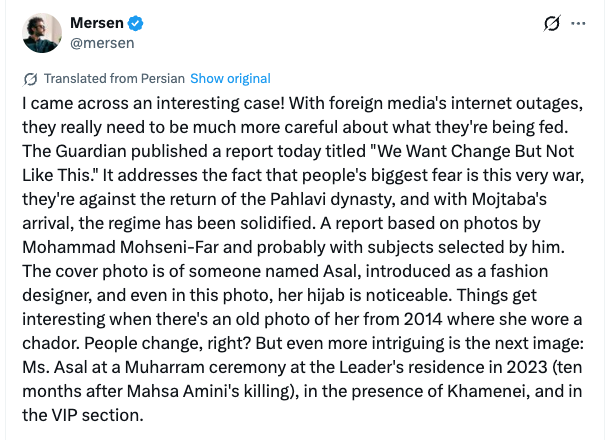
In another, a woman appears in a domestic setting, without any indication of her prior public appearance in the VIP section at an event at the Iranian President’s residence.
به مورد جالبی برخوردم! با قطعی اینترنت مدیای خارجی باید خیلی بیشتر حواسشون باشه چی داره به خوردشون داده میشه. گاردین امروز گزارشی منتشر کرده با عنوان «ما خواهان تغییر هستیم اما نه به این شکل». به این پرداخته که بزرگترین ترس مردم خود این جنگه و مخالف بازگشت پهلوی هستن و با اومدن… pic.twitter.com/Powv4io6ui
— Mersen (@mersen) March 18, 2026
Photojournalism is never neutral. It selects, frames, and directs attention. That is precisely why transparency about sourcing is essential.
The issue is not that Iranian photographers are used. In many cases, they are the only ones able to document events on the ground. The issue is whether readers are given enough information to understand the constraints and affiliations under which those images are produced.
The Guardian’s reporting emphasizes lived experience. It quotes residents navigating fear and uncertainty and presents Tehran as a city under constant threat.
But the same reporting does not examine the conditions under which those images are captured, nor the photographer’s institutional connections.
This creates an imbalance. The narrative is humanized, but the source is not scrutinized.
In environments where media is tightly regulated, photographers do not operate in a vacuum. The authorities shape access, movement, and publication: affiliations and past work matter.
The Guardian has a responsibility not just to show compelling images, but to be transparent about where they come from and under what conditions they are produced.
In the absence of that context, the images tell only part of the story.
Liked this article? Follow HonestReporting on Twitter, Facebook, Instagram and TikTok to see even more posts and videos debunking news bias and smears, as well as other content explaining what’s really going on in Israel and the region. Get updates direct to your phone. Join our WhatsApp and Telegram channels!
© Divuach Ne’eman R”A, 2025