Key Takeaways
- Twenty-one years into a four-year term: Mahmoud Abbas has postponed Palestinian elections yet again, extending his rule without a democratic mandate while 79% of Palestinians want him to resign.
- Western double standards: Despite Abbas repeatedly breaking promises of democratic reform, Western governments continue to reward the Palestinian Authority with diplomatic recognition and international support.
- Palestinians and Israelis pay the price: The absence of accountable Palestinian leadership denies Palestinians their democratic rights, undermines Israeli security, and makes a lasting peace agreement increasingly difficult.
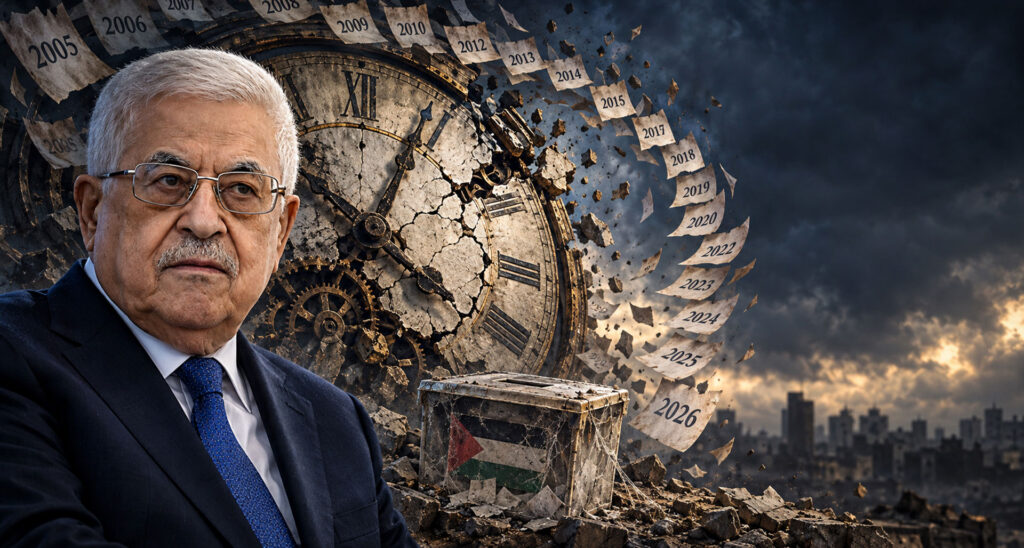
On Shabbat, Palestinian Authority President Mahmoud Abbas signed a decree. Palestinian presidential and legislative elections, it declared, will now take place on September 11, 2027. The legislative vote promised for November 28 this year has been scrapped. As ever, his office blamed Israel.
In fifteen days, Israelis will vote. They will do so after three years of war, with Jewish and Arab citizens alike casting ballots in an election held on the date the law requires. A few miles away, Palestinians in the West Bank will watch. Most of them have never voted for a president in their lives. The postponement fits a pattern that has remained constant for two decades.
A Term Without An End
Abbas won the presidency in January 2005, two months after Yasser Arafat’s death, for a four-year term that expired in January 2009. That December, the PLO Central Council, a body his own Fatah movement dominates, extended his mandate until new elections could be held, elections which never came. He is now in the twenty-second year of a four-year term, and next month he turns 91.
The legislature has fared even worse. The Palestinian Legislative Council last faced voters in January 2006, when Hamas won a majority, and it stopped meeting after Hamas seized Gaza the following year. In December 2018, Abbas announced that the Constitutional Court had ordered the council dissolved and fresh elections held within six months. That court had been created by his own decree in 2016 and, as the European on Foreign Relations has noted, was staffed largely by Fatah loyalists. The council was duly dissolved, but the elections that were supposed to follow have still not been held, almost eight years later.
Since then, Abbas has governed by decree, relying on a provision of the Basic Law intended for emergencies when the legislature is not in session. The election law and the rules of succession discussed below were both rewritten this way, with no parliament to debate either.
Israelis, meanwhile, have gone to the polls eight times since Abbas’s mandate expired. On October 27 they will do so for the ninth.
Freedom House rates the West Bank Not Free, awarding it 4 out of 40 for political rights. It describes a Palestinian Authority that “operates with an expired presidential mandate and has no functioning legislature.”
This is not Abbas’ first postponement. In 2021, he set dates and watched three dozen lists register. Then, weeks before polling day, he called it off, citing Israel’s failure to guarantee that Palestinians in East Jerusalem would be allowed to vote. Abbas insisted that elections could not proceed without their participation. But alternatives, including polling stations in UN facilities and electronic voting, had been proposed. As an analysis published by the Carnegie Endowment noted at the time, the Palestinian Authority rejected these options. Critics, including Palestinians, argued that Jerusalem was a pretext. Fatah was divided into rival electoral lists, and Abbas faced the prospect of another defeat by Hamas.
In June 2025 came the letter. Abbas wrote to Emmanuel Macron and Saudi Crown Prince Mohammed bin Salman committing to presidential and general elections within a year. Macron recognized a Palestinian state that September, and, as Ynet has reported, Abbas’s pledge played a significant role in that decision. That pledge has now been broken, but France’s recognition stands.
What Ramallah Calls Democracy
Elections are only the most visible absence. In June 2021, weeks after the canceled vote, Palestinian Authority security officers stormed a house in Hebron and dragged away Nizar Banat, one of Abbas’s loudest critics. Within an hour he was dead. A post-mortem found he had been beaten on his head, chest, neck, legs and hands. The protests that followed were met with a wave of arrests.
This year, Abbas amended the local elections law, again by decree, requiring every candidate to sign a written pledge to the PLO’s political program. No one should mourn Hamas’s absence from a ballot. But Jerusalem Center for Security and Foreign Affairs researcher Maurice Hirsch, the former director of the Military Prosecution in Judea and Samaria, has pointed out that the Popular Front for the Liberation of Palestine, a terrorist organization that rejects Israel’s right to exist, remains inside the PLO and is free to run. In other words, the rule does less to exclude rejectionists than to shield Fatah from competition. Hirsch describes the result as a Soviet-style democracy in which everyone may vote, but only for one party.
Succession follows the same logic. As Amine Ayoub of the Middle East Forum sets out in an analysis in Ynet, Abbas has used a constitutional declaration to place Hussein al-Sheikh first in line, a mechanism Palestinian legal critics say contradicts the Basic Law itself. At Fatah’s conference in May, its first in a decade, Abbas’s son Yasser won a seat on the central committee. Neither man has faced Palestinian voters.
Palestinians know this. In August, the Palestinian Center for Policy and Survey Research found that 79 percent want Abbas to resign, and that only 14 percent of likely voters would choose him. Numbers like those go a long way towards explaining why the elections keep slipping.
The Test
This is the man the West insists on calling a moderate. In August 2023, Abbas told senior Fatah figures that Europeans had fought the Jews “because of their social role, and not their religion,” and that Hitler’s quarrel with them was about usury and money. The United States, Germany and the European Union condemned the remarks. His spokesman doubled down.
Nor was it a one-off. His 1982 doctoral thesis cast doubt on the number of Jews murdered in the Shoah, and he made similar claims about the Jews’ “social function” in a speech to the Palestinian National Council in 2018.
According to Freedom House, 156 of the UN’s 193 member states now recognize the State of Palestine. Recognition was meant to come with conditions. Abbas promised elections. They have been postponed. He promised an end to “pay-for-slay”, the payments to terrorists and their families which reward and incentivize the murder of Jews. A State Department report has since found that the payments continued, including to terrorists released from Israeli prisons in October 2025. In both cases, Western governments kept their side of the bargain and Ramallah did not.
Imagine an Israeli prime minister twenty-one years into a four-year term. Imagine him dissolving the Knesset and ruling by decree. Imagine him canceling every election he feared losing, writing the candidacy rules to protect his own party, and placing his son on its leadership body. Imagine one of his most prominent critics dragged from his home by state security officers and beaten to death.
We know what the consequences would be: He would face boycotts and sanctions, not diplomatic recognition.
This is the double standard facing Israel at every turn in practice. Democracy and accountability are demanded of the Jewish state with a ferocity applied to almost no one else, while the Palestinian Authority is rewarded for promising them and forgiven when it fails to deliver.
Who Pays
Ultimately though, this impacts the Palestinians first and foremost. They are governed by men they did not choose and cannot remove, and the world that claims to champion them has decided their right to vote can wait.
The practical meaning of that is stark. Any Palestinian under the age of 39 has never voted for a president, and anyone under 38 has never voted for a parliament. In one of the youngest societies in the region, that is most of the population. The PA’s budget, including the foreign aid that sustains it, is set without a single elected legislator to question it. As Ayoub writes, two decades without elections have allowed patronage networks and control of international funding to harden around a narrow circle. Those who object publicly risk arrest, or the fate of Nizar Banat.
And unsurprisingly, those who loudly claim solidarity with Palestinians have had little to say about any of this. A movement that speaks constantly of Palestinian self-determination has shown little interest in its most basic expression, a free vote. Nizar Banat’s killing drew nothing like the outrage that follows Israeli actions, and Saturday’s postponement is unlikely to draw much either. Their concern for Palestinians tends to surface when Israel can be blamed and to fall silent when the harm comes from Palestinian leaders.
And of course, Israelis pay too. The most immediate cost is security. In Jenin and Tulkarm, as Ayoub notes, local armed networks have shown they can operate beyond Ramallah’s effective control. Meanwhile the payments described above continue to reward those who carry out attacks against Israelis, and the PA’s succession is being settled behind closed doors by men whose authority on the ground no one can vouch for.
The deeper cost is to peace. Palestinian leaders have turned down statehood before. Yasser Arafat walked away from Ehud Barak’s offer at Camp David in 2000. In 2008, Ehud Olmert offered Abbas a state on all but 6.3 percent of the West Bank, with land swaps to compensate for the rest and the Old City placed under international control. Abbas later acknowledged that he had rejected Olmert’s 2008 peace proposal, explaining that he would not agree to it because Olmert had shown him the proposed territorial map but would not allow him it.
An unelected leader is also in no position to make the compromises a final agreement would demand, on refugees or on Jerusalem, even if he wished to. Whatever Abbas agreed to, a successor could reject. Although in fairness, the man Palestinians say they want next does not offer much reassurance. In the same August poll carried out by the Palestinian Center for Policy and Survey Research, Marwan Barghouti, serving five life sentences for the murder of Israelis, was the clear favorite to succeed Abbas, and 72 percent of respondents opposed Hamas disarming before a full Israeli withdrawal from Gaza.
A lasting peace needs a Palestinian leadership that is accountable to its own people and willing to accept a Jewish state beside it. Today there is no one on the other side with the mandate to sign such an agreement, and no sign of anyone willing to.
In two weeks, Israel will hold an election in wartime. The Palestinian Authority, after two decades of promises, has put its own off once again. The Palestinian people deserve leaders they can vote out. Until they have them, no one should mistake the Palestinian Authority for a democracy, or reward it as if it were one.
Liked this article? Follow HonestReporting on Twitter, Facebook, Instagram and TikTok to see even more posts and videos debunking news bias and smears, as well as other content explaining what’s really going on in Israel and the region. Get updates direct to your phone. Join our WhatsApp and Telegram channels!
© Divuach Ne’eman R”A, 2025