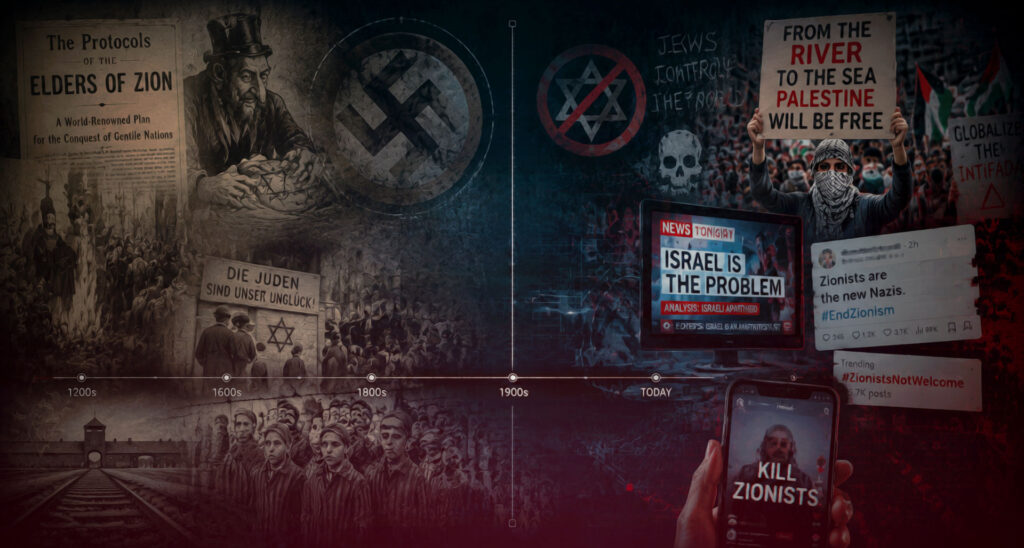
Key Takeaways:
- Jew-hate did not begin or end with the Holocaust. It is a recurring phenomenon that has adapted across centuries by repackaging the same underlying accusations in new political, religious, racial, and cultural forms.
- Ancient anti-Jewish libels, including blood libels, economic conspiracies, racial theories, and global control fantasies, continue to echo in modern discourse surrounding Israel, Zionism, and Jewish identity.
- Antisemitism persists not only through extremists, but through deeply embedded societal assumptions that often go unrecognized, making historical literacy essential for identifying contemporary manifestations of Jew-hate.
For many people, the Holocaust is the primary reference point for understanding Jew-hate. Yet the Holocaust was not its beginning, nor was it its conclusion. It was one chapter in a much longer story, one that stretches back thousands of years and continues to be written today.
Jew-hate is often described as the world’s oldest hatred. Across centuries, Jews have been accused of murdering children in medieval blood libels, poisoning wells during the Black Death, betraying nations through accusations of dual loyalty, and secretly controlling governments, economies, and the media through conspiracy fantasies such as The Protocols of the Elders of Zion. These accusations have taken religious, racial, economic, and national forms, yet they repeatedly return to the same underlying themes: that Jews are uniquely dangerous, uniquely malevolent, and uniquely responsible for the problems of the societies around them.
Understanding the history of Jew-hate is crucial because contemporary manifestations do not emerge in isolation. Modern anti-Jewish ideas are deeply connected to older myths, anxieties, and cultural memories that have evolved across centuries. As Vlad Khaykin of the Simon Wiesenthal Center often says, “antisemitism always dresses for the occasion.”
Like a Boggart, it shifts form depending on the fears and assumptions of the observer. On one hand, Jews are accused of being too separate and tribal. On the other, they are condemned for being too integrated, influential, or cosmopolitan. Jews have been portrayed as capitalist exploiters and communist revolutionaries, rootless outsiders and dangerous nationalists.
The accusations often contradict one another, but contradiction has never weakened Jew-hate because its function is not analytical. It is psychological and civilizational. “The Jew” imagined by the Jew-hater does not exist in reality. It exists as a cultural and psychological construction onto which societies project their fears, failures, and anxieties.
Jew-hate survives by attaching itself to whatever a society fears most. In different eras, Jews have been cast as Christ-killers, racial contaminants, capitalist exploiters, communist revolutionaries, and, in parts of the contemporary Left, embodiments of whiteness, colonialism, and oppressive power.
Without historical literacy, ancient accusations are easily repackaged as new moral insights. The old accusation that Jews poison wells becomes the claim that the Jewish state deliberately withholds water. Medieval fantasies of Jewish manipulation become conspiracies about Zionist control. Different century, different language, same underlying logic.
The difficulty is compounded by the fact that many people approach Jew-hate as though it exists only in obvious extremists. But prejudice does not survive for two thousand years merely through fringe actors. It survives because societies absorb and reproduce anti-Jewish assumptions so deeply that they cease to appear as prejudice at all. As George Orwell observed:
“What vitiates nearly all that is written about antisemitism is the assumption in the writer’s mind that he himself is immune to it. ‘Since I know that antisemitism is irrational,’ he argues, ‘it follows that I do not share it.’ He thus fails to start his investigation in the one place where he could get hold of some reliable evidence – that is, in his own mind.”
That challenge is uncomfortable because it requires introspection rather than performance. It demands that people interrogate not only explicit hostility toward Jews, but also the assumptions they have inherited about Jewish power, identity, and legitimacy. Jew-hate is not always expressed through overt animosity. Sometimes it appears through double standards, through the denial of Jewish peoplehood, or through the demand that Jews justify forms of collective existence considered normal for every other people.
Historical Foundations
Although many of the most influential anti-Jewish ideas emerged through Christian Europe, some argue that a specific hostility toward Jews predates Christianity itself. In the Book of Exodus, Pharaoh frames the Israelites as a dangerous internal population whose loyalties lie elsewhere, establishing one of the earliest recorded accusations of Jewish dual loyalty and collective subversion. Yet the decisive transformation came with the Christianization of the Roman Empire. As Christianity became politically dominant, the accusation that Jews collectively killed Jesus became embedded within Western civilization itself.
As David Nirenberg argues, Christian civilization defined itself in opposition to “Judaism,” which became associated not only with Jews as people, but with error, materialism, stubbornness, and spiritual corruption more broadly. Jews were no longer merely a distinct minority people. They became associated with deicide, spiritual corruption, and civilizational danger. From this foundation emerged many of the core anti-Jewish myths that would shape the next two thousand years.
Blood Libel
The Blood Libel is one of the oldest and most enduring forms of Jew-hate. Emerging in medieval Christian Europe, it accused Jews of kidnapping and murdering Christian children, often for supposed ritual purposes connected to Pesach. The earliest example emerged in Norwich in 1144, when Jews were falsely accused of murdering a Christian boy named William. Yet beneath the accusation sat an even older theological claim: that the Jews collectively murdered Jesus. The Jew was therefore constructed not merely as wrong or foreign, but as metaphysically evil, uniquely capable of cruelty against innocence itself. This framing positioned Jews outside the moral boundaries of humanity and justified centuries of persecution, expulsions, massacres, and mob violence.
The power of the Blood Libel lies in the emotional intensity of the accusation. There are few charges more inflammatory than the deliberate murder of children. Once Jews were established in the Christian imagination as capable of killing Christ, accusations about harming children became believable within the existing moral framework.
Although the medieval blood libel may appear distant from the contemporary world, its structure remains strikingly familiar. Modern accusations directed at Israel frequently rely upon the same underlying assumption: that Jews, collectively embodied in the Jewish state, intentionally target children or deliberately inflict suffering upon civilians for its own sake. Claims that Israel purposefully murders Palestinian children, commits genocide, promotes organ-harvesting accusations, or weaponizes starvation often operate within the emotional architecture of the blood libel, even when expressed in secular humanitarian language.
Economic Libel
The Economic Libel casts Jews as uniquely greedy and manipulative, portraying them as people so driven by wealth that they are willing to exploit, corrupt, or harm others in pursuit of it. Its roots are both theological and historical. Within Christian tradition, Judas Iscariot, the disciple who betrayed Jesus for thirty pieces of silver, became associated with Jewishness itself. Over time, the image of the greedy and financially corrupt Jew developed into one of the defining stereotypes of European civilization.
Throughout much of medieval Europe, Jews were excluded from land ownership, guilds, and many professions. Christian prohibitions on lending money with interest pushed some Jews into financial roles that were economically necessary yet morally stigmatized. Jews were then demonized for occupying positions they had often been forced into.
These ideas reached one of their most influential expressions in The Protocols of the Elders of Zion, the fabricated Russian text purporting to reveal a Jewish conspiracy for global domination. Although thoroughly debunked, the text spread internationally and shaped both Nazi propaganda and broader antisemitic thought.
The Economic Libel remains highly relevant today. Contemporary discourse frequently frames Jews, “Zionists,” or Israel as uniquely wealthy and financially manipulative. Conspiracies surrounding figures such as George Soros, rhetoric about “globalists,” and claims that “Zionists control Washington” recycle older fantasies about hidden Jewish influence. Jewish success is often portrayed not as the result of ordinary human variation, historical circumstance, or cultural emphasis on education, but as evidence of corruption or collective scheming.
Racial Libel
While many people imagine antisemitism becoming racial only in the nineteenth century, elements of racialization appeared much earlier. In late medieval and early modern Spain, for example, the doctrine of limpieza de sangre (“purity of blood”) treated Jewish ancestry as a permanent stain that could not be erased through conversion to Christianity. As scholars such as Geraldine Heng have demonstrated, medieval societies already treated Jews as possessing inheritable and essential characteristics. Jews increasingly came to be seen not simply as different, but as biologically and permanently different, a distinct collective whose supposed moral, physical, and behavioral flaws were carried through bloodlines and embodied within the Jewish body itself.
The modern period did not invent the racialization of Jews. It reframed and institutionalized older ideas through the authority of racial “science.” Nineteenth and twentieth-century pseudoscience attempted to classify Jews biologically through skull measurements, physiognomy, and theories about degeneration. Nazi propaganda portrayed Jews through grotesque caricatures emphasizing noses, lips, hair, posture, and bodily deformity.
But these ideas were never confined to Nazism alone. Jewish bodies have long been treated as sites of projection and anxiety within Western culture, shaped by assumptions about abnormality, excess, degeneracy, or foreignness. The social stigma attached to supposedly “Jewish” features, particularly the nose, became so deeply embedded that many Jews feel pressure to alter their appearance in order to assimilate or avoid discrimination. In The Jew’s Body, Sander Gilman explores how Jewish bodies became enduring objects of cultural obsession and racial projection.
The Nazis elevated these ideas into a genocidal worldview and political system. Jews were framed as a biological threat whose very existence supposedly endangered the purity and survival of the Aryan race. Jews continue to be racialized in contemporary discourse, even if the language used today is often political, cultural, or genetic rather than openly pseudoscientific. Khazar conspiracy theories, for example, attempt to deny Jewish indigeneity and continuity by claiming Ashkenazi Jews are not “real” Jews but descendants of a Turkic population. Obsessions with Jewish genetics, DNA, authenticity, and claims that Israelis are merely “European colonizers” frequently operate as modern forms of racialization.
View this post on Instagram
Conspiracy Fantasy
The Conspiracy Fantasy represents one of the most totalizing forms of Jew-hate: the belief that Jews secretly control the world. Here, Jews are imagined not merely as different or dangerous, but as omnipotent manipulators directing global events from behind the scenes. The power of this fantasy lies in its flexibility. Virtually any political, economic, or social crisis can be absorbed into its framework and blamed upon a hidden Jewish hand.
Historically, Jews occupied a paradoxical position within many societies. They were a vulnerable minority lacking state power, yet they were simultaneously imagined as uniquely influential and threatening.
This logic reached its clearest expression in The Protocols of the Elders of Zion, which portrayed Jews as orchestrating revolutions, manipulating economies, controlling media, and undermining civilization itself. Despite being a proven forgery, the text became one of the most influential antisemitic documents in history because it offered a totalizing explanation for social change and instability in which Jews could be blamed for virtually every political, economic, or cultural crisis. Its themes spread far beyond Tsarist Russia, influencing European fascism, Soviet antizionist propaganda, and antisemitic discourse throughout parts of the Arab world.
Modern conspiracy fantasies continue to recycle these themes. Jews are accused of controlling governments, Hollywood, finance, journalism, academia, and international institutions. Israel is often portrayed not as a small state pursuing its own interests, but as the hidden force directing Western foreign policy. Claims that Israel or “the Jews” manipulated the United States into wars in the Middle East, or conspiracies alleging that “Zionists” secretly orchestrate immigration, media narratives, or global instability, reflect the same conspiratorial logic.
Conspiracy fantasies are particularly dangerous because they transform Jews into the explanation for societal complexity itself. Economic crises, wars, political instability, cultural change, and social fragmentation can all be blamed upon a hidden Jewish hand. The Jew becomes the ultimate symbolic scapegoat, blamed not for a single problem, but for the structure of modernity itself.
Conclusion
These libels overlap, reinforce one another, and persist across time. Different eras emphasize different themes, but the underlying structure remains remarkably consistent: Jews are positioned as uniquely dangerous to the societies around them. Whether framed through religion, race, economics, nationalism, or conspiracy, the accusation ultimately returns to the same idea: that Jews represent a threat to the moral, political, or social order itself.
Without historical literacy, ancient prejudices are repeatedly mistaken for new moral insights. The language changes, but the underlying logic remains disturbingly familiar.
Liked this article? Follow HonestReporting on Twitter, Facebook, Instagram and TikTok to see even more posts and videos debunking news bias and smears, as well as other content explaining what’s really going on in Israel and the region. Get updates direct to your phone. Join our WhatsApp and Telegram channels!
© Divuach Ne’eman R”A, 2025