Key Takeaways:
- The socialist magazine puts Nova’s victims – not Hamas – on trial, depicting them through unsupported claims about drugs and decadence.
- It santizes terrorism and erases civilian status, recasting Hamas terrorists as “fedayeen,” murder as “crossfire” and kibbutzim as military complexes.
- Writer Zenab Huriyah Ahmed’s argument rests on factual errors and unsupported sourcing, before culminating in a grotesque comparison between Israeli culture and Nazi Germany.
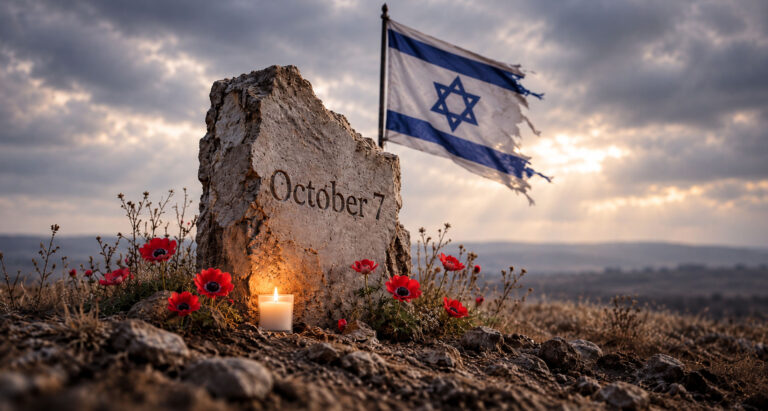
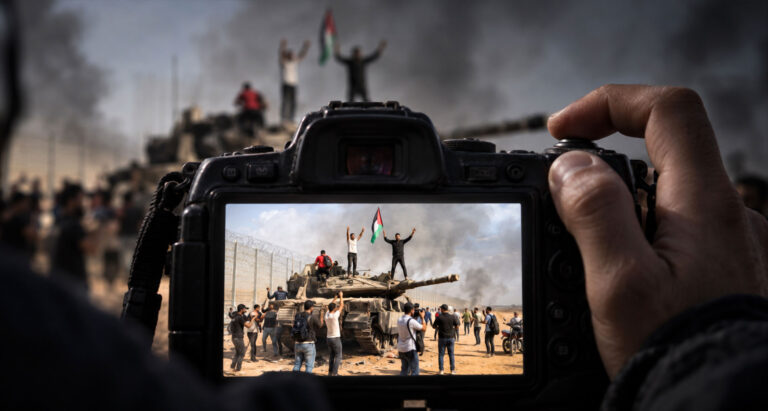
Current Affairs wants readers to believe that the real scandal of the Nova massacre was not the terrorists who hunted down and murdered hundreds of festivalgoers, but the people who were dancing there.
In a lengthy essay by activist Zenab Huriyah Ahmed, electronic music, drugs and Israeli rave culture are cast as instruments of moral numbness – evidence, she argues, that Israelis can party their way through occupation, apartheid and what the socialist magazine calls “genocide.”
The article opens at Nova on October 7, 2023. But before Hamas appears, Ahmed lingers over mushrooms, ecstasy, LSD, DMT, ayahuasca and even opium, alongside tattoos, piercings, Hindu imagery and supposedly appropriated clothing.
None of this elaborate scene-setting is sourced. Ahmed neither identifies an eyewitness account nor cites contemporaneous reporting. Instead, she presents a scene that has been conjured from her own imagination.
The effect is unmistakable: the victims are made to look decadent, intoxicated and morally compromised before their murderers arrive.
By the time the massacre begins, the article has already put the dead on trial.
Contaminating the Victims
Hamas, by contrast, initially enters the scene almost without human agency. Ahmed renders the attack through a sequence of noises: “Boom.” “Cracks.” “Pops.” “Hisses.” The festival-goers are described in intimate, judgmental detail; their killers arrive as disembodied sound effects.
The contrast is revealing. Ahmed gives the victims identities only to implicate them, while obscuring the people who chose to attack them.
Even this heavily dramatized opening cannot get the most basic fact right. Its first sentence reads: “It’s 6:29 AM on a Tuesday.”
October 7, 2023 was a Saturday.
That error is not an isolated lapse. It is the first sign of an article that repeatedly bends facts, language and history around its predetermined conclusion.
2/10
— HonestReporting (@HonestReporting) August 4, 2026
The opening is designed to contaminate the victims before their murderers even appear.
Zenab Ahmed describes Nova attendees taking mushrooms, ecstasy, LSD, DMT and ayahuasca, even “smoking opium.”
They are reduced to drugs, tattoos, piercings and supposedly… pic.twitter.com/lSMs4mTI5B
Elementary Errors, Sweeping Conclusions
The problems go well beyond framing. Again and again, basic facts are misstated, contradicted or bent to fit the argument.
For example, Ahmed dates the founding of Kibbutz Nirim to 1955 – only to identify it later in the same article as one of the 11 Jewish communities established in the Negev in 1946. Nirim’s own history confirms that it was founded in 1946 and moved to its present location after the 1948 war. The article appears to have confused relocation with establishment.
She also calls Itamar Ben-Gvir Israel’s defense minister. He has never held that position. Yoav Gallant was defense minister on October 7; Israel Katz holds the office today.
Then there is the claim that Hamas recognizes the Oslo Accords. Hamas condemned Oslo from the outset, and its 2017 policy document rejected the agreements and the obligations arising from them.
Elsewhere, Ahmed writes that Israel’s Gaza ground offensive “grows” into attacks in Lebanon, Yemen, Syria, Iran and Iraq – as though separate operations against attacks from different armed actors amounted to one expanding ground campaign.
Most revealingly, she asserts without evidence that Palestinian terrorists met secretly to prevent “another exodus of their people.” October 7 is thus retrospectively furnished with a humanitarian motive that Ahmed neither documents nor demonstrates.
One error might be carelessness. Taken together, the contradictions, unsupported assertions and mangled history reveal the method: the facts are not allowed to test Ahmed’s thesis. They are made to obey it.
3/10
— HonestReporting (@HonestReporting) August 4, 2026
That first sentence is only the beginning of Ahmed’s mangling of basic facts.
• Says Nirim was founded in 1955, then later identifies it as one of the 11 communities established in 1946.
• Calls Itamar Ben-Gvir Israel’s “Defense Minister.” Yoav Gallant held that office on… pic.twitter.com/TtoDCtJQAO
When a Massacre Becomes “Crossfire”
The article’s vocabulary changes markedly depending on whether Ahmed is describing Israelis or Palestinian terrorists.
Hamas gunmen are elevated into “fedayeen” – literally, those who sacrifice themselves. The massacre at Nova becomes “crossfire.” Attacks on civilian communities become raids on “installations.” Terrorists “fight through” another festival, take hostages and “pull back” into Gaza, as though Ahmed were narrating a conventional military operation.
The perpetrators receive the language of armed struggle. Their victims are reduced to collateral damage.
But Nova was not an incidental exchange of fire between two armies. Terrorists armed with automatic weapons, grenades and RPGs entered the festival grounds, fired into cars and hiding places, pursued people fleeing across open fields and murdered hundreds. Forty-four civilians were abducted from the festival.
Evidence and eyewitness testimony attests to rape, including gang rape, occurring at and around Nova and along the route taken by fleeing festival-goers. Israel’s independent Civil Commission documented sexual violence and the deliberate killing of entire families during the wider October 7 attack.
Current Affairs need not accept every Israeli account without scrutiny. But scrutiny is not the same as euphemism. A deliberate assault on civilians must still be described as one.
Calling the massacre “crossfire” does not provide context. It removes the killers from the sentence.
That is the article’s recurring linguistic trick: Hamas is granted political agency, purpose and the vocabulary of resistance, but relieved of moral responsibility. Its victims are left in the passive voice.
4/10
— HonestReporting (@HonestReporting) August 4, 2026
Littered throughout are euphemisms designed to obscure who did what to whom.
• Hamas terrorists become “fedayeen” – a romanticized label of armed self-sacrifice.
• A deliberate massacre becomes “crossfire.”
• Attacks on civilian communities become raids on… pic.twitter.com/V9ycIQGe9k
Turning Farms Into Military Targets
The article’s most disturbing maneuver is not to say outright that Israeli civilians deserved to be attacked. It does something more insidious: it erodes their civilian status.
Ahmed describes the kibbutzim as “military-agrarian complexes” and their farmers as “tools of social erasure.” Homes, fields, irrigation systems and entire civilian communities are rhetorically placed on a continuum with army bases.
The implications are unmistakable. Farms become instruments of warfare. Farmers become agents of conquest. Former military service becomes permanent culpability. Merely living – or dancing – near Gaza becomes participation in Palestinian oppression.
Ahmed never quite says that the kibbutz residents or Nova festivalgoers were legitimate targets. Instead, she constructs a vocabulary in which they barely qualify as civilians at all.
That is how victim-blaming is intellectualized.
5/10
— HonestReporting (@HonestReporting) August 4, 2026
The article’s most sinister maneuver is to retroactively strip civilians of their civilian status.
The kibbutzim are called “military-agrarian complexes.”
Their farmers are declared “tools of social erasure.”
Their homes, fields and communities are rhetorically folded into… pic.twitter.com/8yGekEtJ5a
A Citation That Does Not Support the Claim
Ahmed states as fact that Israeli police and security forces killed some Nova attendees.
Her own source does not establish that.
It is an Al Jazeera report summarizing a Haaretz article that quoted an unnamed police official. The report said an Israeli military helicopter firing at terrorists had “apparently” also struck some revelers. It provided no further details.
Current Affairs strips away every limitation: the uncertainty, the anonymous attribution and the lack of supporting evidence. It also broadens a tentative allegation involving a military helicopter into a definitive claim about Israeli “police and security forces.”
Investigating possible friendly-fire incidents on October 7 is entirely legitimate – and necessary. But responsible journalism would attribute the allegation, explain its limitations and acknowledge that it remains unsubstantiated. Current Affairs instead converts uncertainty into fact.
The same problem recurs throughout the article.
The elaborate inventory of drugs supposedly being consumed at Nova is unsupported. The claimed secret meeting to prevent another Palestinian exodus is unsourced. And the hyperlink offered for the claim that the Nova attackers were originally deployed to Netivot leads to a feature about poverty and rocket fire in the city – not evidence of Hamas’s operational plans.
A hyperlink may create the appearance of sourcing. It does not become evidence merely because it is blue and clickable. It either supports the claim attached to it, or it does not.
6/10
— HonestReporting (@HonestReporting) August 4, 2026
Ahmed then states as fact that some Nova attendees were: “killed by Israeli police and security forces.”
But her link does not establish that.
It repeats an unnamed-source report that helicopter fire “apparently” hit some revelers. No further details were provided.
But…
History With Only One Responsible Actor
Ahmed’s historical narrative follows a consistent rule: Palestinian violence is presented as something forced upon its perpetrators. Israeli conduct is presented as freely chosen, uniquely revealing and collectively inherited.
The traffic collision that helped ignite the First Intifada is described with the intentional-sounding verb “rams.” Yet even the Institute for Palestine Studies describes an Israeli army truck colliding with a vehicle carrying Palestinian workers in a traffic accident. Rumors that it was deliberate helped inflame the unrest, but rumor is not established fact.
For the Second Intifada, Ahmed moves directly from Ariel Sharon’s visit to the Temple Mount – Judaism’s holiest site, also revered by Muslims as Haram al-Sharif – to an uprising that then produces Israeli “responses.”
Missing from this compressed account are the suicide bombings, shootings and other deliberate attacks on Israeli civilians that became central features of the violence.
The precise origins and planning of the Second Intifada remain disputed. But evidence that mobilization had begun before Sharon’s visit, including statements by senior Palestinian officials, makes Ahmed’s neat causal sequence anything but settled history.
The imbalance is revealing.
Palestinian perpetrators receive grievance, historical context and diminished agency. Israelis receive collective culpability extending across generations.
7/10
— HonestReporting (@HonestReporting) August 4, 2026
The history is rewritten according to one consistent rule:
Palestinian violence is forced upon its perpetrators.
Israeli conduct is freely chosen and uniquely revealing.
The traffic accident that helped ignite the First Intifada becomes an Israeli army vehicle that simply… pic.twitter.com/1LLfZfT9AK
From Nova to Nuremberg
Although the article’s destination is visible from the outset, it becomes explicit in its closing passages.
Ahmed describes Israeli electronic music as serving a genocidal political project. She compares its “fascistic utility” to that of classical music in Nazi Germany and imagines Netanyahu and Ben-Gvir facing a “new version of the Nuremberg Trials,” followed by a parallel reckoning with Israeli rave culture.
Consider the trajectory.
The article begins with civilians massacred at a music festival. It first presents them as drug-addled, decadent and culturally compromised. It then recasts their murder as “crossfire,” places their communities on a continuum with military installations and ends by casting their culture in the role of culture under Nazi Germany.
The obscenity is difficult to overstate: Ahmed begins with mostly Jewish civilians massacred at a music festival and ends by casting their culture – and, by implication, the victims themselves – in the role of Nazi Germany.
Ahmed then presumes to tell Mizrahi Jews that they have suppressed their “Arab roots,” imagines Zionism being “forced to contract” and argues that Palestinians must “decisively get the upper hand.”
None of this illuminates Israeli electronic music.
It does expose the article’s moral hierarchy: Hamas terrorists are romanticized as resistance fighters, their victims are posthumously indicted, and Israeli society is grotesquely cast through the lens of Nazi Germany.
Current Affairs begins with the Nova dead. It ends by making them answer for their own murder.
8/10
— HonestReporting (@HonestReporting) August 4, 2026
The destination becomes unmistakable at the end.
Ahmed calls Israeli electronic music: “The soundtrack for a new era of genocide.”
She says it will be remembered for its “fascistic utility” alongside Wagner and Beethoven in Nazi Germany.
She imagines Netanyahu and… pic.twitter.com/ikFcaNL8eF
The Double Standard Is Not Accidental
Ahmed’s own public statements make that moral hierarchy even clearer.
Two days after October 7, she wrote that she devoted less energy to criticizing Palestinian fighters who “kill and terrorise people” because she considered the surrounding political system worse. A week later, she published a post titled, “Why I Think (Hope?) Israel Will Fail in Gaza.” She subsequently promoted a “Rave Against the Occupation.”
The contrast could hardly be clearer.
A Palestinian-aligned rave is presented as solidarity and resistance. An Israeli rave becomes a fascistic sedative whose participants can be implicated in the violence committed against them.
These posts help explain how Ahmed distributes sympathy and responsibility. Palestinian violence receives context, grievance and justification. Israeli civilians are collectivized, morally indicted and made to answer for the actions of their government.
9/10
— HonestReporting (@HonestReporting) August 4, 2026
Ahmed’s own posts show that none of this framing is accidental.
Two days after October 7, she said she spent less energy criticizing Palestinian terrorists who “kill and terrorise people” because she considered the wider system worse.
A week later: “Why I Think (Hope?)… pic.twitter.com/xFavWG5pax
Current Affairs Owns the Result
This is not merely the excess of one contributor.
Current Affairs changed the headline to make the victim-blaming more explicit. An earlier version was headlined, “Why Israelis Are Obsessed With EDM.”
The version now online – “Israel’s Rave Music Drowns Out the Sound of its Victims” – is even more accusatory. Its subheading claims that EDM and drug culture numb Israelis to occupation, apartheid and “genocide.”
Editor Nathan J. Robinson subsequently praised the essay as “remarkable,” specifically endorsing its argument that Israeli electronic music distracts young people from confronting their country’s alleged atrocities.
Current Affairs therefore cannot dismiss the factual errors, unsupported allegations and dehumanizing framing as the excesses of a single contributor. The magazine edited the article, chose to publish it and then publicly promoted its central argument.
Criticism of Israel does not require romanticizing terrorists, just as advocacy for Palestinians does not require stripping Israeli civilians of their civilian status. Nor should cultural analysis depend upon an unsourced drug fantasy, distorted history and citations that fail to support the claims attached to them.
Opinion journalism still requires facts, yet this article repeatedly substitutes ideology for evidence, euphemism for accurate description and collective guilt for moral judgment.
Current Affairs claims Israeli music drowns out Palestinian victims. Its own writing drowns out the Israeli victims whose massacre it exploits.
10/10
— HonestReporting (@HonestReporting) August 4, 2026
This was not merely one writer’s grotesque exercise in victim-blaming.@curaffairs edited the headline to make it worse. Its editor, @NathanJRobinson, then praised the piece as “remarkable.”
This is what happens when ideology replaces journalism.https://t.co/vPYBEIV5c5
Liked this article? Follow HonestReporting on Twitter, Facebook, Instagram and TikTok to see even more posts and videos debunking news bias and smears, as well as other content explaining what’s really going on in Israel and the region. Get updates direct to your phone. Join our WhatsApp and Telegram channels!
© Divuach Ne’eman R”A, 2025